
Epson C31CK00A9991 vs Star Micronics TSP1043D: Specification Comparison
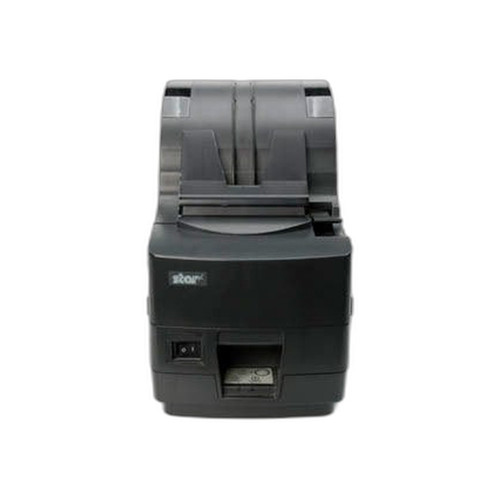
Both the Epson TM-P80II (C31CK00A9991) and the Star Micronics TSP1043D (39462010) are direct thermal receipt printers targeting point-of-sale environments, printing on 3-inch-class receipt roll media at 203 dpi. One is a mobile, Bluetooth-capable cradle unit; the other is a fixed-station wired printer. Despite one being filed under 'Label Printer' in the product taxonomy, the hardware class, media type, and application overlap is sufficient for a legitimate cross-shop comparison by buyers evaluating fixed versus mobile receipt printing.

In This Guide
Which printer delivers faster throughput at the point of sale?
Print speed is the primary throughput metric for receipt printers under queue pressure. The Star Micronics TSP1043D is rated at 425.2 inches per minute (ips), while the Epson TM-P80II is rated at 236.2 ips — a difference of 189 ips, or roughly 80% faster in favor of the Star unit.
For high-volume fixed POS lanes — grocery checkout, quick-service restaurants, or busy hospitality counters — the TSP1043D's speed advantage meaningfully reduces per-transaction time and line queue buildup. The Epson's 236.2 ips speed is competitive for mobile or moderate-volume scenarios but would be a bottleneck if deployed at a high-throughput fixed terminal.
Both units print at 203 dpi resolution, so print quality for standard receipt text and barcodes is equivalent. Speed is the sole differentiator on throughput; resolution is a tie.
Which printer fits fixed-station versus mobile or multi-terminal deployments?
The Epson TM-P80II is explicitly designed for mobile use: its specified interfaces include Bluetooth wireless plus wired connectivity, and the form factor is described as a mobile cradle with battery cradle support for cordless operation. This makes it suitable for tableside ordering, line-busting, warehouse pick-and-pack, or any deployment where the printer must travel with or near the operator.
The Star Micronics TSP1043D specifies wired connectivity only. No wireless or Bluetooth interface is listed in the provided specifications. This positions it as a fixed-station device — appropriate for a dedicated POS counter but not for mobile workflows.
The Epson spec also notes compatibility with multi-terminal retail environments and no-ribbon consumables for that use case. The Star spec notes an auto-cutter feature, which is relevant for unattended or high-volume fixed receipt stations. Auto-cutter capability is not specified for the Epson in the provided data.
Which printer offers better warranty coverage and lower total cost of ownership?
The Star Micronics TSP1043D carries a 2-year warranty per its listed specifications. The Epson TM-P80II carries a 1-year warranty. For a fixed-station commercial deployment where downtime is costly, the TSP1043D's longer warranty period reduces the risk of out-of-pocket repair or replacement costs in the second year of operation.
Both printers use direct thermal print method, eliminating ribbon consumables. This parity means ongoing consumable costs are equivalent — both require only thermal receipt roll stock, and neither requires ink or toner.
Paper width differs slightly: the Epson specifies 3.0-inch media width; the Star specifies 3.15-inch media width and 3.15-inch print width. Buyers should verify roll stock compatibility with their existing supply chain, as these are not the same roll specification and mixing them across a mixed fleet would require stocking two SKUs.
Which should you choose: the C31CK00A9991 or the TSP1043D?
Our take: The TSP1043D is the stronger choice when the deployment is a fixed, high-volume POS station where print speed and warranty duration are the primary criteria. Its 425.2 ips throughput is 80% faster than the Epson's 236.2 ips, its 2-year warranty doubles the Epson's 1-year coverage, and its auto-cutter is suited to unattended receipt dispensing. Conversely, the Epson TM-P80II C31CK00A9991 is the correct choice when mobility is required: it is the only unit of the two with Bluetooth and a battery cradle for cordless operation, making it the sole viable option for tableside, line-busting, or roaming POS workflows. Resolution (203 dpi) and print method (direct thermal) are identical across both models. Buyers running a fixed counter operation should favor the Star; buyers needing a printer that travels with the operator have no functional substitute in the TSP1043D.
Side-by-Side Comparison
Spec-for-spec, from manufacturer data.
| Specification | Epson C31CK00A9991 | Star Micronics TSP1043D |
|---|---|---|
| Product Class | Mobile Receipt Printer | Receipt Printer (Fixed) |
| SKU | C31CK00A9991 | 39462010 |
| Print Method | Direct Thermal | Direct Thermal |
| Print Speed | 236.2 ips | 425.2 ips |
| Print Resolution | 203 dpi | 203 dpi |
| Print Width | 3" | 3.15" |
| Paper / Media Width | 3" | 3.15" |
| Media Type | Receipt rolls | Receipt roll |
| Connectivity | Bluetooth + Wired | Wired only |
| Wireless / Bluetooth | Yes (Bluetooth) | — |
| Form Factor | Mobile Cradle | Desktop / Fixed station |
| Battery / Cordless Operation | Yes (battery cradle) | — |
| Auto-Cutter | — | Yes |
| Output Color | — | Two-color monochrome |
| Warranty | 1 year | 2 years |
| Ribbon Required | No | No |
Frequently Asked Questions
Which should you choose: the C31CK00A9991 or the TSP1043D?
The TSP1043D is the stronger choice when the deployment is a fixed, high-volume POS station where print speed and warranty duration are the primary criteria. Its 425.2 ips throughput is 80% faster than the Epson's 236.2 ips, its 2-year warranty doubles the Epson's 1-year coverage, and its auto-cutter is suited to unattended receipt dispensing. Conversely, the Epson TM-P80II C31CK00A9991 is the correct choice when mobility is required: it is the only unit of the two with Bluetooth and a battery cradle for cordless operation, making it the sole viable option for tableside, line-busting, or roaming POS workflows. Resolution (203 dpi) and print method (direct thermal) are identical across both models. Buyers running a fixed counter operation should favor the Star; buyers needing a printer that travels with the operator have no functional substitute in the TSP1043D.
Is the Epson C31CK00A9991 or the Star TSP1043D better for a busy restaurant or retail checkout lane?
Based on the provided specifications, the Star TSP1043D is better suited to a high-throughput fixed checkout lane. Its print speed of 425.2 ips is approximately 80% faster than the Epson's 236.2 ips, and it includes an auto-cutter — both attributes that matter under sustained queue pressure at a fixed counter.
Can the Star TSP1043D be used as a mobile or wireless receipt printer?
No — based on the provided specifications, the TSP1043D lists wired connectivity only. No Bluetooth or wireless interface is specified. Only the Epson TM-P80II C31CK00A9991 specifies Bluetooth wireless connectivity and a battery cradle for cordless, mobile operation.
Do these two printers use the same receipt roll stock?
Not exactly. The Epson TM-P80II specifies a 3.0-inch media width, while the Star TSP1043D specifies a 3.15-inch media width. Both are direct thermal and require no ribbon, but the roll widths differ. Verify roll compatibility with your supplier before mixing these printers in a shared-supply deployment.
More Label Printer Comparisons
- Epson C31CK00A9991 vs Brother RJ4230B
- Epson C31CK00A9991 vs Epson C31CJ99A9981
- Epson C31CK00A9991 vs Epson C31CJ57012
- Epson C31CJ99A9981 vs Brother RJ4230B
- Epson C31CJ99A9981 vs Star Micronics TSP1043D
- Epson C31CJ99A9981 vs Epson C31CJ57012
Label Printer Buying Guides
Get a Second Opinion on Your Camera Choice
Share your site layout, coverage goals, and budget. Our team will validate the camera selection, flag anything we would change, and recommend products that match the use case.