
Epson C31CK00A9991 vs Epson C31CJ57012: Specification Comparison
Both the Epson C31CK00A9991 (TM-P80II) and the Epson C31CJ57012 are direct thermal receipt printers from Epson's TM series, designed for point-of-sale receipt generation without ink ribbons. The TM-P80II is a 3-inch mobile unit built around cordless, Bluetooth-enabled operation with a battery cradle, while the C31CJ57012 is a wired countertop/under-counter unit targeting high-volume, fixed POS installations via Ethernet, USB, and Serial interfaces. This comparison evaluates both models across print performance, connectivity and deployment model, and form factor suitability.

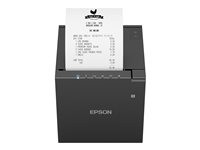
In This Guide
- Which printer delivers faster throughput and sharper output?
- Which printer fits a wired fixed-counter POS versus a mobile or multi-terminal setup?
- Which printer is better suited for high-volume fixed installations versus mobile or space-constrained deployments?
- Which should you choose: the C31CK00A9991 or the C31CJ57012?
- Side-by-Side Specs
- FAQ
Which printer delivers faster throughput and sharper output?
The C31CK00A9991 (TM-P80II) is rated at 236.2 inches per minute at 203 dpi monochrome resolution. The C31CJ57012 is rated at 500 mm/s, which converts to approximately 1,181 inches per minute, at 180 dpi monochrome resolution.
On raw speed alone, the C31CJ57012 is substantially faster — nearly five times the linear throughput of the TM-P80II. This makes the C31CJ57012 more capable during peak transaction periods at high-volume fixed POS lanes.
On resolution, the TM-P80II holds a modest advantage at 203 dpi versus 180 dpi, which can translate to marginally crisper barcode rendering and finer text on printed receipts. However, both are monochrome direct thermal outputs and the practical difference in receipt legibility at these resolutions is limited. Neither model's specs list a paper width for the C31CJ57012, while the TM-P80II is explicitly rated for 3-inch media width.
Which printer fits a wired fixed-counter POS versus a mobile or multi-terminal setup?
The C31CK00A9991 (TM-P80II) connects via Bluetooth wireless and a wired interface, and is powered by a battery cradle for cordless operation. This positions it squarely as a mobile receipt printer — suited for line-busting, tableside POS, pop-up retail, or any scenario where the printer needs to move with or near a staff member away from a fixed power source.
The C31CJ57012 connects via Serial, Ethernet, and USB according to its product specs (the datasheet tagline references Ethernet and USB specifically). It is described as a compact countertop or under-counter unit. It offers no wireless or battery-backed connectivity as specified.
For IT buyers building a wired, networked POS infrastructure — where printers are fixed at checkout lanes and connected to a LAN — the C31CJ57012's Ethernet interface is a meaningful advantage. For deployments requiring mobility, the TM-P80II's Bluetooth and battery cradle are the only option between these two models.
Which printer is better suited for high-volume fixed installations versus mobile or space-constrained deployments?
The C31CK00A9991 (TM-P80II) is specified as a Mobile Cradle form factor. Its battery cradle enables cordless operation, and the 3-inch print width targets standard receipt roll stock. The product is described as compatible with multi-terminal retail environments and no-ribbon consumables. Power is supplied via battery cradle — no AC tether required during mobile use.
The C31CJ57012 is specified as a compact countertop/under-counter form factor. Its 500 mm/s rated print speed is well above the TM-P80II and is described as targeting high-volume POS. The power supply is listed as a 'Power Supply Box,' consistent with a fixed AC-powered installation.
Neither model's specs include operating temperature range, drop/ingress ratings, or duty cycle figures. The TM-P80II's mobile form factor implies ruggedization for field use, but no IP rating or MIL-SPEC data is present in the provided specs. Buyers requiring environmental or durability specifications should consult the respective datasheets before specifying either unit.
Which should you choose: the C31CK00A9991 or the C31CJ57012?
Our take: The C31CK00A9991 (TM-P80II) is the stronger choice when the deployment requires untethered, mobile receipt printing — particularly for line-busting, tableside service, or pop-up POS where Bluetooth connectivity and battery cradle operation are essential. The C31CJ57012 is the stronger choice for fixed, high-volume countertop installations: its 500 mm/s print speed (approximately 1,181 inches per minute) is nearly five times the TM-P80II's rated 236.2 inches per minute, its Ethernet port enables direct LAN integration without a host PC USB tether, and its Serial interface supports legacy POS controller compatibility that the TM-P80II does not provide. The TM-P80II holds a marginal resolution advantage at 203 dpi versus 180 dpi. Paper width is confirmed at 3 inches only for the TM-P80II; that spec is absent for the C31CJ57012. Installers building fixed networked POS lanes should favor the C31CJ57012; those equipping mobile staff should specify the TM-P80II.
Side-by-Side Comparison
Spec-for-spec, from manufacturer data.
| Specification | Epson C31CK00A9991 | Epson C31CJ57012 |
|---|---|---|
| Product Type | Mobile Receipt Printer | Receipt Printer (Countertop/Under-Counter) |
| Print Method | Direct Thermal | Direct Thermal |
| Print Speed | 236.2 inches/min | 500 mm/s (~1,181 inches/min) |
| Print Resolution | 203 dpi monochrome | 180 dpi monochrome |
| Paper / Print Width | 3 inches | — |
| Connectivity | Bluetooth (wireless) + Wired | Serial, Ethernet, USB |
| Wireless | Bluetooth | — |
| Network Interface | — | Ethernet |
| Form Factor | Mobile Cradle | Compact Countertop / Under-Counter |
| Power Source | Battery cradle (cordless) | Power Supply Box (AC) |
| Media Type | Thermal receipt rolls | Thermal receipt roll |
| Ribbon Required | No | No |
| Compatible Use | Multi-terminal / mobile POS | High-volume fixed POS |
| Warranty | 1-year | 1-year |
| SKU | C31CK00A9991 | C31CJ57012 |
Frequently Asked Questions
Which should you choose: the C31CK00A9991 or the C31CJ57012?
The C31CK00A9991 (TM-P80II) is the stronger choice when the deployment requires untethered, mobile receipt printing — particularly for line-busting, tableside service, or pop-up POS where Bluetooth connectivity and battery cradle operation are essential. The C31CJ57012 is the stronger choice for fixed, high-volume countertop installations: its 500 mm/s print speed (approximately 1,181 inches per minute) is nearly five times the TM-P80II's rated 236.2 inches per minute, its Ethernet port enables direct LAN integration without a host PC USB tether, and its Serial interface supports legacy POS controller compatibility that the TM-P80II does not provide. The TM-P80II holds a marginal resolution advantage at 203 dpi versus 180 dpi. Paper width is confirmed at 3 inches only for the TM-P80II; that spec is absent for the C31CJ57012. Installers building fixed networked POS lanes should favor the C31CJ57012; those equipping mobile staff should specify the TM-P80II.
Is the C31CK00A9991 or C31CJ57012 better for a high-volume retail checkout lane?
The C31CJ57012 is better suited for high-volume fixed checkout lanes. Its rated print speed of 500 mm/s (approximately 1,181 inches per minute) is nearly five times faster than the C31CK00A9991's 236.2 inches per minute, and its Ethernet interface allows direct integration into a POS network without requiring a USB host.
Can either of these printers work without being plugged into a wall?
Only the C31CK00A9991 (TM-P80II) supports cordless operation. Its specs list a battery cradle for cordless use and Bluetooth wireless connectivity. The C31CJ57012 is powered by an AC power supply box and has no battery or wireless capability listed in its specs.
Which printer produces sharper receipts — the C31CK00A9991 or the C31CJ57012?
Based on the provided specs, the C31CK00A9991 (TM-P80II) prints at 203 dpi versus 180 dpi for the C31CJ57012. The TM-P80II's higher resolution may yield marginally crisper text and barcodes. Both are monochrome direct thermal outputs, and the practical difference in receipt legibility between 203 dpi and 180 dpi is typically minor in real-world POS use.
More Label Printer Comparisons
- Epson C31CK00A9991 vs Brother RJ4230B
- Epson C31CK00A9991 vs Star Micronics TSP1043D
- Epson C31CK00A9991 vs Epson C31CJ99A9981
- Epson C31CJ99A9981 vs Brother RJ4230B
- Epson C31CJ99A9981 vs Star Micronics TSP1043D
- Epson C31CJ99A9981 vs Epson C31CJ57012
Label Printer Buying Guides
Get a Second Opinion on Your Camera Choice
Share your site layout, coverage goals, and budget. Our team will validate the camera selection, flag anything we would change, and recommend products that match the use case.