
CyberPower PR1000LCD vs Vertiv GXT5-1000LVRT2UXL: Specification Comparison
Both the CyberPower PR1000LCD and the Vertiv GXT5-1000LVRT2UXL are 1000VA/1000W single-phase UPS units targeting small-to-midsize installations where clean, conditioned power is non-negotiable. Despite identical nameplate capacity, they represent fundamentally different topologies—line-interactive AVR versus online double-conversion—and different physical footprints (mini-tower versus 2U rack/tower convertible), making this a legitimate cross-shop for buyers weighing topology risk, rack space, runtime scalability, and total cost of ownership at the 1 kVA tier.
In This Guide
- Which UPS topology delivers cleaner, more reliable output for sensitive loads?
- How do runtime, battery runtime scalability, and battery serviceability compare?
- Which unit better fits rack-mount deployments and enterprise management requirements?
- Which should you choose: the PR1000LCD or the GXT5-1000LVRT2UXL?
- Side-by-Side Specs
- FAQ
Which UPS topology delivers cleaner, more reliable output for sensitive loads?
The PR1000LCD uses a line-interactive topology with automatic voltage regulation (AVR). Under normal utility power, the load runs directly off utility with AVR correcting voltage sags and swells within its 78–149 VAC operating window before switching to battery. Transfer to battery is not instantaneous; the specified transfer time is 4 ms typical. Output regulation is ±5% at 120 VAC.
The GXT5-1000LVRT2UXL employs online double-conversion, meaning the load is continuously powered from a rectifier-inverter chain and is never directly on utility power. Transfer time is effectively zero—the spec lists 'zero (always-on double-conversion).' Output is pure sinewave at user-configurable 110/115/120/125 VAC with ±3% regulation, tighter than the PR1000LCD's ±5%.
For loads with sensitive power supplies—network switches, servers, VoIP gateways, or IP camera NVRs—the zero-transfer-time and tighter output regulation of the GXT5 are material advantages. The PR1000LCD's 4 ms transfer time meets most ATX power supply hold-up specifications but is non-zero. Both units output pure sinewave on battery, eliminating compatibility concerns with active PFC power supplies. The GXT5 also publishes efficiency figures: up to 95% in online mode, 98% in ECO mode; the PR1000LCD does not publish an efficiency rating in the provided specs.
How do runtime, battery runtime scalability, and battery serviceability compare?
The PR1000LCD ships with 2 × 12V/12Ah sealed lead-acid batteries integrated in the mini-tower chassis. Published runtime is 3.1 minutes at full 1000W load and 10.5 minutes at 500W (50% load). Batteries are user-replaceable but the chassis does not support external battery cabinets per the provided specifications. Recharge time is 3 hours in quick-charge mode, 8 hours in eco mode.
The GXT5-1000LVRT2UXL uses user-replaceable, hot-swappable VRLA batteries that are front-accessible and require no tools for replacement. Critically, the spec explicitly supports optional external battery cabinets daisy-chained up to 3 units, enabling runtime extension beyond the internal pack. Published runtime figures for the GXT5 at specific load percentages are not included in the provided specifications.
The GXT5's hot-swap, tool-free battery replacement is operationally superior for rack environments where taking equipment offline is disruptive. The PR1000LCD's published runtime numbers (10.5 min @ 50% load) give buyers a concrete planning figure, whereas the GXT5's runtime at equivalent loads is not specified in the provided data. For installations requiring extended runtime beyond internal battery capacity, only the GXT5 offers a documented scalability path through external cabinets.
Which unit better fits rack-mount deployments and enterprise management requirements?
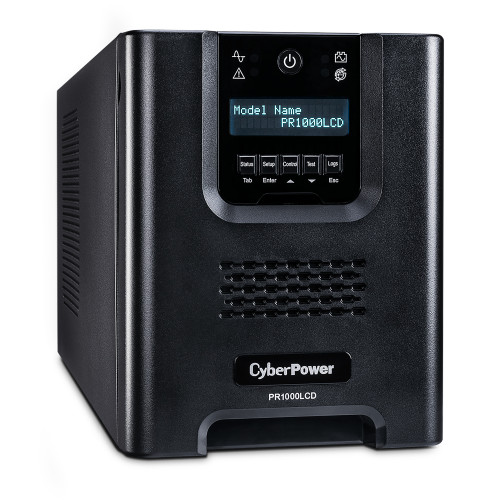
The PR1000LCD is a mini-tower only, measuring 6.7 × 8.7 × 17 in and weighing 44 lbs. It is not rack-mountable per the provided specifications. It provides 8 × NEMA 5-15R outlets (all battery and surge protected, 4 with critical load priority), USB, serial, and SNMP connectivity, and ships with PowerPanel Business Edition management software. The LCD is removable with a 4.5 ft cable. Surge protection is rated at 1,030 joules.
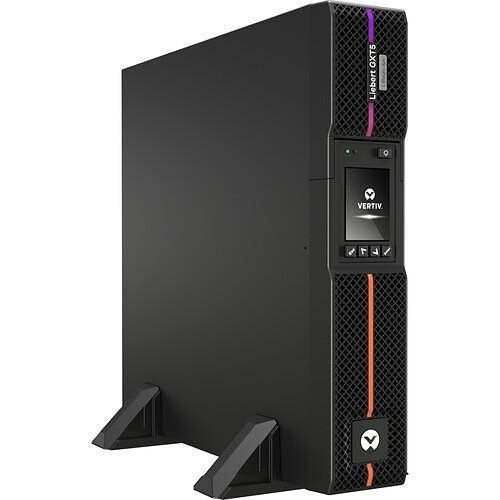
The GXT5-1000LVRT2UXL ships as a 2U rack-mount unit that converts to tower orientation, measuring 16.9 × 15.7 × 3.4 in and weighing 37 lbs. It provides 6 × NEMA 5-15R outlets in programmable groups. Standard connectivity is USB and RS-232 serial; network management requires an optional Intellislot card (not included). No bundled management software is named in the provided specifications. Noise level is specified at less than 45 dBA at 1 meter; the PR1000LCD does not publish a noise figure.
The PR1000LCD's built-in SNMP and PowerPanel Business Edition software give it an out-of-box network management advantage at no additional hardware cost. The GXT5 requires a separately purchased Intellislot card for network-level monitoring. However, the GXT5's 2U rack/tower form factor is the only option for installers standardizing on rack-mounted infrastructure, and its 6 programmable outlet groups allow load-shedding automation the PR1000LCD does not document. The PR1000LCD offers 2 more outlets (8 vs. 6) and a higher surge joule rating (1,030 J vs. no joule figure published for the GXT5).
Which should you choose: the PR1000LCD or the GXT5-1000LVRT2UXL?
Our take: The GXT5-1000LVRT2UXL is the stronger choice when the load is a rack-mounted, power-sensitive system—such as a server, NVR, or core network switch—where zero transfer time, tighter output regulation, and hot-swappable batteries without downtime are required. Key spec deltas: the GXT5's online double-conversion delivers 0 ms transfer versus the PR1000LCD's 4 ms typical, output regulation is ±3% versus ±5%, and battery replacement is hot-swap tool-free versus a standard user-replaceable procedure. The PR1000LCD is the stronger choice for desktop or floor-standing deployments on a tighter budget where out-of-box SNMP management (no add-on card required), 8 outlets versus 6, and a documented 1,030 J surge rating matter. If the installation is rack-based and involves mission-critical or sensitive loads, specify the GXT5. If the site is a small office or retail closet with no rack and cost sensitivity is high, the PR1000LCD is the practical fit.
Side-by-Side Comparison
Spec-for-spec, from manufacturer data.
| Specification | CyberPower PR1000LCD | Vertiv GXT5-1000LVRT2UXL |
|---|---|---|
| Topology | Line-Interactive with AVR | Online Double-Conversion |
| Capacity | 1000VA / 1000W | 1000VA / 1000W (unity PF) |
| Form Factor | Mini-Tower | 2U Rack/Tower Convertible |
| Dimensions (W×H×D) | 6.7 × 8.7 × 17 in | 16.9 × 3.4 × 15.7 in (W×H×D) |
| Weight | 44 lbs | 37 lbs |
| Transfer Time | 4 ms typical | Zero (always-on) |
| Output Voltage Regulation | 120 VAC ±5% | 110/115/120/125 VAC ±3% (configurable) |
| Output Waveform | Pure Sine Wave | Pure Sine Wave |
| Outlets | 8 × NEMA 5-15R | 6 × NEMA 5-15R (programmable groups) |
| Input Voltage Range | 78–149 VAC | 60–150 VAC |
| Battery Type | 2 × 12V/12Ah sealed lead-acid, user-replaceable | VRLA, hot-swappable, tool-free, front-accessible |
| External Battery Scalability | Not specified | Yes, up to 3 external cabinets (daisy-chain) |
| Runtime @ 50% Load | 10.5 min (500W) | Not specified in provided specs |
| Connectivity | USB, Serial, SNMP | USB, RS-232; network via optional Intellislot card |
| Efficiency | Not specified | Up to 95% (online), 98% (ECO mode) |
| Surge Protection | 1,030 Joules | Not specified in provided specs |
| Certifications | UL1778, cUL 107.3, FCC Class A, Energy Star, RoHS | TAA, Energy Star 2.0, cULus, FCC Class A, CE |
| Warranty | 3-year limited, $375,000 connected equipment guarantee | 3-year advanced replacement, batteries included |
Frequently Asked Questions
Which should you choose: the PR1000LCD or the GXT5-1000LVRT2UXL?
The GXT5-1000LVRT2UXL is the stronger choice when the load is a rack-mounted, power-sensitive system—such as a server, NVR, or core network switch—where zero transfer time, tighter output regulation, and hot-swappable batteries without downtime are required. Key spec deltas: the GXT5's online double-conversion delivers 0 ms transfer versus the PR1000LCD's 4 ms typical, output regulation is ±3% versus ±5%, and battery replacement is hot-swap tool-free versus a standard user-replaceable procedure. The PR1000LCD is the stronger choice for desktop or floor-standing deployments on a tighter budget where out-of-box SNMP management (no add-on card required), 8 outlets versus 6, and a documented 1,030 J surge rating matter. If the installation is rack-based and involves mission-critical or sensitive loads, specify the GXT5. If the site is a small office or retail closet with no rack and cost sensitivity is high, the PR1000LCD is the practical fit.
Can either UPS be rack-mounted in a standard 19-inch rack?
Only the Vertiv GXT5-1000LVRT2UXL supports rack mounting. It is a 2U rack/tower convertible unit (16.9 × 15.7 × 3.4 in) designed to install in a standard 19-inch rack or stand as a tower. The CyberPower PR1000LCD is a mini-tower form factor only (6.7 × 8.7 × 17 in) and rack mounting is not listed in its provided specifications.
Which UPS is better for sensitive IT loads like servers or NVRs that cannot tolerate even a brief power gap?
The Vertiv GXT5-1000LVRT2UXL is the appropriate choice. Its online double-conversion topology means the load is always powered from the inverter and transfer time is zero—utility disturbances never reach the load directly. The CyberPower PR1000LCD is line-interactive with a specified 4 ms typical transfer time, which most ATX power supplies tolerate but is non-zero. The GXT5 also provides tighter output voltage regulation (±3% versus ±5%) and user-configurable output voltage (110/115/120/125 VAC).
Which unit includes network management capabilities out of the box?
The CyberPower PR1000LCD includes USB, serial, and SNMP connectivity and bundles PowerPanel Business Edition software, giving it out-of-box network management capability. The Vertiv GXT5-1000LVRT2UXL includes USB and RS-232 serial as standard; network management requires an optional Intellislot network card, which is not included. No bundled management software is named in the GXT5's provided specifications.
More UPS Comparisons
- CyberPower PR1000RTXL2UC vs APC by Schneider Electric SURT1000RMXLI
- CyberPower PR1000RTXL2UC vs APC by Schneider Electric SMT1000CUS
- CyberPower PR1000RTXL2UC vs Vertiv GXT5-1000LVRT2UXL
- CyberPower PR1000RTXL2UC vs APC by Schneider Electric SMT1000J
- CyberPower PR1000RTXL2UC vs CyberPower CP1000PFCLCD
- CyberPower PR1000RTXL2UC vs CyberPower PR1000LCD
UPS Buying Guides
Get a Second Opinion on Your Camera Choice
Share your site layout, coverage goals, and budget. Our team will validate the camera selection, flag anything we would change, and recommend products that match the use case.