
CyberPower CP1000PFCLCD vs APC by Schneider Electric SMT1000CUS: Specification Comparison
Both the CyberPower CP1000PFCLCD and the APC Smart-UPS SMT1000CUS are 1000 VA line-interactive tower UPS units designed to protect sensitive electronics from power disturbances at 120 V AC. Each delivers pure sine wave output, making them genuine cross-shop candidates for home offices, workstations, network closets, and light IT loads. This comparison evaluates output capacity and runtime, physical and connectivity characteristics, and management features—the three dimensions most relevant to installers and IT buyers selecting a 1 kVA desktop UPS.
In This Guide
- Which unit delivers more usable watt capacity and longer runtime?
- How do the units differ in physical footprint, weight, and outlet availability?
- Which unit offers broader management, monitoring, and software integration?
- Which should you choose: the CP1000PFCLCD or the SMT1000CUS?
- Side-by-Side Specs
- FAQ
Which unit delivers more usable watt capacity and longer runtime?
The CyberPower CP1000PFCLCD is rated at 600 W, while the APC SMT1000CUS is rated at 700 W—a 100 W difference on the same 1000 VA rating, meaning the APC carries a higher power factor (0.70 vs 0.60). For loads approaching 600–700 W, the SMT1000CUS provides headroom the CP1000PFCLCD does not.
CyberPower specifies concrete runtime figures: 2 minutes at 600 W full load and 6 minutes at 300 W half load, backed by a 12 V / 9 Ah sealed lead-acid battery. APC does not publish discrete runtime figures in the provided specifications, instead referencing a runtime graph; a direct minute-for-minute comparison at equivalent loads cannot be made from the spec sheet alone.
The CP1000PFCLCD battery is user-replaceable with a published part number (RB1270X2C). The APC replacement battery is identified as RBC6; the provided specs do not specify Ah capacity or whether the replacement is user-installable without tools.
How do the units differ in physical footprint, weight, and outlet availability?
The CyberPower CP1000PFCLCD is a mini-tower measuring 3.94 × 9.7 × 10.24 in and weighs 15.39 lb. The APC SMT1000CUS is listed at a single dimension of 8.6 in (interpreted as height from the provided spec) and weighs 44.3 lb—nearly three times heavier. This substantial weight difference has practical implications for desk placement, cabinet loading, and field serviceability.
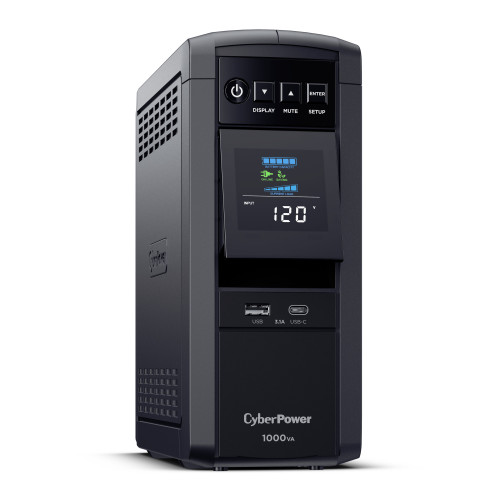
Outlet count differs meaningfully: the CP1000PFCLCD provides 10 × NEMA 5-15R receptacles (5 battery-backed + surge, 5 surge-only), while the SMT1000CUS provides 8 × NEMA 5-15R. The CyberPower also adds 1020 J of surge protection, RJ45 network line protection (1 in / 1 out), and onboard USB Type-A and Type-C charging ports. APC's specs do not list surge joule rating, network line protection, or USB charging ports.
Input connection on the APC is a NEMA 5-15P plug. CyberPower's input plug type is not explicitly stated in the provided specifications, though the 120 VAC / NEMA 5-15R output implies a standard 15 A cord. The APC specs note an adjustable input voltage range of 75–154 V; CyberPower specifies 88–144 V, giving the APC a wider low-end tolerance by 13 V.
Which unit offers broader management, monitoring, and software integration?
The CyberPower CP1000PFCLCD includes a multifunction color LCD displaying load percentage, input/output voltage, battery charge, estimated runtime, and fault conditions. It connects via USB (HID compliant) and serial (dry contact relay), and ships with PowerPanel software supporting Windows, macOS, and Linux. Automatic battery self-tests run every two weeks; manual tests can be initiated from the LCD or software.
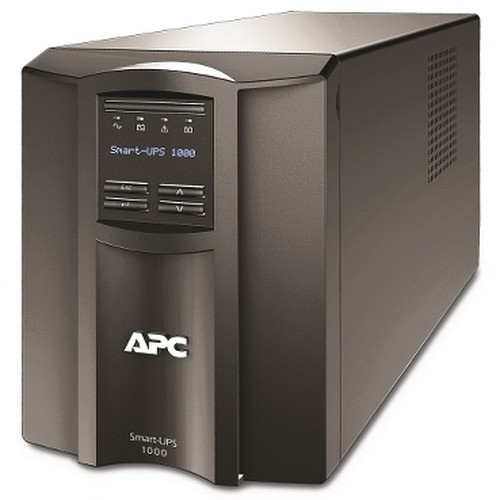
The APC SMT1000CUS includes an LCD (referenced by product name) and connects via USB port, serial port, and a SmartConnect port with one available expansion slot. APC's specs list 'CD with software' as provided equipment but do not name the software title, supported operating systems, or self-test scheduling. The SmartConnect port and expansion slot suggest network card or environmental sensor add-ons, but no specific cards or protocols are listed in the provided specifications.
The CyberPower unit is ENERGY STAR certified and carries a GreenPower Bypass high-efficiency mode with a specified idle draw of under 10 W. The APC SMT1000CUS holds ENERGY STAR V2.0 (USA) and TAA compliance certifications. APC's idle efficiency figures are not provided in the spec sheet. CyberPower specifies output THD of less than 3% at full load and a 4 ms transfer time; neither figure is present in the APC specifications as provided.
Which should you choose: the CP1000PFCLCD or the SMT1000CUS?
Our take: The CP1000PFCLCD is the stronger choice when outlet density, documented runtime figures, USB charging, and cross-platform software matter—while the SMT1000CUS is the stronger choice when watt capacity and input voltage tolerance are the priority. The APC provides 700 W vs. CyberPower's 600 W, a meaningful 17% capacity advantage for loads in the 600–700 W range. The CyberPower counters with 10 outlets vs. 8, a published 6-minute half-load runtime (APC runtime figures not provided in spec), and a unit weight of 15.39 lb vs. 44.3 lb—a significant serviceability factor. The APC's wider input range (75–154 V vs. 88–144 V) benefits sites with chronic undervoltage. For network closets requiring TAA-compliant procurement, the SMT1000CUS is the only option here. For general workstation or AV protection where outlet count, weight, and transparent runtime data drive the decision, the CP1000PFCLCD presents a well-documented specification profile.
Side-by-Side Comparison
Spec-for-spec, from manufacturer data.
| Specification | CyberPower CP1000PFCLCD | APC by Schneider Electric SMT1000CUS |
|---|---|---|
| Capacity (VA) | 1000 VA | 1000 VA |
| Capacity (Watts) | 600 W | 700 W |
| Topology | Line Interactive | Line Interactive |
| Output Waveform | Pure Sine Wave | Sine Wave |
| Input Voltage Range | 88–144 VAC | 75–154 V (adjustable) |
| Output Voltage | 120 VAC ± 5% | 120 VAC |
| Transfer Time | 4 ms | — |
| Output THD | <3% at full load | — |
| Total Outlets | 10 × NEMA 5-15R | 8 × NEMA 5-15R |
| Battery-Backed Outlets | 5 × NEMA 5-15R | — |
| Surge Protection | 1020 J | — |
| Network Line Protection | RJ45 (1 in / 1 out) | — |
| Runtime at Half Load | 6 min at 300 W | — |
| Battery | 12 V / 9 Ah Sealed Lead-Acid | Lead-Acid (Ah not specified) |
| Management Interfaces | USB (HID), Serial, LCD | USB, Serial, SmartConnect, Expansion Slot |
| Weight | 15.39 lb | 44.3 lb |
| Dimensions (W×H×D) | 3.94 × 9.7 × 10.24 in | 8.6 in (single dimension provided) |
| USB Charging Ports | Type-A + Type-C | — |
| Certifications | UL1778, cUL 107.3, FCC Class B, RoHS, ENERGY STAR | cULus, ENERGY STAR V2.0, TAA Compliant |
| Warranty | 3 Year Limited | — |
| Connected Equipment Policy | $500,000 | — |
Frequently Asked Questions
Which should you choose: the CP1000PFCLCD or the SMT1000CUS?
The CP1000PFCLCD is the stronger choice when outlet density, documented runtime figures, USB charging, and cross-platform software matter—while the SMT1000CUS is the stronger choice when watt capacity and input voltage tolerance are the priority. The APC provides 700 W vs. CyberPower's 600 W, a meaningful 17% capacity advantage for loads in the 600–700 W range. The CyberPower counters with 10 outlets vs. 8, a published 6-minute half-load runtime (APC runtime figures not provided in spec), and a unit weight of 15.39 lb vs. 44.3 lb—a significant serviceability factor. The APC's wider input range (75–154 V vs. 88–144 V) benefits sites with chronic undervoltage. For network closets requiring TAA-compliant procurement, the SMT1000CUS is the only option here. For general workstation or AV protection where outlet count, weight, and transparent runtime data drive the decision, the CP1000PFCLCD presents a well-documented specification profile.
Which UPS supports heavier loads—the CP1000PFCLCD or the SMT1000CUS?
The APC SMT1000CUS is rated at 700 W versus the CyberPower CP1000PFCLCD's 600 W, both at 1000 VA. If your protected load approaches or exceeds 600 W, the SMT1000CUS provides the necessary headroom; the CP1000PFCLCD would be at or beyond its rated watt ceiling in that scenario.
Is either UPS TAA compliant for government or education purchasing?
Yes—the APC SMT1000CUS is listed as TAA compliant in its provided certifications. The CyberPower CP1000PFCLCD specifications do not include TAA compliance; buyers subject to Trade Agreements Act requirements should select the SMT1000CUS.
Can I monitor and manage either UPS from Linux or macOS?
The CyberPower CP1000PFCLCD ships with PowerPanel software explicitly supporting Windows, macOS, and Linux via USB HID or serial connection. The APC SMT1000CUS lists software on CD and a SmartConnect port but the provided specifications do not name supported operating systems; buyers dependent on Linux or macOS management should verify APC compatibility through APC's published documentation before purchasing.
More UPS Comparisons
- CyberPower PR1000RTXL2UC vs APC by Schneider Electric SURT1000RMXLI
- CyberPower PR1000RTXL2UC vs APC by Schneider Electric SMT1000CUS
- CyberPower PR1000RTXL2UC vs Vertiv GXT5-1000LVRT2UXL
- CyberPower PR1000RTXL2UC vs APC by Schneider Electric SMT1000J
- CyberPower PR1000RTXL2UC vs CyberPower CP1000PFCLCD
- CyberPower PR1000RTXL2UC vs CyberPower PR1000LCD
UPS Buying Guides
Get a Second Opinion on Your Camera Choice
Share your site layout, coverage goals, and budget. Our team will validate the camera selection, flag anything we would change, and recommend products that match the use case.