
Comnet CNGE24MS vs Comnet CWGE24MS2: Specification Comparison
The Comnet CNGE24MS and CWGE24MS2 are both 24-port managed Gigabit Ethernet switches designed for commercial and light industrial surveillance and networking deployments. Both offer a mix of copper and SFP fiber ports, AC power input, and Layer 2 managed switching capabilities. This comparison examines port architecture, environmental and power specifications, and protocol/management depth to help integrators and IT buyers determine which switch best suits their fiber-heavy, redundancy-sensitive, or feature-rich network requirements.
In This Guide
- Which switch offers the right copper-to-fiber port balance and throughput for my deployment?
- Which switch is better suited for demanding installation environments and what are the power requirements?
- Which switch provides stronger redundancy, security, and management protocol support?
- Which should you choose: the CNGE24MS or the CWGE24MS2?
- Side-by-Side Specs
- FAQ
Which switch offers the right copper-to-fiber port balance and throughput for my deployment?
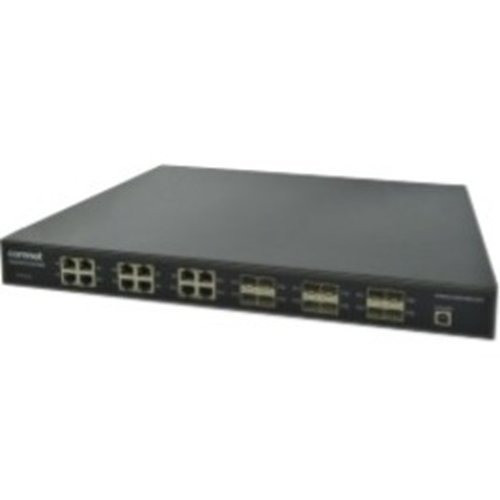
The CNGE24MS provides 16 x 10/100/1000Base-TX copper ports and 8 x 100/1000Base-FX SFP ports, yielding a 2:1 copper-to-fiber ratio. Its switching bandwidth is rated at 48 Gbps with a switching latency of 7 μs. Jumbo frame support tops out at 9.6K bytes, and the MAC address table holds 8,000 entries with support for up to 256 VLANs.
The CWGE24MS2 inverts that ratio significantly: it offers only 4 x Gigabit combo ports (copper) alongside 20 x 100/1000Base-FX SFP ports, making it the fiber-dominant option. Jumbo frame support is specified at 10K bytes. Switching bandwidth, latency, MAC table size, and VLAN count are not provided in the available specifications for the CWGE24MS2.
Buyers needing predominantly copper edge connections should favor the CNGE24MS. Deployments requiring dense fiber uplinks — such as long-run camera runs or fiber-backbone aggregation — align better with the CWGE24MS2's 20-port SFP configuration.
Which switch is better suited for demanding installation environments and what are the power requirements?
The CNGE24MS is specified for an operating temperature range of -40°C to +70°C and storage from -40°C to +85°C, with 5%–95% non-condensing humidity tolerance. It draws 25 W from a 100–240 VAC input. Physical dimensions are 30 x 16.5 x 8.8 cm at a weight of 2.4 kg, and Comnet rates its MTBF at greater than 100,000 hours — a concrete reliability data point.
The CWGE24MS2 accepts 100–240 VAC as its primary power supply and additionally supports a 12 VDC battery backup input — a meaningful advantage for deployments requiring UPS or DC backup redundancy. Operating temperature range, storage temperature, humidity rating, dimensions, weight, and MTBF are not listed in the available specifications for the CWGE24MS2.
For harsh-environment or outdoor-cabinet installs where temperature extremes are a concern, the CNGE24MS's verified -40°C floor and documented MTBF provide specification-backed assurance. The CWGE24MS2's dual-power-input support (AC + 12 VDC) is a distinct advantage for power-redundant or UPS-backed rack environments, but its environmental limits cannot be confirmed from available data.
Which switch provides stronger redundancy, security, and management protocol support?
The CNGE24MS supports C-Ring, Legacy Ring, C-Chain, MRP, Fast Recovery, MSTP, RSTP, and STP for network redundancy — a notably broad set that includes Comnet-proprietary ring protocols (C-Ring, C-Chain) suited to surveillance ring topologies. Security features include Device Binding, Port-Based Network Access Control, RADIUS, SNMPv3, HTTPS, and SSH.
The CWGE24MS2 lists ERPS G.8032, MSTP/RSTP/STP, SNMPv1/v2c/v3, RMON, 802.1Q VLAN, TACACS+, 802.1x, IEEE 1588v2 (precision time protocol), 802.3AZ (Energy Efficient Ethernet), and LLDP. Its feature set also notes ACL, IGMP Snooping, Port Mirroring, QoS, and Rapid Spanning Tree. IPv6 is explicitly supported. TACACS+, IEEE 1588v2, RMON, 802.3AZ, LLDP, and ACL are not mentioned in the CNGE24MS specifications.
The CWGE24MS2 offers a broader documented protocol stack for enterprise-adjacent environments — particularly TACACS+ for AAA integration, IEEE 1588v2 for time-sensitive applications, and RMON for traffic monitoring. The CNGE24MS's Comnet-proprietary ring protocols and Device Binding provide advantages in hardened surveillance ring deployments where those specific redundancy mechanisms are already in use.
Which should you choose: the CNGE24MS or the CWGE24MS2?
Our take: The CNGE24MS is the stronger choice when a deployment requires hardened environmental performance, documented reliability metrics, and Comnet-proprietary ring redundancy in a copper-heavy topology. It specifies a verified -40°C to +70°C operating range and an MTBF exceeding 100,000 hours — neither of which appears in the CWGE24MS2's available data — and its 16 copper ports suit mixed wired-camera and IP-device environments. The CWGE24MS2 is the stronger choice when fiber density is the priority: its 20 SFP ports versus the CNGE24MS's 8 support more fiber-run camera or uplink connections from a single switch. The CWGE24MS2 also adds 12 VDC battery backup input, IEEE 1588v2 precision timing, TACACS+, RMON, and explicit IPv6 support — protocol depth not confirmed for the CNGE24MS. Integrators running Comnet-ring surveillance topologies in temperature-extreme environments should select the CNGE24MS; those building fiber-dense or enterprise-managed backbone aggregation points should evaluate the CWGE24MS2.
Side-by-Side Comparison
Spec-for-spec, from manufacturer data.
| Specification | Comnet CNGE24MS | Comnet CWGE24MS2 |
|---|---|---|
| Total Ports | 24 (16 TX + 8 SFP) | 24 (4 combo + 20 SFP) |
| Copper Ports | 16 x 10/100/1000Base-TX | 4 x Gigabit Combo |
| SFP / Fiber Ports | 8 x 100/1000Base-FX | 20 x 100/1000Base-FX |
| Switching Bandwidth | 48 Gbps | — |
| Switching Latency | 7 μs | — |
| Jumbo Frame Support | 9.6K bytes | 10K bytes |
| MAC Table Size | 8,000 entries | — |
| Max VLANs | 256 | — |
| Primary Power Input | 100–240 VAC | 100–240 VAC |
| DC Backup Input | — | 12 VDC |
| Power Consumption | 25 W | — |
| Operating Temperature | -40°C to +70°C | — |
| MTBF | > 100,000 hours | — |
| Redundancy Protocols | C-Ring, C-Chain, MRP, Fast Recovery, MSTP, RSTP, STP | ERPS G.8032, MSTP/RSTP/STP |
| Security / AAA | Device Binding, Port-Based NAC, RADIUS, SNMPv3, HTTPS, SSH | TACACS+, 802.1x, SNMPv1/v2c/v3, SSH |
| Additional Protocols | — | IEEE 1588v2, RMON, LLDP, 802.3AZ, IPv6, ACL, IGMP Snooping, QoS |
Frequently Asked Questions
Which should you choose: the CNGE24MS or the CWGE24MS2?
The CNGE24MS is the stronger choice when a deployment requires hardened environmental performance, documented reliability metrics, and Comnet-proprietary ring redundancy in a copper-heavy topology. It specifies a verified -40°C to +70°C operating range and an MTBF exceeding 100,000 hours — neither of which appears in the CWGE24MS2's available data — and its 16 copper ports suit mixed wired-camera and IP-device environments. The CWGE24MS2 is the stronger choice when fiber density is the priority: its 20 SFP ports versus the CNGE24MS's 8 support more fiber-run camera or uplink connections from a single switch. The CWGE24MS2 also adds 12 VDC battery backup input, IEEE 1588v2 precision timing, TACACS+, RMON, and explicit IPv6 support — protocol depth not confirmed for the CNGE24MS. Integrators running Comnet-ring surveillance topologies in temperature-extreme environments should select the CNGE24MS; those building fiber-dense or enterprise-managed backbone aggregation points should evaluate the CWGE24MS2.
Is the CNGE24MS or CWGE24MS2 better for a large fiber-run camera network?
The CWGE24MS2 is the better fit for fiber-heavy deployments. It provides 20 x 100/1000Base-FX SFP ports compared to the CNGE24MS's 8 SFP ports, allowing significantly more fiber-connected cameras or uplinks from a single switch. The CNGE24MS's 16 copper ports make it the better choice when most devices connect via Cat5e/Cat6.
Can either switch handle outdoor or cabinet installations in extreme temperatures?
Only the CNGE24MS provides a specified operating temperature range (-40°C to +70°C) in the available data, along with a documented MTBF of greater than 100,000 hours. The CWGE24MS2's operating temperature range is not listed in its available specifications, so its suitability for extreme-temperature environments cannot be confirmed from spec data alone.
Which switch is better for an enterprise or multi-vendor managed network requiring AAA authentication and advanced protocols?
The CWGE24MS2 documents a broader enterprise protocol stack, including TACACS+ (enterprise AAA), RMON (traffic monitoring), IEEE 1588v2 (precision time), 802.1x port authentication, LLDP, and explicit IPv6 support — none of which appear in the CNGE24MS's available specifications. For environments requiring integration with RADIUS and TACACS+ AAA servers or precision timing, the CWGE24MS2 is the better-documented option.
More Network Switch Comparisons
- TP-Link S5500-24GP4XF vs NETGEAR GS728TP-300NAS
- TP-Link S5500-24GP4XF vs Comnet CNGE24FX12TX12MSPOE
- TP-Link S5500-24GP4XF vs Ubiquiti USW-24
- TP-Link S5500-24GP4XF vs Ubiquiti USW-ENTERPRISEXG-24
- TP-Link S5500-24GP4XF vs TP-Link SL2428P
- TP-Link S5500-24GP4XF vs TP-Link SG3428XPP-M2
Network Switch Buying Guides
Get a Second Opinion on Your Camera Choice
Share your site layout, coverage goals, and budget. Our team will validate the camera selection, flag anything we would change, and recommend products that match the use case.