
Comelit KCA2071A vs Comelit CLV1F: Specification Comparison
Both the Comelit KCA2071A and CLV1F are 4MP PoE+-powered video intercoms from the same manufacturer, targeting commercial and residential entry-control applications where a visitor station delivers video identification and two-way audio to an indoor unit or management platform. The comparison centers on three decision-critical axes: image resolution and audio capability, physical installation format and environmental hardening, and system platform compatibility — differences that directly determine which unit suits a given infrastructure and deployment context.

In This Guide
- How do resolution and audio capability compare between the KCA2071A and CLV1F?
- Which unit is better suited for demanding physical installation conditions and retrofit scenarios?
- Are the KCA2071A and CLV1F compatible with the same Comelit systems and management platforms?
- Which should you choose: the KCA2071A or the CLV1F?
- Side-by-Side Specs
- FAQ
How do resolution and audio capability compare between the KCA2071A and CLV1F?
The KCA2071A is specified at 2560×1440 (4MP), while the CLV1F is specified at 2688×1520 (also marketed as 4MP). Both carry the 4MP designation, but the CLV1F's stated pixel array is marginally larger at 2688×1520 versus 2560×1440 — a difference of roughly 9% more pixels. Neither datasheet provides additional imaging specs such as frame rate, low-light sensitivity, lens field of view, or WDR capability, so no further imaging comparison can be made from the provided specifications.
On audio, the KCA2071A specifies microphone support, which confirms at minimum one-way capture. The CLV1F specifies two-way audio explicitly. The KCA2071A spec does not confirm two-way audio; buyers requiring confirmed duplex communication at the door station should note this gap in the KCA2071A documentation as provided.
Which unit is better suited for demanding physical installation conditions and retrofit scenarios?
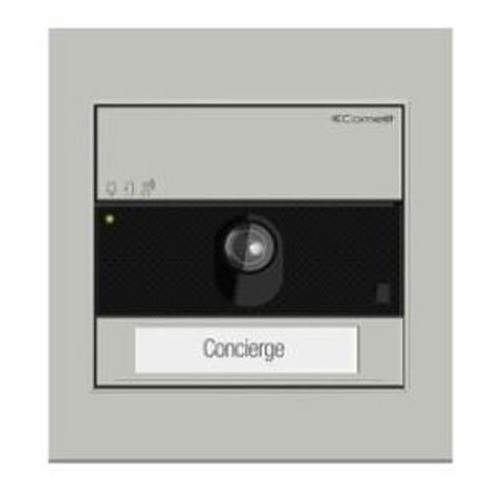
The KCA2071A is a wall-mounted, hands-free unit with stated dimensions of 105 mm × 105 mm × 20 mm and an IK08 impact resistance rating. IK08 denotes resistance to 5 joules of impact energy per IEC 62262, providing a defined, verifiable level of mechanical protection. No IP ingress-protection rating is listed in the provided specs for either unit.
The CLV1F is a flush-mount unit described as vandal-resistant, designed to sit inside a standard single-gang rough-in box — a form factor that suits both retrofit and new-construction wiring chases. The term 'vandal-resistant' is stated but no IK rating is cited for the CLV1F, meaning the KCA2071A's IK08 is the only numerically substantiated impact rating available. The CLV1F's flush profile reduces protrusion and potential leverage points, which is a practical installation consideration in high-traffic or public-access areas. Dimensions for the CLV1F are not provided in the supplied specifications.
Are the KCA2071A and CLV1F compatible with the same Comelit systems and management platforms?
Platform compatibility is the sharpest differentiator between these two units. The KCA2071A is specified as compatible with the Comelit CIAO and SimpleBus 2 ecosystems. SimpleBus 2 is Comelit's established two-wire bus architecture; CIAO is its associated software/management layer. This makes the KCA2071A a direct fit for existing SimpleBus 2 infrastructure and for integrators already deployed on that platform.
The CLV1F is specified as compatible with Comelit Carson Living only. Carson Living is a distinct Comelit platform — the two systems are not interchangeable. An integrator or end-user committed to SimpleBus 2 cannot substitute the CLV1F, and vice versa. No cross-platform compatibility is stated for either unit. Both units share single-cable network integration via PoE+ (802.3at), but the management and call-routing ecosystems are mutually exclusive based on the provided specifications.
Which should you choose: the KCA2071A or the CLV1F?
Our take: The KCA2071A is the stronger choice when the deployment runs on Comelit SimpleBus 2 or CIAO infrastructure, while the CLV1F is the correct selection for Carson Living environments — platform lock-in makes this the primary decision gate. Beyond compatibility, three spec deltas matter: the CLV1F's stated resolution of 2688×1520 edges out the KCA2071A's 2560×1440 by approximately 9% in pixel count; the KCA2071A carries a documented IK08 impact rating whereas the CLV1F's vandal resistance is asserted without an equivalent IK number; and the CLV1F explicitly confirms two-way audio while the KCA2071A's provided specs list only microphone support. Both units are PoE+ (802.3at) and carry a 2-year warranty. Installers should select solely on platform: KCA2071A for SimpleBus 2 / CIAO sites, CLV1F for Carson Living deployments.
Side-by-Side Comparison
Spec-for-spec, from manufacturer data.
| Specification | Comelit KCA2071A | Comelit CLV1F |
|---|---|---|
| SKU | KCA2071A | CLV1F |
| Product Line | CIAO Kit SimpleBus 2 | Vandalcom 1 Pb Flush |
| Resolution | 2560×1440 | 2688×1520 |
| Power | PoE+ (802.3at) | PoE+ (802.3at) |
| Form Factor | Hands-Free Wall-Mounted Unit | Flush-Mount Video Intercom |
| Mount Type | Wall Mount | Flush Mount (single-gang rough-in) |
| Housing Color | White | White |
| Audio | Microphone supported | Two-way |
| Impact Rating | IK08 | — |
| Vandal Resistance | — | Vandal-resistant (no IK rating stated) |
| System Compatibility | Comelit CIAO & SimpleBus 2 | Comelit Carson Living |
| Installation | Wall-mounted | Single-cable network integration |
| Dimensions | 105 mm × 105 mm × 20 mm | — (not provided) |
| Warranty | 2-Year | 2-Year |
| Datasheet | /content/product-datasheets/KCA2071A.pdf | /content/product-datasheets/CLV1F.pdf |
Frequently Asked Questions
Which should you choose: the KCA2071A or the CLV1F?
The KCA2071A is the stronger choice when the deployment runs on Comelit SimpleBus 2 or CIAO infrastructure, while the CLV1F is the correct selection for Carson Living environments — platform lock-in makes this the primary decision gate. Beyond compatibility, three spec deltas matter: the CLV1F's stated resolution of 2688×1520 edges out the KCA2071A's 2560×1440 by approximately 9% in pixel count; the KCA2071A carries a documented IK08 impact rating whereas the CLV1F's vandal resistance is asserted without an equivalent IK number; and the CLV1F explicitly confirms two-way audio while the KCA2071A's provided specs list only microphone support. Both units are PoE+ (802.3at) and carry a 2-year warranty. Installers should select solely on platform: KCA2071A for SimpleBus 2 / CIAO sites, CLV1F for Carson Living deployments.
Can I use the KCA2071A and CLV1F interchangeably on the same Comelit system?
No. The KCA2071A is compatible with Comelit CIAO and SimpleBus 2, while the CLV1F is compatible with Comelit Carson Living only. These are distinct platforms and the units are not interchangeable. You must match the door station to the specific Comelit ecosystem already deployed at the site.
Which unit offers better impact and vandal protection — the KCA2071A or the CLV1F?
The KCA2071A provides a verified IK08 impact rating (5 joules per IEC 62262), which is a quantified, testable standard. The CLV1F is described as vandal-resistant but no IK rating is listed in the supplied specifications, so its mechanical protection level cannot be numerically compared. If a documented impact rating is a procurement requirement, the KCA2071A is the only unit with one on record from the provided data.
Does either unit require a separate power supply, or does PoE+ cover both?
Both the KCA2071A and the CLV1F are powered by PoE+ (802.3at), meaning a compliant PoE+ switch or midspan injector supplies both power and data over a single network cable. Neither unit requires a separate power supply, simplifying installation labor and conduit runs for both models.
More Intercom Comparisons
- Hanwha TID-600R vs Aiphone IX-EA
- Hanwha TID-600R vs Axis A8207-VE
- Hanwha TID-600R vs Aiphone IX-DVF-6
- Hanwha TID-600R vs Aiphone JOS-1FW
- Aiphone IX-EA vs Axis A8207-VE
- Aiphone IX-EA vs 2N 01273-001
Intercom Buying Guides
Get a Second Opinion on Your Camera Choice
Share your site layout, coverage goals, and budget. Our team will validate the camera selection, flag anything we would change, and recommend products that match the use case.