
Best Video Intercoms for Office Buildings
Video intercoms for office and commercial buildings — IP door stations, reception/guard answering stations, and access-control integration.

Jerry Tildsen
Access Control & Intercoms Specialist · Working integrator
Bottom line
For office and commercial buildings, the right video intercom depends on three converging factors: environmental exposure at the door station, how your reception or security team needs to answer calls, and whether the system needs to hand off door-release commands to an existing access-control platform. Every product listed here is PoE-powered and IP-network-based, so they integrate into standard IT infrastructure — but their environmental ratings, form factors, and software ecosystems differ meaningfully. Match the door station's IP rating and temperature range to your installation site, then match the master/guard station to your staffing model before you buy.
What This Setup Needs
Commercial office video intercoms are purpose-built network endpoints, not consumer doorbells. Getting the spec fit right up front avoids costly retrofits. Here are the decision factors that matter most for office and commercial deployments:
- IP (Ingress Protection) rating at the door station: Covered vestibules in mild climates can often accept IP54, but exposed exterior facades, parking structures, and high-pressure cleaning environments demand IP65 or higher. IP66 withstands powerful water jets; IP68 is fully submersible — critical for flush-cabinet or grade-level installs where standing water is possible.
- Operating temperature range: Standard commercial electronics are typically rated 0–40 °C (32–104 °F). Northern climates, rooftop mechanical rooms, or unheated parking decks can drop well below freezing. A door station rated to -40 °C is a fundamentally different product — it uses a heater or wide-temp components — and cannot be substituted with a standard unit without risk of failure.
- Access-control integration depth: Many office buildings already run an access-control system (Lenel, Software House, Genetec, Milestone, etc.). Evaluate whether the intercom's door-station communicates via SIP (open, integrates broadly), a proprietary VoIP protocol (works within the same brand's ecosystem), or supports Wiegand/OSDP relay output for direct lock control. Open SIP systems give you the most flexibility at the cost of more configuration work.
- Master/guard station type — dedicated hardware vs. software client: A hardwired touchscreen station at a reception desk projects permanence and is always-on; a software client (PC or mobile app) is more flexible for distributed teams but depends on IT network policies and endpoint management. Understand which model each product uses before specifying.
- PoE budget and switch compatibility: All units here are PoE-powered, but confirm whether the door station draws standard PoE (802.3af, 15.4 W) or PoE+ (802.3at, 30 W). High-brightness displays, built-in card readers, and heaters push consumption up. Budget your PoE switch ports accordingly and check per-port wattage, not just total switch capacity.
- Camera resolution and wide-dynamic-range (WDR) performance: Office entrances are notorious for backlighting — glass lobbies flood the sensor with daylight while the visitor stands in shadow. A door station with true WDR (not just digital noise reduction) captures a usable face image for identity verification and audit logging. Ask for sample footage under your specific lighting conditions if possible.
- Scalability — multi-tenant vs. single-tenant: A single-tenant office needs one door station answering to one or two guard/reception stations. A multi-tenant building or campus needs a system that supports multiple call directories, tenant-specific ring routing, and potentially hundreds of sub-stations. Confirm the system's licensed capacity before deploying in a large or growing facility.
Our Picks
Selected from our catalog by spec-fit. All channel-direct and factory-new — not ranked by price.
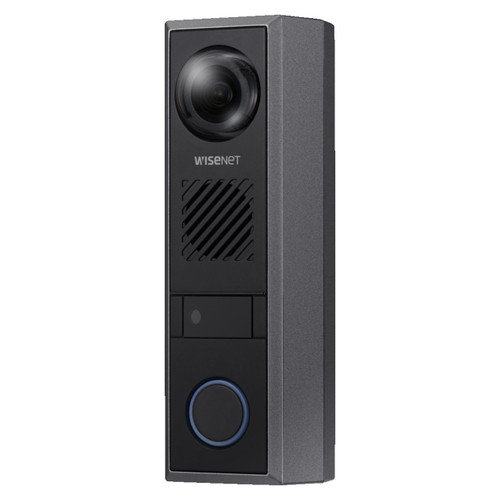
Hanwha TID-600R
Video Door Station
The Hanwha TID-600R is a PoE video door station with IP65 weather resistance, making it a strong fit for exposed exterior entrances on office buildings where rain and dust ingress are genuine concerns. As part of Hanwha's ecosystem, it is well-suited for sites already running Hanwha NVRs or Wisenet cameras where a unified management platform reduces integration overhead.
View product →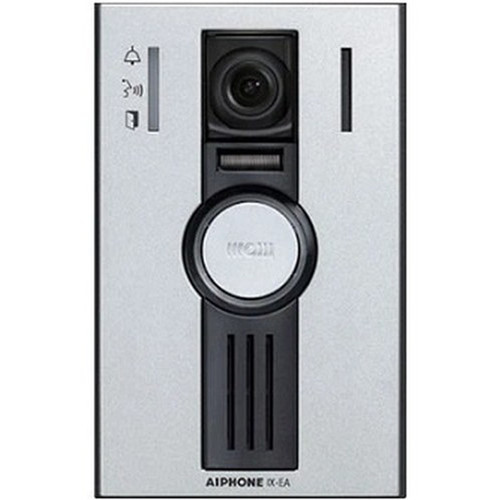
Aiphone IX-EA
Video Door Station
The Aiphone IX-EA is an IP54-rated PoE door station in the IX Series, well-suited for covered or semi-exposed entrances in office lobbies and controlled-access corridors where full outdoor weatherproofing is not required. Its mount form factor and IX Series ecosystem make it a natural fit for multi-door office deployments that pair with Aiphone IX master stations or a SIP-capable phone system for call answering.
View product →
Aiphone IX-MV7-HB
Master/Guard Station
The Aiphone IX-MV7-HB is a dedicated master/guard station rated for standard indoor operating conditions (0–40 °C / 32–104 °F), making it well-suited for reception desks, security consoles, and guard booths in climate-controlled office environments. As an IX Series endpoint, it is designed to work natively with Aiphone IX door stations for straightforward, same-ecosystem call handling without requiring SIP PBX configuration.
View product →Code Blue SLNP0029
Master/Guard Station
The Code Blue SLNP0029 is a PoE-powered, IP68-rated master/guard station in a cabinet form factor — a strong fit for guard posts, security kiosks, or command centers where the answering station itself may be exposed to wash-down conditions or severe weather, such as outdoor security booths or covered parking structures. The IP68 rating is unusually high for a master station and specifically addresses deployments where standard indoor-rated equipment would not survive the environment.
View product →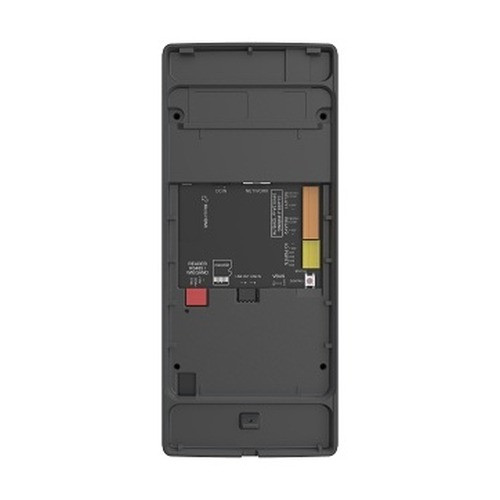
Axis A8207-VE
Video Door Station
The Axis A8207-VE (SKU 02026-001) is a PoE, IP66-rated video door station with an operating temperature range of -40 to 55 °C — making it one of the strongest fits in this group for harsh outdoor environments including northern-climate exteriors, unheated parking structures, and loading-dock entrances where temperature extremes and high-pressure hose-down cleaning are routine. Its Axis pedigree means it integrates with Axis Camera Station and AXIS A1001 door controllers, as well as third-party VMS platforms that support AXIS VAPIX or ONVIF.
View product →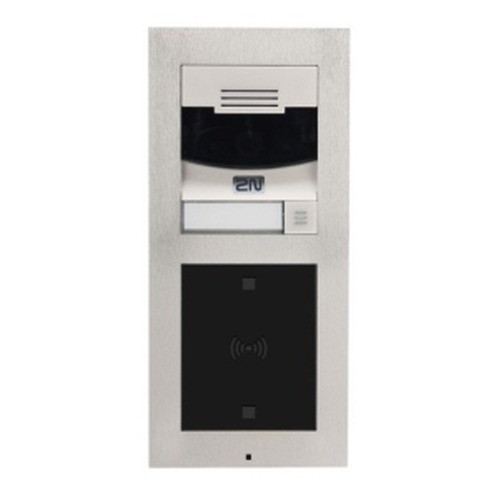
2N 01273-001
Video Door Station
The 2N 01273-001 is an IP54-rated PoE IP intercom main unit — well-suited for office building entrances where the door station will be mounted in a recessed or covered position and the priority is deep access-control integration. 2N's IP intercom platform is widely recognized for broad SIP compatibility and direct integration with major access-control systems, making it a strong fit for multi-tenant offices or campuses that need flexible call routing, directory management, and third-party door-controller connectivity rather than a closed single-brand ecosystem.
View product →Frequently Asked Questions
Do video intercoms require a dedicated server or can they run on existing IT infrastructure?
Most modern IP video intercoms — including all units listed here — are PoE network devices that operate on standard Ethernet infrastructure without requiring a dedicated server for basic door-station-to-master-station calls. However, multi-tenant deployments, call logging, remote access, and access-control integration typically require either the manufacturer's software platform (often server-hosted) or a SIP PBX. Confirm with your IT team whether the platform runs on-premise, in the cloud, or as a hybrid before specifying.
What is the difference between SIP-based intercoms and proprietary-protocol intercoms?
SIP (Session Initiation Protocol) intercoms call any SIP endpoint — a software phone, a UC platform like Teams or 3CX, or a VoIP desk phone — giving you maximum flexibility in how and where calls are answered. Proprietary-protocol systems (common in closed ecosystems like Aiphone IX) require same-brand master stations or licensed apps but typically offer simpler out-of-box setup, tighter feature integration, and a single support path. For offices with existing SIP infrastructure, an open SIP door station may reduce costs; for greenfield installs prioritizing simplicity, a matched proprietary ecosystem often deploys faster.
What PoE standard do commercial video door stations require?
Standard PoE (802.3af) delivers up to 15.4 W per port and is sufficient for many door stations at moderate temperatures. However, units with built-in heaters for cold-weather operation, high-brightness displays, integrated card readers, or IR illuminators can exceed this and require PoE+ (802.3at, up to 30 W) or PoE++ (802.3bt) ports. Always check the specific unit's maximum power draw in the datasheet and verify your switch's per-port wattage budget — a switch rated at 370 W total across 24 ports may only deliver 15.4 W per port under full load.
Can a video intercom integrate with an existing access-control system like Lenel, Software House, or Genetec?
Yes, but the integration depth varies by product and platform. Some intercoms provide a dry-contact relay output that triggers any electric strike or mag-lock directly, regardless of what access-control system controls other doors — this is the most universal but least feature-rich path. Others support OSDP or Wiegand for reader-level integration, and some (particularly 2N) have certified integrations with major access-control platforms that enable unified event logging, cardholder directory sync, and video-verified access. Identify your ACS platform and required feature depth before selecting a door station.
What IP rating do I actually need for an exterior office building entrance?
IP54 is the minimum for light weather exposure (splashing rain, dust) under a canopy. For fully exposed facades with driven rain, specify IP65 or IP66 — the difference is directional vs. high-pressure jet resistance. If the station will be recessed into a grade-level pedestal, subject to flooding, or installed where pressure washing is routine, IP67 or IP68 is appropriate. Overpaying for IP68 on a sheltered lobby entrance is unnecessary; underpaying on an exposed parking-garage column will result in premature failure and warranty disputes.
How do we handle video intercom calls when reception is unmanned after hours?
This is a routing and platform question, not a hardware question — the door station itself is indifferent to who answers. SIP-based systems can forward after-hours calls to a mobile softphone, a security monitoring center, or a call queue on your PBX, just like an office phone. Proprietary systems often have companion mobile apps (Aiphone IX supports mobile answering, for example) or can integrate with a monitoring service via SIP. Define your after-hours coverage model first, then confirm the intercom platform supports the routing logic you need — this is frequently overlooked during spec and discovered at go-live.
Related Resources
- Intercom comparisons — head-to-head spec matchups
- Video Intercom & Door Station Buying Guide
- Best Video Intercoms for Apartment & Multi-Tenant Entry
- Best IP Intercoms for Gated Communities
- All product comparisons
Speccing this for a project?
Send us your requirements and our senior specialists will confirm specs, compatibility, availability and pricing — free, usually within one business day. Channel-direct, factory-new, serving commercial integrators since 2014.
Get a Free QuoteComparing for a project?
Send us the models you are weighing and our team will confirm specs, compatibility, availability, and pricing — free, usually within one business day.