
Brother TD4410D vs Sato WWCT04241-WCN: Specification Comparison
Both the Brother TD4410D and the Sato CT4-LX (WWCT04241-WCN) are direct thermal desktop label printers targeting barcode, tag, and receipt applications in warehouse, logistics, retail, and healthcare environments. They share a 4-inch-class print width and identical rated print speeds, making them genuine cross-shop candidates for organizations evaluating a desktop thermal label printer. Key differentiators span print resolution, connectivity breadth, RFID capability, memory, and print method flexibility — dimensions that strongly influence fit depending on the deployment's technical and operational requirements.
In This Guide
- Which printer delivers the resolution, speed, and print-method flexibility your label runs actually require?
- Does either printer support the connectivity and RFID encoding your infrastructure demands?
- Which unit has the memory, media handling, and ecosystem depth to scale with your label library and operational footprint?
- Which should you choose: the TD4410D or the WWCT04241-WCN?
- Side-by-Side Specs
- FAQ
Which printer delivers the resolution, speed, and print-method flexibility your label runs actually require?
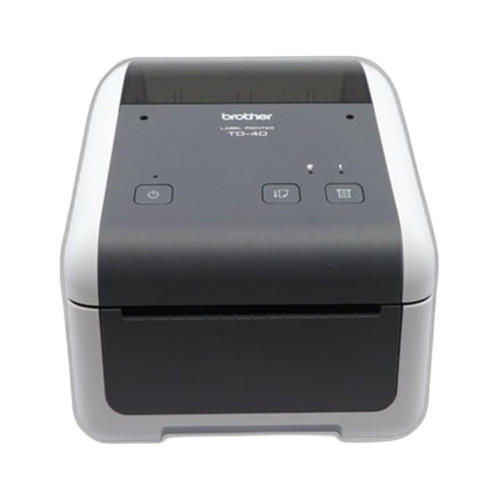
The Brother TD4410D prints at 203 dpi and 8 ips using direct thermal only. At 203 dpi it comfortably handles standard 1D barcodes, GS1 codes, and human-readable text at volume, but falls short of the finer detail needed for dense 2D codes or small-font compliance labels. Its direct-thermal-only design eliminates ribbon cost and consumable management, making it attractive for short-lifespan labels such as receipts, shipping labels, and wristbands.
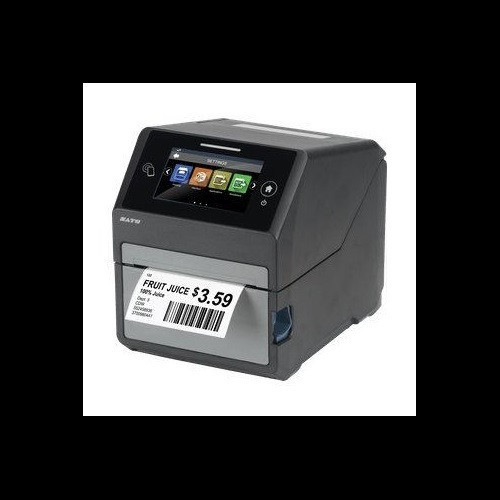
The Sato CT4-LX (WWCT04241-WCN) lists 305 dpi in its datasheet and product description fields, while a separate structured spec field records 203 dpi — a conflict in the provided data that cannot be resolved without manufacturer confirmation. The datasheet-sourced figure is 305 dpi. It supports both direct thermal and thermal transfer print methods, meaning it can produce longer-lasting, heat- and chemical-resistant output when a ribbon is loaded. Print speed is stated as 8 ips in one structured field and 6 ips in the datasheet summary; buyers should verify the authoritative figure with Sato before specifying for high-throughput lines.
Does either printer support the connectivity and RFID encoding your infrastructure demands?
The TD4410D ships with USB 2.0 and a 9-pin serial port. Serial connectivity is a direct asset for integration with legacy POS terminals, WMS controllers, and industrial PLCs that lack USB host ports. No wireless interfaces are specified. There is no RFID capability. Programming language support — ZPL II, CPCL, Raster Graphics, and ESC/P — is broad, enabling drop-in replacement in mixed Zebra and legacy label ecosystems without reprinting label templates.
The Sato CT4-LX provides USB, Ethernet, Wi-Fi, and Bluetooth connectivity, and the datasheet also references NFC. This makes it suitable for networked environments, shared print queues, and mobile device integration without requiring a dedicated wired drop at each station. Critically, it integrates a UHF RFID encoder operating at 860–960 MHz per EPC Class 1 Gen 2 — a capability entirely absent from the TD4410D. For operations requiring simultaneous label printing and RFID inlay encoding (asset tracking, pharmaceutical serialization, retail EAS), the CT4-LX is the only option of the two. Programming language compatibility for the CT4-LX is not provided in the available specifications.
Which unit has the memory, media handling, and ecosystem depth to scale with your label library and operational footprint?
The TD4410D carries 64 MB Flash (with 40 MB available for templates and databases) and 256 MB SDRAM. Media width spans 0.75 inches to 4.65 inches, covering a wide range of label stock. Print width is 4.27 inches. Supported media types include labels, tags, wristbands, and receipts. At 4.58 lbs and 7.08" × 8.82" × 6.10", it is a compact desktop unit. Warranty terms are described only as "Manufacturer Warranty" — duration is not specified in the provided data.
The CT4-LX carries 4 GB Flash, 1 GB DDR3 RAM, and 2 GB user storage — far exceeding the TD4410D's memory, which matters for large stored label libraries, firmware, and RFID encoding tables. Media width runs from 1 inch to 4.1 inches maximum, and roll diameter up to 5 inches. Thermal transfer ribbon capacity is rated at 984 feet. The unit includes a 4.3-inch full-color touchscreen display, enabling on-device menu navigation and job management without a host PC. It weighs 7.3 lbs. A 1-year warranty is explicitly stated. Operating temperature range is documented at 32°F–104°F (0°C–40°C); no equivalent range is provided for the TD4410D.
Which should you choose: the TD4410D or the WWCT04241-WCN?
Our take: The TD4410D is the stronger choice when the deployment requires legacy serial integration, a broad programming-language footprint (ZPL II, CPCL, ESC/P), and a lightweight, low-consumable direct-thermal solution for receipts, wristbands, or short-lifespan labels. The CT4-LX (WWCT04241-WCN) is the clear choice whenever UHF RFID encoding is required — the TD4410D has no RFID capability whatsoever. The CT4-LX also adds Ethernet, Wi-Fi, and Bluetooth versus the TD4410D's USB-and-serial-only connectivity, and carries dramatically more memory (4 GB Flash / 1 GB DDR3 vs. 64 MB Flash / 256 MB SDRAM), supporting larger label libraries and complex RFID encoding tables. Note that the CT4-LX's resolution and print speed carry conflicting values across its spec fields (305 vs. 203 dpi; 8 vs. 6 ips) — verify with Sato before committing to a high-resolution or high-throughput specification. For networked, RFID-enabled, or high-memory environments, specify the CT4-LX; for cost-sensitive, legacy-integrated, or receipt-heavy deployments, the TD4410D fits cleanly.
Side-by-Side Comparison
Spec-for-spec, from manufacturer data.
| Specification | Brother TD4410D | Sato WWCT04241-WCN |
|---|---|---|
| Product Class | Direct Thermal Desktop Label Printer | Direct Thermal / Thermal Transfer Desktop Label Printer |
| Print Method | Direct Thermal only | Direct Thermal and Thermal Transfer |
| Print Resolution | 203 dpi | 305 dpi (datasheet); 203 dpi (structured field) — conflict, verify with Sato |
| Print Speed | 8 ips | 8 ips (structured field); 6 ips (datasheet) — conflict, verify with Sato |
| Max Print Width | 4.27" | 4.09" |
| Media Width Range | 0.75" – 4.65" | 1.0" – 4.1" |
| Max Media Roll Diameter | — | 5" |
| Connectivity | USB 2.0, Serial (9-pin) | USB, Ethernet, Wi-Fi, Bluetooth (NFC per datasheet) |
| RFID Encoding | None | UHF 860–960 MHz, EPC Class 1 Gen 2 |
| Flash Memory | 64 MB (40 MB template/DB) | 4 GB Flash + 2 GB user storage |
| RAM | 256 MB SDRAM | 1 GB DDR3 |
| Display | Not specified | 4.3" full-color touchscreen |
| Programming Languages | ZPL II, CPCL, Raster Graphics, ESC/P | Not specified |
| Weight | 4.58 lbs | 7.3 lbs |
| Dimensions (W × D × H) | 7.08" × 8.82" × 6.10" | 7.0" × 9.375" × 8.4375" |
| Warranty | Manufacturer Warranty (duration not specified) | 1 year |
Frequently Asked Questions
Which should you choose: the TD4410D or the WWCT04241-WCN?
The TD4410D is the stronger choice when the deployment requires legacy serial integration, a broad programming-language footprint (ZPL II, CPCL, ESC/P), and a lightweight, low-consumable direct-thermal solution for receipts, wristbands, or short-lifespan labels. The CT4-LX (WWCT04241-WCN) is the clear choice whenever UHF RFID encoding is required — the TD4410D has no RFID capability whatsoever. The CT4-LX also adds Ethernet, Wi-Fi, and Bluetooth versus the TD4410D's USB-and-serial-only connectivity, and carries dramatically more memory (4 GB Flash / 1 GB DDR3 vs. 64 MB Flash / 256 MB SDRAM), supporting larger label libraries and complex RFID encoding tables. Note that the CT4-LX's resolution and print speed carry conflicting values across its spec fields (305 vs. 203 dpi; 8 vs. 6 ips) — verify with Sato before committing to a high-resolution or high-throughput specification. For networked, RFID-enabled, or high-memory environments, specify the CT4-LX; for cost-sensitive, legacy-integrated, or receipt-heavy deployments, the TD4410D fits cleanly.
Can either printer encode RFID tags at the same time it prints a label?
Only the Sato CT4-LX (WWCT04241-WCN) supports simultaneous label printing and RFID encoding. It integrates a UHF encoder operating at 860–960 MHz per EPC Class 1 Gen 2. The Brother TD4410D has no RFID capability specified and cannot encode RFID inlays.
Which printer works better in a warehouse that still runs serial-port WMS terminals?
The Brother TD4410D includes a 9-pin serial port alongside USB 2.0, making it directly compatible with legacy WMS and POS controllers that use RS-232. The Sato CT4-LX specifies USB, Ethernet, Wi-Fi, and Bluetooth — no serial interface is listed in the provided specifications, which would likely require a serial-to-USB adapter or middleware for legacy serial integration.
Is the TD4410D or the WWCT04241-WCN better suited for a networked multi-station print environment?
The Sato CT4-LX (WWCT04241-WCN) is better suited for networked deployments. It provides Ethernet and Wi-Fi connectivity, enabling placement on a shared print network without a dedicated host PC at each station. The TD4410D offers only USB and serial interfaces — no wired or wireless network connectivity is specified — so each unit must be tethered directly to a host computer.
More Label Printer Comparisons
- Brother TD4550DNWB vs Sato WWCT04241-WCN
- Brother TD4550DNWB vs Sato WWCT04241-NDR
- Brother TD4550DNWB vs Sato WT212-404CW-EX1-2
- Brother TD4550DNWB vs Sato WWCT04441-WDR
- Brother TD4550DNWB vs Brother TD4420DNC
- Brother TD4550DNWB vs Brother TD4410D
Label Printer Buying Guides
Get a Second Opinion on Your Camera Choice
Share your site layout, coverage goals, and budget. Our team will validate the camera selection, flag anything we would change, and recommend products that match the use case.