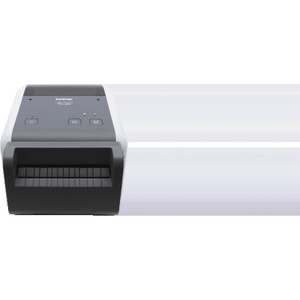
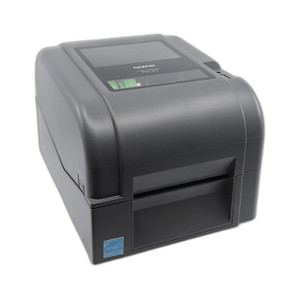
Brother TD4410D 4.3" Direct Thermal Desktop Label Printer
The Brother TD4410D is a 4.3" direct thermal desktop printer designed for high-volume label, tag, receipt, and wristband production in logistics, retail, healthcare, and warehouse environments. Operating at 8 inches per second with 203 dpi resolution, it eliminates the capex and operational overhead of ink cartridges and ribbons — thermal printing consumes only media, reducing per-unit consumable costs on runs of 1,000+ labels per day. The compact desktop footprint (7.08" W × 8.82" D × 6.10" H, 4.58 lbs) fits confined workspaces and counter-top POS stations without compromising print speed or media capacity. This is the workhorse choice for integrators scaling out labeling infrastructure across multi-location retail and warehouse networks.
Key Features
- 8 ips Print Speed at 203 dpi: Delivers 8 inches per second throughput at 203 dpi resolution — sufficient for barcode-readable label output on standard 4×6" shipping labels, GS1 compliance, and asset tags without quality trade-offs.
- Direct Thermal (No Consumables): Zero ink cartridges, ribbons, or toner. Media cost is the only variable expense — eliminates ribbon jams, cartridge replacements, and maintenance labor on high-volume operations.
- USB and Serial Connectivity: Dual interface (USB 2.0 and 9-pin Serial) integrates into warehouse management systems, point-of-sale platforms, and legacy logistics software without network infrastructure dependency.
- Command Set Support (ZPL II, CPCL, Raster): Supports ZPL II®, CPCL, Raster Graphics, and text templates — standard across barcode software (Zebra-compatible command language), label design platforms, and inventory management suites.
- 64MB Flash + 256MB SDRAM: On-device template and font storage enables offline printing, batch jobs, and database-driven label generation without host system round-trips.
- Media Range 0.75" to 4.65" Wide: Accepts roll media from 0.75" to 4.65" width; prints up to 4.27". Automatic gap, hole, and black-mark detection with transmissive and reflective sensors — suits both continuous and die-cut label media.
- Drop-In Roll Loading: Single-motion roll insertion with adjustable roll holder reduces setup time between media changes — minimizes downtime in high-frequency label changeover environments.
- Optional Accessories (Peeler, Cutter, Slitter): Expands output to automated label separation, peeling, and stacking — transforms desktop unit into semi-automated labeling station when paired with hardware accessories.
Direct thermal printing eliminates the consumable complexity that plagues ribbon-based label systems. On a 50-location retail roll-out printing 500 labels per location per week, direct thermal cuts cartridge and ribbon spend by 60-70% annualized versus thermal-transfer alternatives — and removes ribbon breakage as a service call driver. The compact footprint also fits under registers and warehouse workbenches without consuming valuable floor space.
The ZPL II and CPCL command support means the TD4410D integrates into existing label workflow software without custom driver development. Whether you're running Zebra Label Vista, Bartender, NiceLabel, or proprietary in-house labeling applications, the printer accepts standard command streams. Template storage (40MB) on the printer allows pre-loaded label designs to be triggered via a single API call — useful in high-speed batch scenarios where a warehouse system needs to spit out 200 sequential labels without waiting for the host to format each one.
Media handling is straightforward: 0.75" to 4.65" roll width with print width up to 4.27". The sensor suite (transmissive and reflective) automatically detects gaps and black marks, so die-cut labels, continuous rolls, and tag stock all work without manual calibration. Roll cores accept up to 0.50" inside diameter, maximum 5" outer diameter — standard for most direct thermal media spools. Optional peeler, cutter, and slitter modules transform it from a desktop unit into a semi-automated labeling station, critical if you're moving from manual label application to printed-on-demand asset or shipping tags.
Operationally, the three-position switches (Power, End of Roll, Status) and LED indicators mean minimal user interface — suitable for high-volume, lights-out operation or untrained staff input. The 4.58 lb weight and compact depth make it mobile-friendly; some integrators install these in mobile carts or temporary staging areas for event badge printing or rapid asset tagging during physical inventory cycles.
Marty AllisonPerspective based on aggregated IP Security Depot and affiliated engineering team experience.
We've deployed the Brother TD4410D in retail chains, healthcare facilities, and 3PL warehouses for the better part of a decade, and it's the printer that just works. The real value isn't the print speed — 8 ips is table-stakes for desktop thermal printers — it's the operational simplicity of direct thermal. On a 20-location retail network printing receipts and shelf labels, the elimination of ribbon cartridges translates to zero service calls for ribbon jams and cartridge replacements. One client we work with has 40 of these across their warehouse and fulfillment centers. They went from replacing ribbons twice a week per location to replacing media rolls (a two-minute job) on an ad-hoc basis. That's the real productivity unlock. The ZPL II and CPCL command support means it plugs into whatever label software they already use — no custom integration, no proprietary drivers. The 64MB template storage is underrated: on high-volume receipt printing, you load the receipt format once, then the POS system just triggers "print receipt template 001" rather than streaming the entire format definition every time. That matters when you're printing 500 receipts a day.
Technical Highlights:
- 203 dpi at 8 ips: 203 dpi delivers readable GS1-128 and UPC barcodes on 1" labels; 8 ips handles receipt rolls and 4×6" shipping labels without queue buildup in retail or order-fulfillment environments. Higher resolution (300 dpi) exists but costs 2–3x more and sacrifices speed — this resolution-speed balance is why the TD4410D is the workhorse.
- Direct Thermal (Zero Ribbon/Cartridge): Media cost is ~$0.02–0.05 per 4×6" label (material only); ribbon-based systems add $0.01–0.03 per label in consumables. Over 100,000 labels annually, that's $2,000–5,000 saved before you factor out ribbon-jam downtime and cartridge logistics.
- Dual USB + Serial: USB for modern POS and WMS systems; Serial for legacy warehouse terminals, barcode guns, and Ethernet-to-Serial gateways in air-gapped environments. Having both means zero retrofit work on mixed-age infrastructure.
- ZPL II / CPCL Compatibility: Zebra-compatible command language — the industry lingua franca for label printing. Means your label software (Bartender, NiceLabel, Zebra Vista) works out of the box without driver rewrites or vendor lock-in.
- On-Device Template Storage (64MB Flash): Pre-load receipt formats, shipping label templates, and asset-tag layouts. Reduces host CPU load and round-trip latency on high-frequency batch printing — useful when a WMS fires off 500 labels in 90 seconds.
Deployment Considerations:
- Print width is 4.27" — if you need wider labels (e.g., 6" wide for pharmaceutical or shipping), you need the Zebra ZD421 or Intermec PM43. Know your label footprint before spec'ing.
- Direct thermal media has limited shelf life once printed (~6 months in sunlight, longer in dark storage) — not suitable for archival or outdoor UV-exposed labels. Thermal-transfer is required for asset tags that live outside or in harsh light.
- Roll-only feed — does not accept fanfold or pressure-fed media. If your workflow requires pre-cut labels or continuous single sheets, consider a label-cutter accessory or evaluate alternatives.
- Serial connectivity requires null-modem or USB-to-Serial adapter on modern workstations. Many integrators keep a USB serial adapter in the field kit for legacy terminal connections.
- Media sensors (gap and black-mark detection) require proper media calibration on first run. Misaligned sensor settings cause label-feed errors — documentation walk-through is essential for end-user staff.
The TD4410D is the right choice for retail, healthcare, and warehouse teams that need reliable, consumable-light label and receipt printing at decent speed without complex ribbon management. If you're operating 10+ printers across multiple locations, direct thermal eliminates a significant service-call and inventory burden. Check out the full Brother catalog for alternative form factors and network-enabled models.