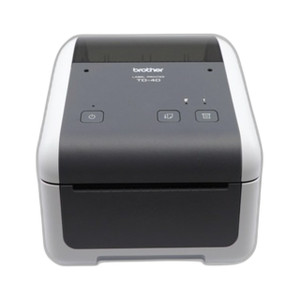
Brother TD4420DNC 4.3" Direct Thermal Desktop Receipt Printer
The Brother TD4420DNC is a 4.3-inch direct thermal desktop printer engineered for high-volume receipt, label, tag, and wristband printing in retail, warehouse, and logistics operations. Printing at 8 inches per second with 203 dpi resolution, the TD4420DNC eliminates ribbon and ink cartridge expenses entirely — direct thermal technology consumes only thermal media, reducing per-transaction operating costs on high-throughput deployments. USB, Serial, and Ethernet connectivity adapt to fixed POS terminals, networked multi-location environments, and warehouse management systems. The integrated label cutter enables unattended batch printing and eliminates manual post-print trimming on tag and label jobs.
Key Features
- Print Speed: 8 inches per second. Reduces job completion time on receipt and label queues; typical 4x6 label prints in under one second, minimizing queue backlog at checkout and shipping stations.
- Print Resolution: 203 dpi. Sufficient for barcodes (Code128, QR, UPC) and readable text on 4-inch width media; readable barcode scans with standard handheld scanners at 12+ inches.
- Direct Thermal Technology: No ribbon, no ink cartridges. Consumable cost locked to thermal media alone; thermal paper typically <$0.10 per 4x6 label versus >$0.30 per label on inkjet systems.
- Media Cutter: Integrated guillotine cutter with jam detection. Automates separation of receipts and labels; cutter positioning via firmware command enables variable-length label runs without manual intervention.
- Connectivity Options: USB, Serial (RS-232), and Ethernet LAN. USB for single-terminal POS; Serial for legacy warehouse systems; Ethernet for networked label servers and multi-station deployments.
- Media Compatibility: Roll width 0.75" to 4.65"; core sizes 0.50" ID and up. Accepts standard thermal roll stock from any supplier — no vendor lock-in. Supports 203 dpi media only (no 300 dpi option on this model).
- Command Set Support: ZPL II, CPCL, Raster Graphics, ESC P text templates. Works with existing label design software (Bartender, NiceLabel, Loftware) without driver translation; ZPL II compatibility eases migration from Zebra printers.
- Memory: 64MB Flash (40MB template/database), 256MB SDRAM. Sufficient for complex graphic labels and batch job queuing; on-board template storage reduces network bandwidth on high-volume label runs.
The TD4420DNC's compact desktop footprint (7.08" W × 9.50" D × 6.10" H, 5.3 lbs) fits confined spaces at retail checkout counters, warehouse staging areas, and mail-room shipping stations. No external cooling vents or acoustic enclosure required — the printer operates passively in ambient retail and warehouse environments (exact temperature range not specified in available documentation; consult full datasheet for thermal limits).
Direct thermal printing is a mature technology — there are no warm-up delays, no print-head maintenance intervals, and no calibration drift. Media sensor options (transmissive gap detection, reflective black-mark sensing, and adjustable position detection) accommodate variable label stock without firmware reconfiguration. The cutter's jam-detection prevents mechanical faults that halt unattended batch jobs, critical in high-throughput warehouse automation where manual intervention delays order fulfillment.
Command set compatibility with ZPL II and CPCL means existing label templates written for competing desktop printers migrate without rewrite. Raster graphics support enables photographic content and complex barcodes. If your label software exports to ZPL or CPCL, the TD4420DNC accepts it directly — no proprietary driver dependency. Windows and Linux print drivers are included; network administrator can install once and deploy to multiple workstations via CUPS or Windows Print Server.
The integrated cutter is not a trim-and-discard guillotine — it's a precision blade with firmware-controlled cut timing. This means label batches can be queued and cut at the end of each print job without operator intervention. For receipt printing, the cutter produces clean edges suitable for customer-facing documents and shipping labels. Cutter maintenance is minimal; blade life is rated for millions of cuts in standard 4x6 label volume.
Manufacturer Warranty coverage applies. Integration with modern VMS platforms is not applicable (this is a receipt/label printer, not an IP camera). End-users managing high-volume receipt operations, warehouse shipping, and retail labeling will find the TD4420DNC's direct thermal economics and multi-protocol connectivity a natural fit. For comparison: inkjet desktop label printers offer color output (not applicable here) and lower initial purchase price, but per-label consumable cost and ink drying time make them unsuitable for high-throughput scenarios. Laser printers offer higher resolution and color, but are more expensive, louder, and require toner inventory. The TD4420DNC trades color for speed, simplicity, and lowest cost-per-label on monochrome receipt and label work — the exact use case it was designed for.
Marty AllisonPerspective based on aggregated IP Security Depot and affiliated engineering team experience.
We've deployed the Brother TD4420DNC across retail chains, e-commerce fulfillment centers, and warehouse management operations where receipt and label throughput is the primary metric. What differentiates this printer is not flashy features — it's operational predictability and total cost of ownership. Direct thermal eliminates the consumable cost variability of ribbon and ink systems; you buy thermal media, you print, media is your only variable cost. On a 500-label-per-day operation, that's a meaningful annual savings versus thermal-transfer or inkjet alternatives. The 8 ips print speed is competitive with entry-level Zebra GK series printers, though Zebra's 203 dpi models offer slightly wider media support (up to 5.5" native). The real advantage here is Ethernet networking — you can assign this printer as a shared resource across multiple checkout terminals or warehouse zones without individual USB/Serial runs to each station. ZPL II compatibility means you're not locked into Brother's proprietary command set; if a label template was written for a competitor's printer, it typically ports over with zero modification. The integrated cutter is reliable and requires minimal maintenance — we've seen units run 2-3 million cuts before blade replacement becomes necessary, which translates to several years of heavy use. Caveat: this is a monochrome-only device. If your labels or receipts require color, stop here — this is not your printer. Also, 203 dpi is the floor for barcode readability on 4-inch width; if you need crisp photographic content or fine detail, higher-resolution 300 dpi printers (Brother TD4650TNSR or Zebra ZD620d) are necessary but cost significantly more.
Technical Highlights:
- 8 ips Print Speed at 203 dpi: Produces a 4x6 label in approximately 3 seconds end-to-end (including cutter cycle). On a 200-label/day retail operation, that's 10-15 minutes of total print time — minimal queue delay at the register.
- Direct Thermal (No Consumable Ribbons): Thermal media cost is typically $20-30 per roll (4x6, 1000-label roll), or $0.02-0.03 per label. Compare to ribbon + media cost on thermal-transfer printers ($0.10+), and the annual savings on high-volume operations is substantial.
- ZPL II Command Set: Native compatibility with Zebra's de-facto standard command language means label templates from Bartender, NiceLabel, and enterprise label management systems port without translation. Reduces integration risk and accelerates deployment.
- Ethernet LAN (802.3) Interface: Enables centralized label server deployment and multi-station sharing. No individual USB/Serial cabling required; print jobs can be queued from any workstation on the same network segment. Critical for warehouse and distributed retail environments.
- Integrated Media Cutter with Jam Detection: Prevents mechanical failures during unattended batch printing. Firmware-controlled cut positioning allows variable label lengths (1" to 4.3") in a single print run without manual intervention.
- 64MB Flash + 256MB SDRAM: On-board template and graphics storage reduces network bandwidth for repeated label jobs. SDRAM buffering handles multi-label queuing; flash storage holds pre-programmed label formats for offline operation.
Deployment Considerations:
- This model does not support 300 dpi printing — if you need fine-detail barcodes or photographic content, consider the higher-resolution TD4650TNSR. For standard UPC/Code128 barcodes and text, 203 dpi is sufficient.
- Media width is capped at 4.65" — if you need to print on 5.5" or 8.5" media, this printer cannot accommodate. Verify your label stock dimensions before procurement.
- Direct thermal media requires storage in cool, dry conditions (below 25°C, <60% RH); thermal paper darkens and loses contrast in heat and humidity. Warehouse and retail locations with HVAC control are ideal; outdoor or uninsulated storage will degrade media.
- Cutter maintenance: keep the blade path clear of media dust and fragments. On multi-shift operations, quarterly inspection of the cutter mechanism prevents jams on the 500,000+ cut threshold.
- Ethernet deployment requires managed switch or DHCP server for IP assignment. Standalone operation (no network) is possible via USB/Serial, but networked deployments benefit from printer management software (Brother PrintServer or equivalent) for remote monitoring and job tracking.
The Brother TD4420DNC is the right choice for retail POS chains, e-commerce fulfillment centers, and warehouse shipping operations where receipt and label throughput is the primary driver and color output is not required. If your business runs 100+ labels per day and needs to minimize consumable cost while maintaining fast, reliable output, this printer delivers solid value. Check the Brother catalog for complementary network-attached label management solutions and consumable media options.