
APC by Schneider Electric SYH6K6RMT vs Vertiv GXT5-6000MVRT4UXLN: Specification Comparison
Both the APC Symmetra RM SYH6K6RMT and the Vertiv GXT5-6000MVRT4UXLN are rack-mountable, online double-conversion UPS systems rated at 6,000 VA, targeting data center, IT closet, and critical infrastructure deployments where continuous power protection is required. This comparison evaluates their power and output characteristics, physical and environmental profiles, and connectivity and management capabilities to help installers and IT buyers select the right unit for their specific load, runtime, and infrastructure requirements.
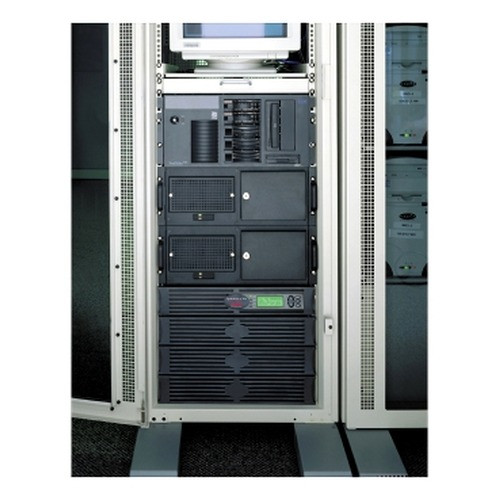
In This Guide
- How do the SYH6K6RMT and GXT5-6000MVRT4UXLN differ in power capacity, output wattage, and efficiency?
- What are the physical footprint, weight, battery architecture, and runtime scalability differences between the two units?
- How do the SYH6K6RMT and GXT5-6000MVRT4UXLN compare on output receptacles, connectivity, and management interfaces?
- Which should you choose: the SYH6K6RMT or the GXT5-6000MVRT4UXLN?
- Side-by-Side Specs
- FAQ
How do the SYH6K6RMT and GXT5-6000MVRT4UXLN differ in power capacity, output wattage, and efficiency?
Both units share a 6,000 VA nameplate rating, but they diverge significantly on real power output. The APC SYH6K6RMT delivers a maximum of 4,200 W (0.70 power factor), while the Vertiv GXT5-6000MVRT4UXLN is rated at 6,000 W (1.00 power factor). For watt-dense modern loads — servers with high-PF PSUs — this is a material difference: the Vertiv can carry 1,800 W more actual load than the APC at the same VA rating.
Efficiency also separates the two. The SYH6K6RMT is rated at 89% efficiency at full load. The GXT5-6000MVRT4UXLN reaches up to 95% in on-line double-conversion mode and up to 98% in Active ECO Mode. The APC carries an ENERGY STAR certification status not listed in its provided specs; the Vertiv is explicitly ENERGY STAR 2.0 certified. For facilities with energy cost sensitivity or green procurement mandates, the Vertiv's efficiency advantage is concrete and spec-verified.
Input voltage for both is 208 VAC nominal. The Vertiv specifies an input range of 176–280 VAC, indicating tolerance for line voltage sag and swell; no equivalent input range window is stated in the APC specs. Output voltage on the SYH6K6RMT is 208 V (configurable to 240 V nominal per the spec); the GXT5-6000MVRT4UXLN provides 208/120 VAC user-configurable output, which natively supports mixed 208 V and 120 V loads without step-down transformers or PDUs.
What are the physical footprint, weight, battery architecture, and runtime scalability differences between the two units?
The SYH6K6RMT occupies 8U of rack space and weighs 294.63 lb (133.64 kg) as configured. The Vertiv GXT5-6000MVRT4UXLN is 6.8 in tall (approximately 4U in a rack-tower convertible form factor) and weighs 125.6 lb. The APC unit is nearly 2.4 times heavier, a critical consideration for floor-load limits, rack weight budgets, and installation labor.
The APC uses a modular internal lead-acid battery architecture: 3 battery modules are pre-installed, with 0 empty battery slots remaining and a typical recharge time of 4 hours. The replacement battery is the SYBT2. Battery life is specified at 3–5 years. The SYH6K6RMT is also described as scalable with 2 kVA power increments (4 power module slots, 3 filled, 1 free), and supports extendable run time. The Vertiv specs provided do not detail internal battery module count, battery chemistry, recharge time, or battery life — those figures are not available in the supplied spec data.
The Vertiv supports an external battery connector, which implies runtime extension capability, but no runtime figures, battery module specs, or EBC model numbers are provided in the submitted specs. Buyers requiring verified runtime numbers for the Vertiv should consult the manufacturer's datasheet directly.
How do the SYH6K6RMT and GXT5-6000MVRT4UXLN compare on output receptacles, connectivity, and management interfaces?
Output connections differ substantially. The SYH6K6RMT provides (2) NEMA L6-20R and (1) NEMA L6-30R receptacles, with a NEMA L6-30P input plug on a 10 ft (3.05 m) cord. The Vertiv GXT5-6000MVRT4UXLN is hardwired in and out, with optional PODs (power output distribution modules) available; no receptacle types are listed in the provided specs. For installations requiring direct plug-in connections without additional PDUs, the APC's discrete receptacle set may simplify deployment; for higher-current or custom distribution needs, the Vertiv's hardwired architecture with optional PODs may be preferred.
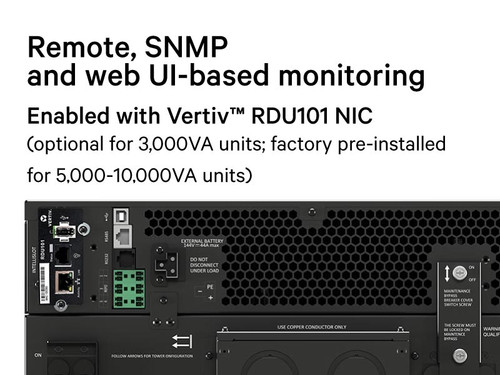
Management connectivity also favors the Vertiv in breadth. The GXT5-6000MVRT4UXLN comes factory pre-installed with a Vertiv RDU101 SNMP/Webcard and offers USB, RS485, RS232, a terminal block, and an external battery connector. SNMP and web management are enabled out of the box, with serial support for out-of-band management. The SYH6K6RMT's provided specs list a multi-function LCD status and control console as the control interface; no network management card, SNMP capability, or communication port details are described in the supplied spec data — buyers should verify whether a management card is included or available as an add-on.
The Vertiv carries explicit safety and compliance listings: ENERGY STAR 2.0, UL1778, c-UL, RoHS2, and REACH. The APC's spec sheet does not list certifications in the data provided. Both units feature LCD control panels, though the Vertiv's is described as full-color with gravity-sensing orientation for rack or tower use.
Which should you choose: the SYH6K6RMT or the GXT5-6000MVRT4UXLN?
Our take: The GXT5-6000MVRT4UXLN is the stronger choice when load wattage, energy efficiency, or built-in network management are the primary decision factors. At the same 6,000 VA rating, the Vertiv delivers 6,000 W versus the APC's 4,200 W — a 1,800 W real-power advantage that matters for high-PF server loads. Efficiency reaches up to 95% on-line (vs. 89% for the APC), and the factory-installed RDU101 SNMP/Webcard provides out-of-box remote monitoring without add-on cards. The SYH6K6RMT is the stronger choice when rack weight capacity is constrained, verified battery architecture is required, or discrete NEMA output receptacles are needed without additional PDUs: it weighs 125.6 lb less, includes documented lead-acid battery modules with a 3–5 year life spec and a named replacement unit (SYBT2), and offers plug-in L6-20R and L6-30R outputs. Buyers on mixed-voltage 120/208 V environments benefit from the Vertiv's dual-voltage output; legacy 208 V pure-rack installations may find the APC's simpler architecture sufficient.
Side-by-Side Comparison
Spec-for-spec, from manufacturer data.
| Specification | APC by Schneider Electric SYH6K6RMT | Vertiv GXT5-6000MVRT4UXLN |
|---|---|---|
| VA Rating | 6,000 VA | 6,000 VA |
| Real Power Output (W) | 4,200 W | 6,000 W |
| UPS Topology | Double Conversion Online | On-line double conversion |
| Input Voltage (Nominal) | 208 VAC | 208 VAC |
| Input Voltage Range | — | 176–280 VAC |
| Output Voltage | 208 V (configurable to 240 V) | 208/120 VAC (user-configurable) |
| Output Connections | (2) NEMA L6-20R, (1) NEMA L6-30R | Hardwired; optional PODs |
| Input Connection | NEMA L6-30P, 10 ft cord | Hardwired |
| Efficiency (On-line Mode) | 89% at full load | Up to 95% on-line; up to 98% ECO |
| Waveform | Sine wave | — |
| Rack Height | 8U | ~4U (6.8 in tall, rack/tower convertible) |
| Weight | 294.63 lb (133.64 kg) | 125.6 lb |
| Battery Type | Lead-acid, modular (SYBT2) | — |
| Battery Recharge Time | 4 hours | — |
| Management Interfaces | LCD console (network card not specified) | SNMP/Webcard (RDU101, factory), USB, RS485, RS232, terminal block |
| Certifications | — | ENERGY STAR 2.0, UL1778, c-UL, RoHS2, REACH |
Frequently Asked Questions
Which should you choose: the SYH6K6RMT or the GXT5-6000MVRT4UXLN?
The GXT5-6000MVRT4UXLN is the stronger choice when load wattage, energy efficiency, or built-in network management are the primary decision factors. At the same 6,000 VA rating, the Vertiv delivers 6,000 W versus the APC's 4,200 W — a 1,800 W real-power advantage that matters for high-PF server loads. Efficiency reaches up to 95% on-line (vs. 89% for the APC), and the factory-installed RDU101 SNMP/Webcard provides out-of-box remote monitoring without add-on cards. The SYH6K6RMT is the stronger choice when rack weight capacity is constrained, verified battery architecture is required, or discrete NEMA output receptacles are needed without additional PDUs: it weighs 125.6 lb less, includes documented lead-acid battery modules with a 3–5 year life spec and a named replacement unit (SYBT2), and offers plug-in L6-20R and L6-30R outputs. Buyers on mixed-voltage 120/208 V environments benefit from the Vertiv's dual-voltage output; legacy 208 V pure-rack installations may find the APC's simpler architecture sufficient.
Is the SYH6K6RMT or GXT5-6000MVRT4UXLN better for powering modern high-density servers?
The GXT5-6000MVRT4UXLN is better suited for high-density server loads. Its real power output is rated at 6,000 W at unity power factor, compared to the SYH6K6RMT's 4,200 W maximum. Modern server PSUs typically operate at or near unity power factor, so the Vertiv's full 6 kVA translates directly to usable wattage, while the APC's 4,200 W ceiling limits how much actual load it can carry despite the same VA nameplate.
Which UPS is easier to monitor and manage remotely — the SYH6K6RMT or the GXT5-6000MVRT4UXLN?
The GXT5-6000MVRT4UXLN has a clear advantage for remote management. It ships with a factory pre-installed Vertiv RDU101 SNMP/Webcard and supports USB, RS485, RS232, and web management out of the box — no additional cards or licenses are needed to integrate it into an NMS or BMS. The SYH6K6RMT's provided specs describe only a local LCD control console; whether a network management card is included or available as an option is not stated in the supplied spec data and should be confirmed with the distributor.
Which unit is better if my rack or floor has strict weight limits?
The GXT5-6000MVRT4UXLN is significantly lighter at 125.6 lb versus the SYH6K6RMT's 294.63 lb — a difference of approximately 169 lb. If your rack weight budget, floor load rating, or installation crew constraints are limiting factors, the Vertiv is the practical choice. The APC's greater weight reflects its larger 8U chassis and modular battery array, which provides a documented, field-replaceable battery architecture, but that comes at a significant weight cost.
More UPS Comparisons
- APC by Schneider Electric SYH6K6RMT vs CyberPower OL6KRTHW
- APC by Schneider Electric SYH6K6RMT vs CyberPower OL6KRTHD
- APC by Schneider Electric SYH6K6RMT vs Vertiv GXT5-6KL630RT5UXLN
- APC by Schneider Electric SYH6K6RMT vs APC by Schneider Electric SYH6K6RMI
- APC by Schneider Electric SYH6K6RMT vs APC by Schneider Electric SYH6K6RMT-TF3
- CyberPower OL6KRTHW vs APC by Schneider Electric SYH6K6RMI
UPS Buying Guides
Get a Second Opinion on Your Camera Choice
Share your site layout, coverage goals, and budget. Our team will validate the camera selection, flag anything we would change, and recommend products that match the use case.