
APC by Schneider Electric SYH6K6RMT vs CyberPower OL6KRTHD: Specification Comparison
Both the APC Symmetra RM SYH6K6RMT and the CyberPower OL6KRTHD are rack-mounted, double-conversion online UPS units in the 6 kVA class, targeting data center and IT infrastructure installations that demand zero-transfer-time power protection. The APC is a modular, scalable power-array system aimed at high-availability environments requiring N+1 redundancy, while the CyberPower is a fixed-architecture, power-factor-1 unit emphasizing full watt-for-watt output. Both share sine-wave output and bypass capability, making them legitimate cross-shop candidates for a 6 kVA rack UPS decision.
In This Guide
- How do real-watt output capacity and power factor compare between these two units?
- Which unit offers scalability, redundancy, or runtime extensibility for mission-critical uptime?
- How do physical footprint, input/output connections, and operating environment specs differ?
- Which should you choose: the SYH6K6RMT or the OL6KRTHD?
- Side-by-Side Specs
- FAQ
How do real-watt output capacity and power factor compare between these two units?
The CyberPower OL6KRTHD is rated at 6,000 W with a unity output power factor (PF = 1), meaning the full 6 kVA translates to 6,000 W of usable power for connected loads. The APC SYH6K6RMT is rated at 4,200 W maximum (also listed as Max Configurable Power), representing a 0.70 power factor at full VA load — a meaningful gap of 1,800 W in real watt delivery at full nameplate capacity.
For purely resistive or modern switched-mode power supply loads — which typically present near-unity power factor — the OL6KRTHD delivers 43% more actual wattage from the same 6 kVA rating. Buyers sizing for dense server or GPU compute environments where per-rack wattage is the binding constraint will find this delta significant. The APC's 4,200 W ceiling is spec-stated and not a derating estimate.
On the input side, both units are high-efficiency designs: APC specifies 89% efficiency at full load with an input power factor of 0.98; CyberPower specifies an input power factor of 0.99. APC does not publish an efficiency percentage in the provided specs; CyberPower does not publish one either, so a direct efficiency comparison cannot be made from available data.
Which unit offers scalability, redundancy, or runtime extensibility for mission-critical uptime?
The APC SYH6K6RMT is explicitly architected for N+1 power module redundancy. It ships with 3 of 4 power module slots filled, leaving 1 free slot for a redundant module. Capacity scales in 2 kVA increments (per the 'Product Web Sub-Family' spec), and runtime is extendable — the spec confirms 'Extendable Run Time: 1' (i.e., external battery modules are supported). The replacement battery is the SYBT2; the unit ships with 3 included battery modules.
The CyberPower OL6KRTHD specs provided do not describe power module slots, N+1 redundancy architecture, scalable VA increments, or external battery module compatibility. Runtime extensibility is not confirmed in the available spec data. Buyers requiring a modular-growth or N+1 redundancy design must note this gap in CyberPower's disclosed specifications.
Battery life for the APC is specified at 3–5 years with a 4-hour typical recharge time. CyberPower does not include battery life or recharge time in the provided specs. The APC also provides a 3-year warranty note indirectly in the CyberPower product title ('3YR WTY'), but no formal warranty spec is listed for either unit in the data provided.
How do physical footprint, input/output connections, and operating environment specs differ?
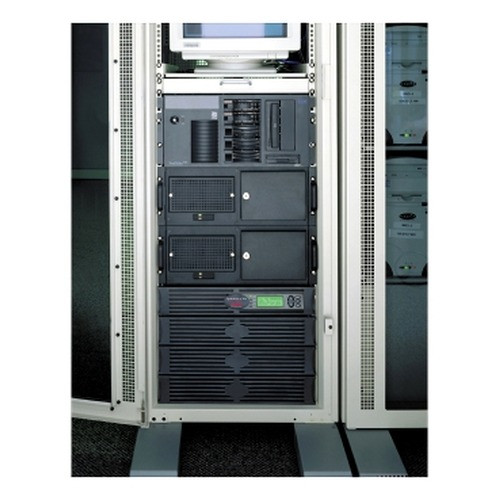
The APC SYH6K6RMT occupies 8U of rack space and weighs 294.63 lb (133.64 kg) — a substantial physical commitment. It connects via a NEMA L6-30P (30A, 208V) input plug on a 10 ft cord and provides (2) NEMA L6-20R plus (1) NEMA L6-30R output receptacles. Input voltage is fixed at 208V nominal (configurable to 240V output per additional information). This unit requires a dedicated 208V circuit; it is not compatible with standard 120V infrastructure.
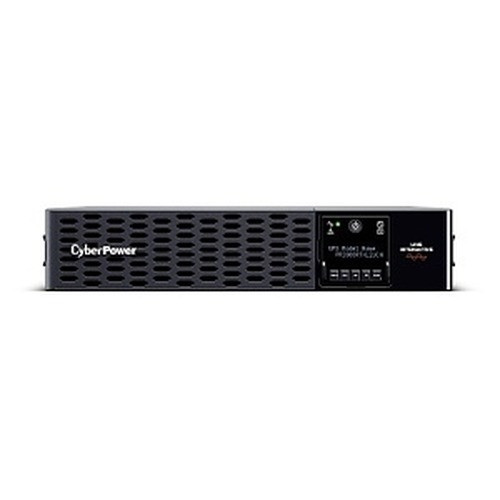
The CyberPower OL6KRTHD accepts an input range of 120–280V and outputs 120–240V, indicating a wide-input design compatible with a broader range of facility voltages and international installations. Its form factor is listed as 2U, dramatically smaller than the APC's 8U — though the CyberPower spec does not include a weight figure for direct comparison. The CyberPower spec does not detail output receptacle types or input connector type.
On environment, the APC specifies an operating altitude to 10,000 ft, storage altitude to 50,000 ft, operating relative humidity 0–95%, acoustic noise of 60 dBA, and heat dissipation of 1,771 Btu/h. The CyberPower lists a noise level of 65 dB; operating altitude, humidity, and heat dissipation are not provided in its spec data. The APC's LCD control panel is specified; the CyberPower's management interface is not detailed in the provided specs beyond noting an 'Rmcard RT' (remote management card) in the product title.
Which should you choose: the SYH6K6RMT or the OL6KRTHD?
Our take: The OL6KRTHD is the stronger choice when maximum real-watt output and installation flexibility across a range of facility voltages are the primary requirements. It delivers 6,000 W at unity power factor versus the SYH6K6RMT's 4,200 W — a 1,800 W advantage — and accepts 120–280V input compared to the APC's fixed 208V-only input, making it more broadly deployable. It also occupies only 2U versus the APC's 8U, preserving rack space. Conversely, the SYH6K6RMT is the stronger choice for environments demanding N+1 power module redundancy, modular VA scalability in 2 kVA steps, and confirmed runtime extensibility via external battery modules — capabilities not disclosed in the CyberPower's provided spec data. The APC is purpose-built for high-availability, growth-oriented deployments on dedicated 208V circuits; the CyberPower targets space-constrained or multi-voltage environments where full watt-for-watt delivery at a fixed 6 kVA is the priority.
Side-by-Side Comparison
Spec-for-spec, from manufacturer data.
| Specification | APC by Schneider Electric SYH6K6RMT | CyberPower OL6KRTHD |
|---|---|---|
| UPS Topology | Double Conversion Online | Double Conversion Online |
| VA Rating | 6,000 VA | 6,000 VA |
| Real-Watt Output | 4,200 W | 6,000 W |
| Output Power Factor | 0.70 (implied) | 1.0 |
| Input Voltage | 208V (fixed) | 120–280V (wide range) |
| Output Voltage | 208V (configurable to 240V) | 120–240V |
| Input Connection | NEMA L6-30P (30A) | — |
| Output Connections | (2) NEMA L6-20R, (1) NEMA L6-30R | — |
| Input Power Factor | 0.98 | 0.99 |
| Efficiency at Full Load | 89% | — |
| Waveform | Sine wave | Sine wave |
| Bypass | Internal (Automatic and Manual) | — |
| Rack Height | 8U | 2U |
| Weight | 294.63 lb (133.64 kg) | — |
| N+1 / Modular Power Slots | Yes — 4 slots, 3 filled, 1 free | — |
| Runtime Extendable | Yes (external battery modules) | — |
| Battery Recharge Time | 4 hours | — |
| Battery Life | 3–5 years | — |
| Noise Level | 60 dBA | 65 dB |
| Heat Dissipation | 1,771 Btu/h | — |
| Operating Altitude | 0–10,000 ft | — |
| THD (Output) | < 5% at full load | 5% |
Frequently Asked Questions
Which should you choose: the SYH6K6RMT or the OL6KRTHD?
The OL6KRTHD is the stronger choice when maximum real-watt output and installation flexibility across a range of facility voltages are the primary requirements. It delivers 6,000 W at unity power factor versus the SYH6K6RMT's 4,200 W — a 1,800 W advantage — and accepts 120–280V input compared to the APC's fixed 208V-only input, making it more broadly deployable. It also occupies only 2U versus the APC's 8U, preserving rack space. Conversely, the SYH6K6RMT is the stronger choice for environments demanding N+1 power module redundancy, modular VA scalability in 2 kVA steps, and confirmed runtime extensibility via external battery modules — capabilities not disclosed in the CyberPower's provided spec data. The APC is purpose-built for high-availability, growth-oriented deployments on dedicated 208V circuits; the CyberPower targets space-constrained or multi-voltage environments where full watt-for-watt delivery at a fixed 6 kVA is the priority.
Which unit delivers more usable power to connected servers — the SYH6K6RMT or the OL6KRTHD?
The OL6KRTHD delivers more usable watts: its unity power factor (PF = 1) means all 6,000 VA translate to 6,000 W of real power. The SYH6K6RMT is spec-rated at a maximum of 4,200 W at its 6,000 VA nameplate, reflecting a 0.70 power factor — a difference of 1,800 W. For watt-limited loads such as dense servers or GPU compute, the OL6KRTHD has a material advantage based on the provided specifications.
Is the SYH6K6RMT or OL6KRTHD better for larger deployments where the power load may grow over time?
The SYH6K6RMT is architecturally designed for growth: it supports N+1 power module redundancy with one free module slot, scales in 2 kVA increments, and confirms runtime extensibility via external battery modules. None of these scalability or redundancy features are disclosed in the OL6KRTHD's provided specifications. For deployments expecting incremental load growth or requiring hot-standby power redundancy, the APC Symmetra RM's modular design is the documented choice.
Can either of these UPS units be installed on a standard 120V facility circuit?
Only the CyberPower OL6KRTHD supports a 120V input, with its spec-stated minimum input voltage of 120V and a maximum of 280V. The APC SYH6K6RMT requires a dedicated 208V input circuit (NEMA L6-30P, 30A) and is not compatible with 120V infrastructure. Facilities without an existing 208V circuit would need to provision one before deploying the APC unit.
More UPS Comparisons
- APC by Schneider Electric SYH6K6RMT vs CyberPower OL6KRTHW
- APC by Schneider Electric SYH6K6RMT vs Vertiv GXT5-6000MVRT4UXLN
- APC by Schneider Electric SYH6K6RMT vs Vertiv GXT5-6KL630RT5UXLN
- APC by Schneider Electric SYH6K6RMT vs APC by Schneider Electric SYH6K6RMI
- APC by Schneider Electric SYH6K6RMT vs APC by Schneider Electric SYH6K6RMT-TF3
- CyberPower OL6KRTHW vs APC by Schneider Electric SYH6K6RMI
UPS Buying Guides
Get a Second Opinion on Your Camera Choice
Share your site layout, coverage goals, and budget. Our team will validate the camera selection, flag anything we would change, and recommend products that match the use case.