
APC by Schneider Electric SYH6K6RMT vs CyberPower OL6KRTHW: Specification Comparison
Both the APC Symmetra RM SYH6K6RMT and CyberPower OL6KRTHW are rack-mounted, double-conversion online UPS units rated at 6 kVA, making them direct cross-shop candidates for data centers, server rooms, and critical infrastructure environments. The comparison covers power architecture and efficiency, battery and runtime scalability, and physical and environmental integration — the three axes that most influence a capital purchase decision at this power tier.
In This Guide
- How do the power architecture and efficiency specs differ between the SYH6K6RMT and OL6KRTHW?
- Which unit offers better battery scalability and runtime flexibility — the SYH6K6RMT or OL6KRTHW?
- How do the two units compare on physical footprint, noise, heat output, and operating environment specs?
- Which should you choose: the SYH6K6RMT or the OL6KRTHW?
- Side-by-Side Specs
- FAQ
How do the power architecture and efficiency specs differ between the SYH6K6RMT and OL6KRTHW?
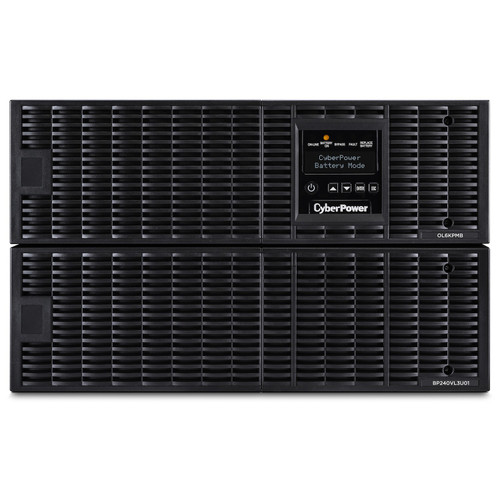
Both units use double-conversion online topology with sine-wave output, eliminating transfer-time risk during utility anomalies. The key divergence is in output real power and power factor. The OL6KRTHW carries a true power factor of 1.0, meaning its 6,000 VA rating translates directly to 6,000 W of usable output — a full kilowatt more than the SYH6K6RMT's 4,200 W at its 0.7 effective output power factor.
Efficiency at full load is specified only for the SYH6K6RMT at 89%. CyberPower does not publish a full-load efficiency figure in the provided specs. Input power factor at full load is 0.98 for the APC unit and 0.99 for the CyberPower unit — effectively equivalent. Harmonic distortion on output is cited as less than 5% for the SYH6K6RMT; the OL6KRTHW lists output voltage THD at 5% — nearly the same threshold. The APC unit specifies a crest factor up to 5:1; the OL6KRTHW specifies 3:1, meaning it is less tolerant of high-peak-to-RMS load profiles such as those produced by some older power supplies.
Input voltage range differs materially: the SYH6K6RMT is designed for a 208 V nominal input (configurable to 208 or 240 V output), while the OL6KRTHW accepts a wide input range of 120–280 V and can deliver 120–240 V output. This makes the OL6KRTHW more flexible in mixed or international voltage environments, whereas the SYH6K6RMT is purpose-built for 208 V three-phase-derived infrastructure common in North American data centers.
Which unit offers better battery scalability and runtime flexibility — the SYH6K6RMT or OL6KRTHW?
The SYH6K6RMT ships with 3 included battery modules (SYBT2 replacement), rated at 458 W battery charge power, with a typical recharge time of 4 hours. Battery life is specified at 3–5 years. The product's Symmetra platform explicitly supports extended run time, and the 'Extendable Run Time' attribute is listed as supported. No external battery module (EBM) compatibility data is provided in the OL6KRTHW's supplied specs, and no recharge time, battery life, or battery module count figures are given for the CyberPower unit.
The SYH6K6RMT's modular Symmetra architecture also includes a redundancy dimension: it ships with 3 of 4 power module slots filled, providing N+1 power module redundancy within the chassis without additional hardware. The OL6KRTHW specs do not reference internal power module redundancy.
For sites where runtime beyond a basic ride-through is a hard requirement — or where N+1 power redundancy within the UPS chassis is mandated — the SYH6K6RMT provides documented, spec-confirmed capabilities. The OL6KRTHW's battery and redundancy characteristics in the provided specifications are largely unspecified and cannot be evaluated on equal terms.
How do the two units compare on physical footprint, noise, heat output, and operating environment specs?
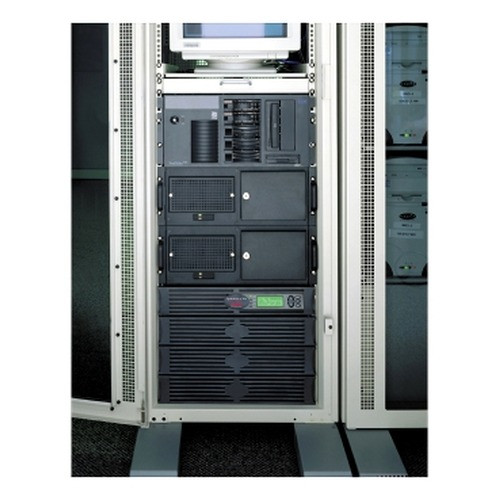
The SYH6K6RMT occupies 8U of rack space and weighs 294.63 lb (133.64 kg) — a substantial physical commitment. It dissipates 1,771 Btu/h and operates at 60 dBA. The OL6KRTHW is rated at 6U and 65 dBA; heat dissipation and weight are not provided in the supplied specs.
The SYH6K6RMT provides detailed environmental tolerances: operating altitude up to 10,000 ft, storage altitude up to 50,000 ft, operating relative humidity 0–95%, storage temperature 5–113 °F (−15 to 45 °C). None of these environmental parameters are specified for the OL6KRTHW in the provided data, making environmental suitability comparisons for edge, high-altitude, or temperature-variable deployments impossible for that unit.
Both units are rack-mountable. The APC unit specifies front-mounting preference, lower rack positioning, and rack-mount mode explicitly. The OL6KRTHW's mounting configuration details are not included in the provided specs. The APC unit includes a multi-function LCD status and control console; no control panel description is given for the OL6KRTHW. The APC unit ships with a 10 ft (3.05 m) input cable; cable details are absent from the OL6KRTHW spec set.
Which should you choose: the SYH6K6RMT or the OL6KRTHW?
Our take: The OL6KRTHW is the stronger choice when maximizing usable real output power from a 6 kVA UPS is the primary requirement: its PF=1 architecture delivers the full 6,000 W versus the SYH6K6RMT's 4,200 W — a 43% real-power advantage — and its 120–280 V wide-input range suits mixed or international voltage environments. The SYH6K6RMT is the stronger choice when platform resilience, documented runtime scalability, and verified environmental specs drive the decision: it ships with N+1 power module redundancy built in (3 of 4 slots filled), supports extended battery run time, specifies a 4-hour recharge cycle and 3–5-year battery life, and documents operating altitude up to 10,000 ft and heat dissipation at 1,771 Btu/h — none of which are addressed in the OL6KRTHW's provided specifications. For 208 V North American data center infrastructure with redundancy and runtime requirements, the SYH6K6RMT's Symmetra modular architecture is the more fully specified and verifiable option.
Side-by-Side Comparison
Spec-for-spec, from manufacturer data.
| Specification | APC by Schneider Electric SYH6K6RMT | CyberPower OL6KRTHW |
|---|---|---|
| UPS Topology | Double-Conversion Online | Double-Conversion Online |
| Rated Capacity (VA) | 6,000 VA | 6,000 VA |
| Rated Real Power (W) | 4,200 W | 6,000 W |
| Output Power Factor | 0.70 (implied) | 1.0 |
| Input Voltage (Nominal) | 208 V | 120–280 V (wide range) |
| Output Voltage | 208 V (configurable 208/240 V) | 120–240 V |
| Input Frequency | 50/60 Hz ±5 Hz auto-sensing | 40–70 Hz |
| Input Power Factor | 0.98 | 0.99 |
| Waveform | Sine wave | Sine wave |
| Output Voltage THD | < 5% at full load | 5% |
| Crest Factor | Up to 5:1 | 3:1 |
| Efficiency (Full Load) | 89% | — |
| Rack Units | 8U | 6U |
| Weight | 294.63 lb (133.64 kg) | — |
| Noise Level | 60 dBA | 65 dBA |
| Heat Dissipation | 1,771 Btu/h | — |
| N+1 Power Module Redundancy | Yes (3 of 4 slots filled) | — |
| Extended Runtime Support | Yes | — |
| Battery Recharge Time | 4 hours | — |
| Battery Life | 3–5 years | — |
| Replacement Battery | SYBT2 | — |
| Bypass Type | Internal (Automatic and Manual) | — |
| Operating Altitude | 0–10,000 ft | — |
| Operating Humidity | 0–95% | — |
| Control Panel | Multi-function LCD | — |
| Input Connector | NEMA L6-30P (30A) + Hard Wire 3-wire | — |
| Output Connectors | (2) NEMA L6-20R, (1) NEMA L6-30R | — |
| Color | Black | — |
Frequently Asked Questions
Which should you choose: the SYH6K6RMT or the OL6KRTHW?
The OL6KRTHW is the stronger choice when maximizing usable real output power from a 6 kVA UPS is the primary requirement: its PF=1 architecture delivers the full 6,000 W versus the SYH6K6RMT's 4,200 W — a 43% real-power advantage — and its 120–280 V wide-input range suits mixed or international voltage environments. The SYH6K6RMT is the stronger choice when platform resilience, documented runtime scalability, and verified environmental specs drive the decision: it ships with N+1 power module redundancy built in (3 of 4 slots filled), supports extended battery run time, specifies a 4-hour recharge cycle and 3–5-year battery life, and documents operating altitude up to 10,000 ft and heat dissipation at 1,771 Btu/h — none of which are addressed in the OL6KRTHW's provided specifications. For 208 V North American data center infrastructure with redundancy and runtime requirements, the SYH6K6RMT's Symmetra modular architecture is the more fully specified and verifiable option.
Which UPS delivers more usable power to my servers — the SYH6K6RMT or the OL6KRTHW?
The OL6KRTHW delivers more usable real power: its power factor of 1.0 means the full 6,000 VA rating converts to 6,000 W of output. The SYH6K6RMT is rated at 4,200 W despite its 6,000 VA capacity, reflecting an effective output power factor of approximately 0.7. If your load is measured in watts and approaches 5,000–6,000 W, the OL6KRTHW has the spec advantage. If your load is under 4,200 W and you prioritize redundancy and runtime, the SYH6K6RMT covers that envelope.
Is the SYH6K6RMT or OL6KRTHW better for deployments that need extended battery runtime or N+1 redundancy?
Based on the provided specifications, the SYH6K6RMT is the better-documented choice for both. It explicitly supports extended run time, ships with 3 of 4 power module slots filled for N+1 redundancy within the chassis, includes 3 battery modules with a 4-hour recharge time, and uses the replaceable SYBT2 module. The OL6KRTHW's provided specs do not address external battery module compatibility, internal redundancy, recharge time, or battery life, so those capabilities cannot be confirmed from the available data.
Which unit is easier to integrate into a standard North American 208 V data center rack environment?
The SYH6K6RMT is designed specifically for 208 V North American environments: it ships with a NEMA L6-30P input plug, provides NEMA L6-20R and L6-30R output receptacles, includes a 10 ft input cable, and is configurable for 208 or 240 V nominal output. The OL6KRTHW accepts a wider 120–280 V input range and supports 120–240 V output but does not have input or output connector types specified in the provided data, making direct receptacle compatibility verification impossible without additional documentation.
More UPS Comparisons
- APC by Schneider Electric SYH6K6RMT vs CyberPower OL6KRTHD
- APC by Schneider Electric SYH6K6RMT vs Vertiv GXT5-6000MVRT4UXLN
- APC by Schneider Electric SYH6K6RMT vs Vertiv GXT5-6KL630RT5UXLN
- APC by Schneider Electric SYH6K6RMT vs APC by Schneider Electric SYH6K6RMI
- APC by Schneider Electric SYH6K6RMT vs APC by Schneider Electric SYH6K6RMT-TF3
- CyberPower OL6KRTHW vs APC by Schneider Electric SYH6K6RMI
UPS Buying Guides
Get a Second Opinion on Your Camera Choice
Share your site layout, coverage goals, and budget. Our team will validate the camera selection, flag anything we would change, and recommend products that match the use case.