
APC by Schneider Electric SURT20KRMXLT-TF5 vs Panduit U20N32V: Specification Comparison
Both the APC Smart-UPS RT SURT20KRMXLT-TF5 and the Panduit SteadySine U20N32V are 20 kVA rackmount uninterruptible power supplies aimed at protecting critical IT and data center loads. A buyer evaluating either unit is shopping for the same capacity class and device type — rackmount UPS at the 20 kVA tier — making a direct comparison appropriate. Key differentiators include topology, physical footprint, outlet configuration, and target application environment, each of which carries real operational consequences for installers and IT infrastructure teams.
In This Guide
- What UPS topology and power-conversion architecture does each unit use — and why does it matter for load protection?
- How do the two units differ in rack space consumption and physical dimensions — and which fits tighter rack budgets?
- What output receptacle types and counts does each UPS provide, and what management or integration accessories are included?
- Which should you choose: the SURT20KRMXLT-TF5 or the U20N32V?
- Side-by-Side Specs
- FAQ
What UPS topology and power-conversion architecture does each unit use — and why does it matter for load protection?
The Panduit U20N32V is specified as True Online Double-Conversion. In this topology, incoming AC is continuously rectified to DC and then re-inverted to clean AC, meaning the load is always running off the inverter. There is zero transfer time on mains failure, and the output is fully isolated from input voltage sags, surges, and frequency variations. This is the highest-protection topology for sensitive data center equipment.
The APC SURT20KRMXLT-TF5 spec data provided does not state the UPS topology explicitly. The Smart-UPS RT family is commercially known as a double-conversion (online) line, but that claim cannot be sourced from the specifications supplied here. Buyers requiring confirmed double-conversion operation for this unit should verify via the APC product datasheet before specifying.
For applications such as edge data centers, enterprise MTDC, or any environment with dirty or unreliable utility power, a confirmed True Online Double-Conversion topology (as stated for the U20N32V) is a critical selection criterion.
How do the two units differ in rack space consumption and physical dimensions — and which fits tighter rack budgets?
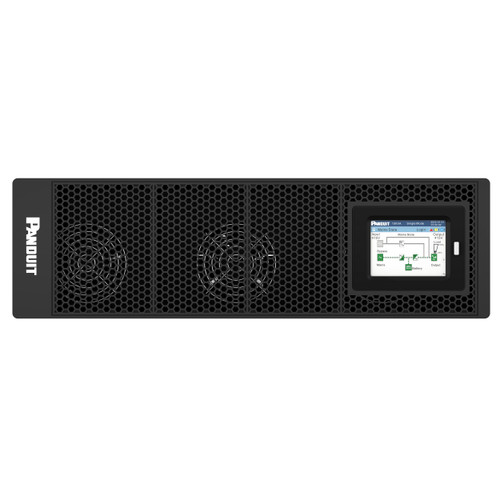
The Panduit U20N32V occupies 3U of rack space, with a specified height of 12 in (306 mm) and a width of 17.3 in (440 mm). Its depth is not provided in the supplied specifications.
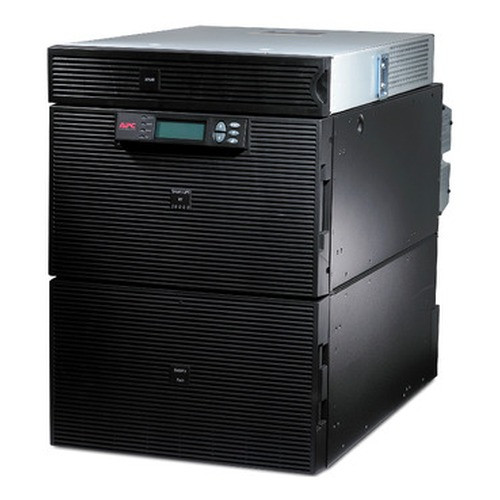
The APC SURT20KRMXLT-TF5 is specified at 14U rack height, with overall dimensions of 62.2 H × 43.2 W × 77.3 D cm (approximately 24.5 H × 17.0 W × 30.5 D in). The mounting type is confirmed as Rack Mount, and the unit ships with Rack Mounting Support Rails.
The footprint difference is substantial: the Panduit U20N32V consumes 3U versus the APC unit's 14U. In a 42U cabinet, the APC unit alone occupies one-third of available rack space. For deployments with constrained rack real estate — edge nodes, co-location cages, or dense enterprise rows — the U20N32V's 3U form factor represents a meaningful space advantage. Installers should confirm depth compatibility for both units against their specific cabinet dimensions, as depth is not specified for the U20N32V in the provided data.
What output receptacle types and counts does each UPS provide, and what management or integration accessories are included?
The APC SURT20KRMXLT-TF5 provides a defined outlet mix: 12× NEMA 5-20R and 4× NEMA L6-20R and 1× L6 outlet (presumably L6-30R or hardwire; exact format not clarified in the provided spec). This gives installers flexibility to serve both standard 120 V/20 A single-phase loads (5-20R) and 208 V/20 A loads (L6-20R) from a single UPS. The unit ships with a CD with Software, Smart UPS Signalling RS-232 Cable, and a Web/SNMP Management Card — the last item being notable, as network management capability is included in the box.
The Panduit U20N32V specification does not list output receptacle types, outlet counts, or included accessories in the data provided. Buyers integrating the U20N32V into environments requiring specific NEMA outlet configurations will need to consult the Panduit datasheet (referenced as /content/product-datasheets/U20N32V.pdf) before committing.
For mixed 120 V / 208 V server and networking loads — typical in North American data center rows — the APC unit's documented outlet inventory and the included Web/SNMP Management Card provide immediate operational value without additional procurement. The Panduit unit's outlet and management accessory details are absent from the supplied specifications and cannot be compared on this axis.
Which should you choose: the SURT20KRMXLT-TF5 or the U20N32V?
Our take: The SURT20KRMXLT-TF5 is the stronger choice when outlet-level flexibility and out-of-box network management are the top priorities; the U20N32V is the stronger choice when rack-space conservation and a confirmed True Online Double-Conversion topology are non-negotiable. Concretely: the Panduit U20N32V consumes 3U versus the APC's 14U — an 11U difference that is decisive in dense or edge deployments. The U20N32V explicitly states True Online Double-Conversion topology; the APC spec sheet provided does not confirm topology. Conversely, the APC unit documents 12× 5-20R plus 4× L6-20R outlets and includes a Web/SNMP Management Card; the Panduit unit lists neither outlets nor included accessories in the supplied data. Buyers running mixed-voltage North American server environments who need confirmed outlet types and SNMP management in the box should favor the APC. Buyers prioritizing minimal rack footprint and explicit double-conversion protection — particularly in edge, co-location, or enterprise MTDC deployments — should favor the Panduit U20N32V.
Side-by-Side Comparison
Spec-for-spec, from manufacturer data.
| Specification | APC by Schneider Electric SURT20KRMXLT-TF5 | Panduit U20N32V |
|---|---|---|
| Device Type | UPS | UPS |
| Capacity | 20 kVA | 20 kVA |
| Topology | — (not stated in provided specs) | True Online Double-Conversion |
| Form Factor | Rackmount | 3U Rackmount |
| Rack Units | 14U | 3U |
| Height | 62.2 cm (24.5 in) | 306 mm (12 in) |
| Width | 43.2 cm (17.0 in) | 440 mm (17.3 in) |
| Depth | 77.3 cm (30.5 in) | — (not stated in provided specs) |
| Output Outlets — 5-20R | 12× | — (not stated in provided specs) |
| Output Outlets — L6-20R | 4× | — (not stated in provided specs) |
| Battery Type | Maintenance-free sealed Lead-Acid (suspended electrolyte, leakproof) | — (not stated in provided specs) |
| Included Management | Web/SNMP Management Card + RS-232 Cable | — (not stated in provided specs) |
| Other Included Accessories | Rack Mounting Support Rails, CD with Software, User Manual | — (not stated in provided specs) |
| Color | Black | — (not stated in provided specs) |
| Target Application | — (not stated in provided specs) | Data Center, Edge, Enterprise MTDC |
| Sub-Brand / Series | Smart-UPS Series | SteadySine |
Frequently Asked Questions
Which should you choose: the SURT20KRMXLT-TF5 or the U20N32V?
The SURT20KRMXLT-TF5 is the stronger choice when outlet-level flexibility and out-of-box network management are the top priorities; the U20N32V is the stronger choice when rack-space conservation and a confirmed True Online Double-Conversion topology are non-negotiable. Concretely: the Panduit U20N32V consumes 3U versus the APC's 14U — an 11U difference that is decisive in dense or edge deployments. The U20N32V explicitly states True Online Double-Conversion topology; the APC spec sheet provided does not confirm topology. Conversely, the APC unit documents 12× 5-20R plus 4× L6-20R outlets and includes a Web/SNMP Management Card; the Panduit unit lists neither outlets nor included accessories in the supplied data. Buyers running mixed-voltage North American server environments who need confirmed outlet types and SNMP management in the box should favor the APC. Buyers prioritizing minimal rack footprint and explicit double-conversion protection — particularly in edge, co-location, or enterprise MTDC deployments — should favor the Panduit U20N32V.
Is the SURT20KRMXLT-TF5 or U20N32V better for a space-constrained rack environment?
Based on the provided specifications, the Panduit U20N32V is significantly more space-efficient: it is rated at 3U, while the APC SURT20KRMXLT-TF5 requires 14U. If rack space is limited — for example in a co-location cage, edge node, or fully populated enterprise cabinet — the U20N32V's 3U profile is a material advantage. Note that depth for the U20N32V is not stated in the available specs, so cabinet depth compatibility should be confirmed separately.
Which unit has a confirmed True Online Double-Conversion topology?
The Panduit U20N32V explicitly states True Online Double-Conversion in its provided specifications. The APC SURT20KRMXLT-TF5 does not specify topology in the supplied spec data. Buyers for whom zero-transfer-time, input-isolated power protection is a hard requirement should verify the APC unit's topology directly via the manufacturer datasheet before specifying.
Does either UPS include network management capability out of the box?
Yes — the APC SURT20KRMXLT-TF5 lists a Web/SNMP Management Card among its included accessories, along with a Smart UPS Signalling RS-232 Cable and software CD. The Panduit U20N32V specification provided does not mention any included accessories or management interfaces. Buyers requiring immediate SNMP/web monitoring without additional purchases should factor this into their evaluation.
More UPS Comparisons
- Panduit U20N32V vs APC by Schneider Electric SURT20KRMXLT-1TF10K
- Panduit U20N32V vs APC by Schneider Electric E3SUPS20KFBS
- Panduit U20N32V vs APC by Schneider Electric SUVTP20KH2B4S
- Panduit U20N32V vs Vertiv GXT5-20KMVRT11UXLN
- APC by Schneider Electric SURT20KRMXLT-1TF10K vs Vertiv GXT5-20KMVRT11UXLN
- APC by Schneider Electric SURT20KRMXLT-1TF10K vs APC by Schneider Electric E3SUPS20KFBS
UPS Buying Guides
Get a Second Opinion on Your Camera Choice
Share your site layout, coverage goals, and budget. Our team will validate the camera selection, flag anything we would change, and recommend products that match the use case.