
APC by Schneider Electric SURT20KRMXLT-1TF10K vs Vertiv GXT5-20KMVRT11UXLN: Specification Comparison
Both the APC Smart-UPS RT SURT20KRMXLT-1TF10K and the Vertiv Liebert GXT5 GXT5-20KMVRT11UXLN are 20 kVA rack-mountable online UPS systems designed for 208 V AC input environments with dual-voltage (208 V and 120 V AC) output capability. They target the same data center and critical-infrastructure buyer segment requiring three-phase-adjacent high-density power protection. The comparison is valid: same power class, same device type, same general installation context. Key decision axes are power architecture and efficiency, physical footprint and weight, and management depth.
In This Guide
- How do power architecture, efficiency, and output fidelity compare between the SURT20KRMXLT-1TF10K and GXT5-20KMVRT11UXLN?
- What do runtime, battery, and recharge characteristics look like for each unit?
- How do physical footprint, rack space, and management and interface capabilities differ?
- Which should you choose: the SURT20KRMXLT-1TF10K or the GXT5-20KMVRT11UXLN?
- Side-by-Side Specs
- FAQ
How do power architecture, efficiency, and output fidelity compare between the SURT20KRMXLT-1TF10K and GXT5-20KMVRT11UXLN?
The APC SURT20KRMXLT-1TF10K is specified as a 20 kVA / 16 kW unit, yielding a power factor of 0.80. Output waveform is confirmed sine wave. Input frequency is listed at 70 Hz with a 60 Hz output — an unusual input figure that may reflect a broadened acceptance window; buyers should verify with APC documentation for their facility. No efficiency rating is provided in the available specifications.
The Vertiv GXT5-20KMVRT11UXLN is specified at 20 kVA / 20 kW, reflecting a unity (1.0) power factor. Topology is explicitly stated as on-line double conversion. Efficiency reaches up to 98% in Active ECO Mode and up to 95% in standard on-line mode per the provided specs. Input voltage range is 176–280 V AC, offering a wider tolerance window than is documented for the APC unit. The GXT5 carries ENERGY STAR 2.0 certification, UL1778, c-UL, RoHS2, and REACH listings; no equivalent certifications are listed for the APC unit in the provided specs.
The unity power factor of the GXT5 (20 kW from 20 kVA) versus the APC's 0.80 power factor (16 kW from 20 kVA) means the Vertiv unit delivers 25% more real power at the same VA rating — a material difference for high-density compute loads.
What do runtime, battery, and recharge characteristics look like for each unit?
The APC SURT20KRMXLT-1TF10K provides specified runtime figures: 4.90 minutes at full load (20 kVA) and 15.30 minutes at half load (10 kVA). Typical battery recharge time is documented at 2.50 hours. Battery chemistry is confirmed as lead acid.
The Vertiv GXT5-20KMVRT11UXLN does not include runtime, recharge time, or battery chemistry data in the provided specifications. Buyers evaluating runtime requirements cannot make a direct spec-to-spec comparison on this dimension and should consult the Vertiv datasheet (referenced as GXT5-20KMVRT11UXLN.pdf) for those figures.
The APC unit's runtime data at least provides a baseline: under 5 minutes at full load is typical for an internal-battery 20 kVA unit; most deployments at this class pair with external battery cabinets for extended runtime. Whether the Vertiv unit ships with more or less internal battery capacity is not determinable from available specs.
How do physical footprint, rack space, and management and interface capabilities differ?
The APC SURT20KRMXLT-1TF10K occupies 16U of rack space and measures 27.9" H × 17" W × 30.4" D, weighing 766.61 lb. It includes 11 outlets and is noted as SNMP Manageable. Form factor is rack-mountable. No additional interface types, communications cards, or display details are specified in the available data.
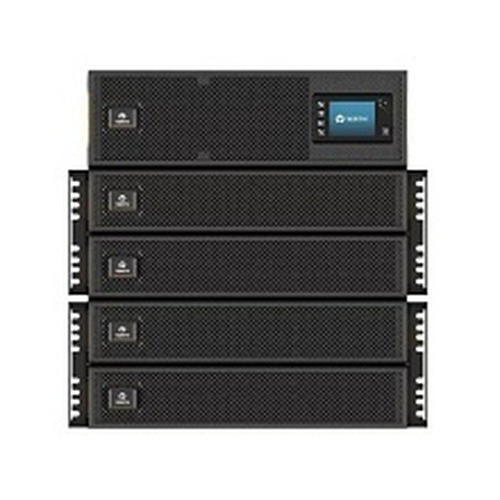
The Vertiv GXT5-20KMVRT11UXLN occupies a stated 11U (implied by model suffix 'RT11U') and measures 19.0" H × 16.9" W × 26.7" D, weighing 396.6 lb. The unit is hardwired in and out (no outlet count is specified). It ships with a factory pre-installed Vertiv RDU101 SNMP/Webcard and supports USB, RS485, RS232, a terminal block, an external battery connector, and EPO. A full-color graphic LCD with gravity-sensing orientation is included. Protocols include SNMP, web management, and serial out-of-band management.
The weight difference is significant for installation planning: the APC unit at 766.61 lb is nearly double the Vertiv's 396.6 lb, which has direct implications for floor loading, lifting equipment, and data center structural requirements. The Vertiv also consumes fewer rack units (11U vs. 16U) and ships with a richer pre-installed communications suite.
Which should you choose: the SURT20KRMXLT-1TF10K or the GXT5-20KMVRT11UXLN?
Our take: The GXT5-20KMVRT11UXLN is the stronger choice when real power delivery, rack density, installation weight, and pre-installed management depth are the primary criteria. The Vertiv delivers 20 kW versus the APC's 16 kW at the same 20 kVA rating — a 25% real-power advantage driven by its unity power factor versus the APC's 0.80. It also weighs 370 lb less (396.6 lb vs. 766.61 lb) and occupies 5 fewer rack units (11U vs. 16U), easing structural and space constraints. The GXT5 ships with a factory RDU101 SNMP/Webcard, USB, RS485, RS232, EPO, and a color LCD; the APC lists only SNMP manageability with no further interface detail in the provided specs. The APC unit offers documented runtime figures (4.9 min full load, 15.3 min half load) and specifies outlet count (11); neither figure is available for the Vertiv. Choose the SURT20KRMXLT-1TF10K only if discrete outlet connectivity or confirmed lead-acid runtime data from a single source is a hard installation requirement.
Side-by-Side Comparison
Spec-for-spec, from manufacturer data.
| Specification | APC by Schneider Electric SURT20KRMXLT-1TF10K | Vertiv GXT5-20KMVRT11UXLN |
|---|---|---|
| Load Capacity (VA) | 20,000 VA | 20,000 VA |
| Load Capacity (Watts) | 16,000 W | 20,000 W |
| Power Factor | 0.80 | 1.00 |
| Topology | — | On-line double conversion |
| Input Voltage | 208 V AC | Typical 208 V AC / Range 176–280 V AC |
| Output Voltage | 120 V AC | 208 V AC | 208 / 120 V AC (user-configurable) |
| Input Frequency | 70 Hz | — |
| Output Frequency | 60 Hz | — |
| Waveform | Sine Wave | — |
| Efficiency | — | Up to 98% ECO / Up to 95% on-line |
| Rack Height | 16U | 11U |
| Unit Weight | 766.61 lb | 396.6 lb |
| Dimensions (H × W × D) | 27.9" × 17" × 30.4" | 19.0" × 16.9" × 26.7" |
| Number of Outlets | 11 | Hardwired (outlet count not specified) |
| Runtime at Full Load | 4.90 min | — |
| Runtime at Half Load | 15.30 min | — |
| Battery Recharge Time | 2.50 hr | — |
| Battery Chemistry | Lead Acid | — |
| Management Interfaces | SNMP | SNMP/Web (RDU101), USB, RS485, RS232, terminal block, EPO |
| Display | — | Full-color graphic LCD with gravity sensing |
| Certifications | — | ENERGY STAR 2.0, UL1778, c-UL, RoHS2, REACH |
| Form Factor | Rack-mountable | Rack/Tower (flexible) |
| Wiring | — | Hardwired in/out; optional PODs |
| Warranty | 2 Year | — |
| Country of Origin | Philippines | — |
Frequently Asked Questions
Which should you choose: the SURT20KRMXLT-1TF10K or the GXT5-20KMVRT11UXLN?
The GXT5-20KMVRT11UXLN is the stronger choice when real power delivery, rack density, installation weight, and pre-installed management depth are the primary criteria. The Vertiv delivers 20 kW versus the APC's 16 kW at the same 20 kVA rating — a 25% real-power advantage driven by its unity power factor versus the APC's 0.80. It also weighs 370 lb less (396.6 lb vs. 766.61 lb) and occupies 5 fewer rack units (11U vs. 16U), easing structural and space constraints. The GXT5 ships with a factory RDU101 SNMP/Webcard, USB, RS485, RS232, EPO, and a color LCD; the APC lists only SNMP manageability with no further interface detail in the provided specs. The APC unit offers documented runtime figures (4.9 min full load, 15.3 min half load) and specifies outlet count (11); neither figure is available for the Vertiv. Choose the SURT20KRMXLT-1TF10K only if discrete outlet connectivity or confirmed lead-acid runtime data from a single source is a hard installation requirement.
Is the SURT20KRMXLT-1TF10K or GXT5-20KMVRT11UXLN better for high-density server loads that draw close to the full 20 kVA rating?
The GXT5-20KMVRT11UXLN is better suited for loads approaching 20 kVA. Its unity power factor means it delivers 20 kW of real power at 20 kVA, whereas the SURT20KRMXLT-1TF10K's 0.80 power factor limits real power output to 16 kW at the same VA rating. For loads between 16 kW and 20 kW, only the Vertiv unit can sustain them without oversizing to a larger APC model.
Which unit is easier to install in a standard data center rack, and does floor loading matter?
The GXT5-20KMVRT11UXLN has a meaningful installation advantage: it weighs 396.6 lb versus the SURT20KRMXLT-1TF10K's 766.61 lb and occupies 11U versus 16U. The APC unit's weight is nearly double and will require verification against floor load ratings and may demand additional lifting resources. If rack space or floor loading is constrained, the Vertiv unit is the easier path.
Which UPS offers more built-in management and monitoring interfaces out of the box?
The GXT5-20KMVRT11UXLN ships with a factory pre-installed RDU101 SNMP/Webcard plus USB, RS485, RS232, a terminal block, EPO, and a full-color LCD — all specified in the provided data. The SURT20KRMXLT-1TF10K is listed only as SNMP Manageable with no further interface detail in the available specifications. Buyers requiring rich out-of-box network management without add-on cards should favor the Vertiv based on the specs provided.
More UPS Comparisons
- Panduit U20N32V vs APC by Schneider Electric SURT20KRMXLT-1TF10K
- Panduit U20N32V vs APC by Schneider Electric E3SUPS20KFBS
- Panduit U20N32V vs APC by Schneider Electric SUVTP20KH2B4S
- Panduit U20N32V vs Vertiv GXT5-20KMVRT11UXLN
- APC by Schneider Electric SURT20KRMXLT-1TF10K vs APC by Schneider Electric E3SUPS20KFBS
- APC by Schneider Electric SURT20KRMXLT-1TF10K vs APC by Schneider Electric SUVTP20KH2B4S
UPS Buying Guides
Get a Second Opinion on Your Camera Choice
Share your site layout, coverage goals, and budget. Our team will validate the camera selection, flag anything we would change, and recommend products that match the use case.