
APC by Schneider Electric SURT20KRMXLT-1TF10K vs APC by Schneider Electric E3SUPS20KFBS: Specification Comparison
Both products are 20 kVA uninterruptible power supplies from APC by Schneider Electric, a capacity tier commonly deployed in mid-to-large data centers, server rooms, and critical infrastructure. The SURT20KRMXLT-1TF10K is a Smart-UPS RT rack-mount unit bundled with a step-down transformer to serve 120 V loads from a 208 V feed, while the E3SUPS20KFBS is an Easy UPS 3S chassis designed for internal battery modules in a 3:3 (three-phase in, three-phase out) online double-conversion topology. Buyers evaluating both will weigh topology, output voltage architecture, physical format, and management depth.
In This Guide
- Which UPS topology and runtime profile better matches your uptime requirements?
- How do output voltage architecture, physical format, and installation constraints compare?
- What do the specs reveal about management capabilities, efficiency indicators, and environmental characteristics?
- Which should you choose: the SURT20KRMXLT-1TF10K or the E3SUPS20KFBS?
- Side-by-Side Specs
- FAQ
Which UPS topology and runtime profile better matches your uptime requirements?
The SURT20KRMXLT-1TF10K does not specify its topology in the provided data, though its waveform is confirmed as sine wave. Runtime at full 20 kVA / 16 kW load is 4.90 minutes, extending to 15.30 minutes at half load (8 kVA / 8 kW). Battery recharge time is specified at 2.50 hours. Battery chemistry is Lead Acid.
The E3SUPS20KFBS explicitly uses Double-conversion (Online) topology, which provides zero transfer time to battery and continuous voltage regulation — the highest tier of power protection. Runtime figures are not provided in the available specs, as the unit is described as a chassis 'for Internal Batteries,' implying runtime depends on separately specified battery modules. Battery voltage is listed at 96 V. Output frequency supports both 50 Hz and 60 Hz environments.
For buyers requiring a guaranteed online double-conversion topology with regulated output at all times, the E3SUPS20KFBS states that explicitly. The SURT20KRMXLT-1TF10K provides concrete runtime numbers (4.90 min full load / 15.30 min half load), which the E3SUPS20KFBS cannot offer without knowing the battery module configuration.
How do output voltage architecture, physical format, and installation constraints compare?
The SURT20KRMXLT-1TF10K outputs both 120 V AC and 208 V AC from a 208 V AC input, enabled by its integrated 10 kVA step-down transformer. It provides 11 outlets and is rack-mountable at 16U (27.9" H × 17" W × 30.4" D), weighing 766.61 lb. Color is Black. Form factor is explicitly rack-mountable.
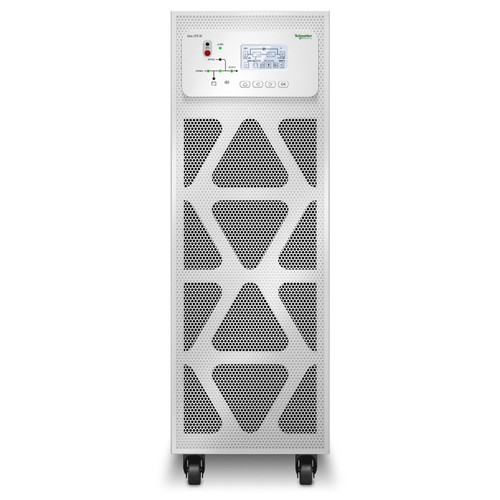
The E3SUPS20KFBS operates 3:3 (three-phase in, three-phase out) at 208–220 V input and 208–220 V output. No outlet count is specified in the provided data. Physical dimensions and weight are not provided. Color is White. An IP20 rating is listed, indicating protection against solid objects larger than 12 mm but no water ingress protection — typical for indoor equipment.
The SURT20KRMXLT-1TF10K is purpose-built for environments needing simultaneous 120 V and 208 V output from a single rack unit, with a confirmed 16U footprint and known weight critical for floor-load and rack-planning. The E3SUPS20KFBS dimensions and weight are absent from the provided specs, making physical installation planning dependent on supplemental documentation.
What do the specs reveal about management capabilities, efficiency indicators, and environmental characteristics?
The SURT20KRMXLT-1TF10K is confirmed SNMP Manageable, enabling integration with network management systems for remote monitoring, alerting, and control. No THD, heat dissipation, noise level, or display type is specified in the provided data. Input frequency acceptance is listed as 70 Hz (single value, not a range), which is an unusual specification and may represent a maximum or a specific design point rather than a range.
The E3SUPS20KFBS specifies an input current Total Harmonic Distortion (THD) of 4%, indicating low harmonic pollution returned to the utility — relevant for facilities with sensitive shared electrical infrastructure. Heat dissipation is 1,400 BTU/h and noise level is 68 dB, both useful for data center thermal and acoustic planning. The control interface is Touch with an LCD display. Input frequency acceptance is 40–70 Hz. SNMP or other network management capabilities are not stated in the provided specs.
The E3SUPS20KFBS provides measurable efficiency and environmental impact data (THD, heat, noise) absent from the SURT20KRMXLT-1TF10K specs. The SURT20KRMXLT-1TF10K confirms SNMP management, which the E3SUPS20KFBS does not address in the provided data. Buyers in SNMP-managed environments should verify E3SUPS20KFBS network management options through supplemental documentation.
Which should you choose: the SURT20KRMXLT-1TF10K or the E3SUPS20KFBS?
Our take: The SURT20KRMXLT-1TF10K is the stronger choice when a rack-mount installation requires simultaneous 120 V and 208 V output, concrete runtime figures, and confirmed SNMP management integration. It delivers both output voltages from a single 208 V feed via its bundled step-down transformer, provides specified runtimes of 4.90 minutes at full load and 15.30 minutes at half load, and confirms SNMP manageability for network-integrated monitoring. The E3SUPS20KFBS counters with an explicitly stated Double-conversion (Online) topology — the highest protection class — plus a low 4% input THD and quantified heat dissipation of 1,400 BTU/h and 68 dB noise, none of which are specified for the SURT20KRMXLT-1TF10K. The E3SUPS20KFBS is better suited for three-phase 208–220 V environments where topology assurance and harmonic impact on shared electrical infrastructure are primary concerns, and where battery runtime is configured via separately selected internal battery modules.
Side-by-Side Comparison
Spec-for-spec, from manufacturer data.
| Specification | APC by Schneider Electric SURT20KRMXLT-1TF10K | APC by Schneider Electric E3SUPS20KFBS |
|---|---|---|
| UPS Topology | Not specified in provided specs | Double-conversion (Online) |
| Load Capacity (VA) | 20 kVA | 20 kVA |
| Load Capacity (Watts) | 16,000 W | 20,000 W |
| Input Voltage | 208 V AC | 208–220 V AC |
| Output Voltage | 120 V AC and 208 V AC | 208–220 V AC |
| Input Frequency | 70 Hz | 40–70 Hz |
| Output Frequency | 60 Hz | 50/60 Hz |
| Input Current | 105 A | — |
| Input THD | — | 4% |
| Number of Outlets | 11 | — |
| Runtime at Full Load | 4.90 min | — |
| Runtime at Half Load | 15.30 min | — |
| Battery Recharge Time | 2.50 hr | — |
| Battery Chemistry / Voltage | Lead Acid | 96 V (chemistry not specified) |
| Heat Dissipation | — | 1,400 BTU/h |
| Noise Level | — | 68 dB |
| Management | SNMP Manageable | — |
| Display / Control | — | LCD / Touch |
| Form Factor | Rack-mountable, 16U | — |
| Dimensions (H × W × D) | 27.9" × 17" × 30.4" | — |
| Weight | 766.61 lb | — |
| IP Rating | — | IP20 |
| Color | Black | White |
| Warranty | 2 Year | — |
| Country of Origin | Philippines | — |
Frequently Asked Questions
Which should you choose: the SURT20KRMXLT-1TF10K or the E3SUPS20KFBS?
The SURT20KRMXLT-1TF10K is the stronger choice when a rack-mount installation requires simultaneous 120 V and 208 V output, concrete runtime figures, and confirmed SNMP management integration. It delivers both output voltages from a single 208 V feed via its bundled step-down transformer, provides specified runtimes of 4.90 minutes at full load and 15.30 minutes at half load, and confirms SNMP manageability for network-integrated monitoring. The E3SUPS20KFBS counters with an explicitly stated Double-conversion (Online) topology — the highest protection class — plus a low 4% input THD and quantified heat dissipation of 1,400 BTU/h and 68 dB noise, none of which are specified for the SURT20KRMXLT-1TF10K. The E3SUPS20KFBS is better suited for three-phase 208–220 V environments where topology assurance and harmonic impact on shared electrical infrastructure are primary concerns, and where battery runtime is configured via separately selected internal battery modules.
Is the SURT20KRMXLT-1TF10K or E3SUPS20KFBS better for a data center that needs to power both 120 V servers and 208 V equipment from the same UPS?
The SURT20KRMXLT-1TF10K is specifically designed for this use case. It accepts 208 V AC input and provides both 120 V AC and 208 V AC output via its integrated 10 kVA step-down transformer, with 11 outlets confirmed. The E3SUPS20KFBS operates 3:3 (three-phase) at 208–220 V in and 208–220 V out; no 120 V output is specified in the provided data.
Which unit offers better power quality protection for sensitive shared electrical infrastructure?
Based on the provided specifications, the E3SUPS20KFBS has an advantage here. It states Double-conversion (Online) topology — meaning utility power never directly feeds the load — and specifies a 4% input current THD, indicating low harmonic pollution returned to the facility's electrical system. The SURT20KRMXLT-1TF10K does not state its topology or THD figures in the provided specs.
Can I plan rack space and floor loading for both units from the specs provided?
Only for the SURT20KRMXLT-1TF10K. Its specs confirm a 16U rack height, dimensions of 27.9" × 17" × 30.4", and a weight of 766.61 lb — all the figures needed for rack and floor-load planning. The E3SUPS20KFBS dimensions and weight are not present in the provided specifications; those details would need to be sourced from the manufacturer's datasheet.
More UPS Comparisons
- Panduit U20N32V vs APC by Schneider Electric SURT20KRMXLT-1TF10K
- Panduit U20N32V vs APC by Schneider Electric E3SUPS20KFBS
- Panduit U20N32V vs APC by Schneider Electric SUVTP20KH2B4S
- Panduit U20N32V vs Vertiv GXT5-20KMVRT11UXLN
- APC by Schneider Electric SURT20KRMXLT-1TF10K vs Vertiv GXT5-20KMVRT11UXLN
- APC by Schneider Electric SURT20KRMXLT-1TF10K vs APC by Schneider Electric SUVTP20KH2B4S
UPS Buying Guides
Get a Second Opinion on Your Camera Choice
Share your site layout, coverage goals, and budget. Our team will validate the camera selection, flag anything we would change, and recommend products that match the use case.