
APC by Schneider Electric SURT1000RMXLI vs APC by Schneider Electric SMT1000J: Specification Comparison
Both units are 1000 VA uninterruptible power supplies from APC by Schneider Electric, sharing the same apparent VA rating, lead-acid battery chemistry, and a SmartSlot expansion bay. However, they differ fundamentally in UPS topology, input voltage region, form factor, and intended deployment context — the SURT1000RMXLI is a rack-mount double-conversion online UPS for 230 V infrastructure, while the SMT1000J is a tower line-interactive UPS localized for Japan's 100 V grid. Buyers evaluating these would be choosing between protection architecture, physical deployment style, and regional power compatibility.
In This Guide
- Which UPS offers stronger power protection and output quality?
- How do rated power capacity, battery autonomy, and recharge time compare?
- Which unit fits better into a rack environment, and what management and certification support does each offer?
- Which should you choose: the SURT1000RMXLI or the SMT1000J?
- Side-by-Side Specs
- FAQ
Which UPS offers stronger power protection and output quality?
The SURT1000RMXLI uses double-conversion online topology, meaning connected equipment always runs from the inverter — utility power is continuously converted to DC and back to AC, delivering zero transfer time during outages and tight output regulation. Specified harmonic distortion is less than 3%, crest factor is 3:1, and output frequency is user-adjustable ±3 Hz. IEEE surge let-through is rated at zero, clamping response meets UL 1449, and surge energy absorption is 420 J. Full-time multi-pole noise filtering is stated.
The SMT1000J is line-interactive, meaning loads normally run directly from utility power with the inverter only boosting or trimming voltage within range (AC 80–123 V, adjustable down to 70 V). On outage, transfer time is not specified. Output waveform is sinewave and surge energy rating is 459 J — the only surge metric higher than the SURT1000RMXLI's 420 J. No harmonic distortion figure, crest factor, or noise filtering specification is provided for the SMT1000J.
For loads sensitive to power quality — servers, storage arrays, precision instruments — double-conversion provides deterministic isolation from the utility. Line-interactive is adequate for less sensitive equipment and offers slightly higher efficiency in normal operation since it avoids the continuous rectifier-inverter conversion losses.
How do rated power capacity, battery autonomy, and recharge time compare?
Both units are rated at 1000 VA. The SURT1000RMXLI delivers 700 W real power; the SMT1000J delivers 670 W — a 30 W difference at full load. Neither datasheet provides runtime curves or autonomy figures at specific load percentages, so battery backup duration cannot be directly compared from the provided specs alone.
Battery recharge time favors the SURT1000RMXLI at 3 hours versus 4 hours for the SMT1000J. Battery charger power for the SURT1000RMXLI is stated at 109 W rated. The SURT1000RMXLI specifies expected battery life of 3–5 years; the SMT1000J does not state a battery life expectancy. Both use lead-acid chemistry.
The SURT1000RMXLI also notes that external battery packs can extend runtime (implied by the RM RT platform architecture), though no connector or expansion spec for this is listed in the provided data. The SMT1000J specification makes no reference to external battery extension capability.
Which unit fits better into a rack environment, and what management and certification support does each offer?
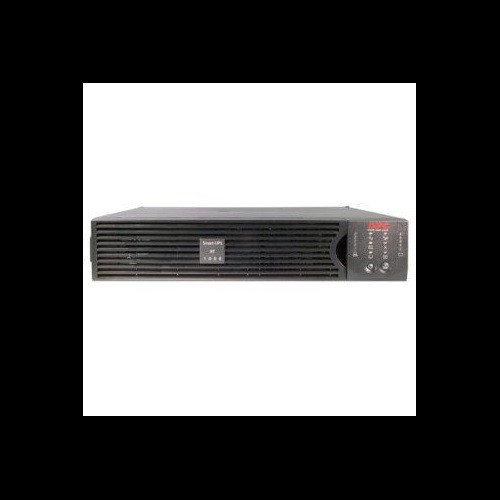
The SURT1000RMXLI is explicitly rack-mounted at 2U (432 mm W × 483 mm D × 85 mm H), weighing 23 kg. It carries certifications including C-Tick, CE, GOST, VDE, UK PSTI and meets EN/IEC 62040-1:2019/A11:2021 and EN/IEC 62040-2:2018. It includes a built-in bypass, IP20 ingress protection rating, and one free SmartSlot. Operating temperature is 0–40 °C; acoustic output is 50 dBA.
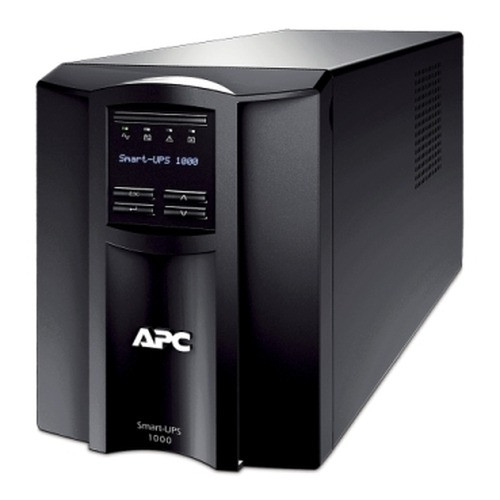
The SMT1000J is a tower unit localized for Japan (100 V input), with shipping dimensions given in inches but no rack-unit figure — it is not a rack appliance. It carries UL 1449, VCCI Class A ITE, RoHS Exemption 7b, and REACH compliance. Management is via USB with one USB Type-A port listed; no network card is mentioned in the spec, though the SmartSlot allows one to be added. Operating temperature is 32–104 °F (0–40 °C equivalent). Acoustic output is 45 dBA — 5 dB quieter than the SURT1000RMXLI. Warranty is stated as a 2-year limited warranty; no warranty duration is specified for the SURT1000RMXLI in the provided data.
For data-center or network-closet rack deployments, only the SURT1000RMXLI is a viable physical fit. The SMT1000J's NEMA 5-15 connectors and 100 V input make it incompatible with 230 V infrastructure regardless of topology preference.
Which should you choose: the SURT1000RMXLI or the SMT1000J?
Our take: The SURT1000RMXLI is the stronger choice when rack-mounting, 230 V grid compatibility, and maximum power protection quality are required. Its double-conversion online topology delivers zero transfer time and less than 3% harmonic distortion versus the SMT1000J's line-interactive architecture, which offers no stated transfer time and no harmonic distortion figure. The SURT1000RMXLI also recharges in 3 hours versus 4 hours and carries a broader set of international certifications including CE, VDE, and UK PSTI. Conversely, the SMT1000J is purpose-built for Japan's 100 V grid with NEMA 5-15 outlets and VCCI Class A compliance — it is the only appropriate option for that environment. It is also 5 dB quieter (45 vs 50 dBA) and provides a stated 2-year warranty. Neither unit is a substitute for the other across regional boundaries; cross-shopping is only valid within a single grid voltage region.
Side-by-Side Comparison
Spec-for-spec, from manufacturer data.
| Specification | APC by Schneider Electric SURT1000RMXLI | APC by Schneider Electric SMT1000J |
|---|---|---|
| UPS Topology | Double-conversion online | Line-interactive |
| Rated Power (VA) | 1000 VA | 1000 VA |
| Rated Power (W) | 700 W | 670 W |
| Input Voltage (Nominal) | 230 V | 100 V |
| Input Voltage Range | 160–280 V | 80–123 V (adj. 70–125 V) |
| Output Voltage | 230 V (also 220/240 V) | 100 V ±5% |
| Output Waveform | Sine wave | Sinewave |
| Harmonic Distortion | < 3% | — |
| Surge Energy Rating | 420 J | 459 J |
| IEEE Surge Let-through | Zero | — |
| Battery Recharge Time | 3 hours | 4 hours |
| Battery Life (Expected) | 3–5 years | — |
| Acoustic Level | 50 dBA | 45 dBA |
| Form Factor | Rack-mount 2U | Tower |
| SmartSlot (Free) | 1 | 1 (total) / 1 (free) |
| Certifications / Compliance | C-Tick, CE, GOST, VDE, UK PSTI | UL 1449, VCCI Class A ITE, RoHS Exemption 7b, REACH |
Frequently Asked Questions
Which should you choose: the SURT1000RMXLI or the SMT1000J?
The SURT1000RMXLI is the stronger choice when rack-mounting, 230 V grid compatibility, and maximum power protection quality are required. Its double-conversion online topology delivers zero transfer time and less than 3% harmonic distortion versus the SMT1000J's line-interactive architecture, which offers no stated transfer time and no harmonic distortion figure. The SURT1000RMXLI also recharges in 3 hours versus 4 hours and carries a broader set of international certifications including CE, VDE, and UK PSTI. Conversely, the SMT1000J is purpose-built for Japan's 100 V grid with NEMA 5-15 outlets and VCCI Class A compliance — it is the only appropriate option for that environment. It is also 5 dB quieter (45 vs 50 dBA) and provides a stated 2-year warranty. Neither unit is a substitute for the other across regional boundaries; cross-shopping is only valid within a single grid voltage region.
Can I use the SMT1000J in a standard 230 V data center rack?
No. The SMT1000J is localized for Japan with a 100 V AC input (range 80–123 V) and NEMA 5-15 connectors. It is a tower unit with no rack-unit specification. Using it on a 230 V feed would exceed its stated input voltage range. The SURT1000RMXLI is the appropriate choice for 230 V rack environments.
Which UPS is better for protecting servers or sensitive network equipment?
Based on the provided specifications, the SURT1000RMXLI's double-conversion online topology provides superior protection: it delivers zero transfer time on outage, less than 3% harmonic distortion, a 3:1 crest factor, and zero IEEE surge let-through. The SMT1000J is line-interactive and does not specify transfer time, harmonic distortion, or crest factor, making its suitability for sensitive loads harder to assess from the provided data alone.
Is the SURT1000RMXLI or SMT1000J better for a quiet office environment?
The SMT1000J specifies a lower acoustic output at 45 dBA versus 50 dBA for the SURT1000RMXLI — a 5 dB difference that is perceptible in a quiet space. However, the SMT1000J is a 100 V tower unit and may not be compatible with your infrastructure. If noise level is a concern and you are on a 230 V grid, neither unit may be optimal; that trade-off should be evaluated against your voltage and form-factor requirements.
More UPS Comparisons
- CyberPower PR1000RTXL2UC vs APC by Schneider Electric SURT1000RMXLI
- CyberPower PR1000RTXL2UC vs APC by Schneider Electric SMT1000CUS
- CyberPower PR1000RTXL2UC vs Vertiv GXT5-1000LVRT2UXL
- CyberPower PR1000RTXL2UC vs APC by Schneider Electric SMT1000J
- CyberPower PR1000RTXL2UC vs CyberPower CP1000PFCLCD
- CyberPower PR1000RTXL2UC vs CyberPower PR1000LCD
UPS Buying Guides
Get a Second Opinion on Your Camera Choice
Share your site layout, coverage goals, and budget. Our team will validate the camera selection, flag anything we would change, and recommend products that match the use case.