
APC by Schneider Electric SRT6KXLT-5KTF vs Vertiv GXT5-6000RT208: Specification Comparison
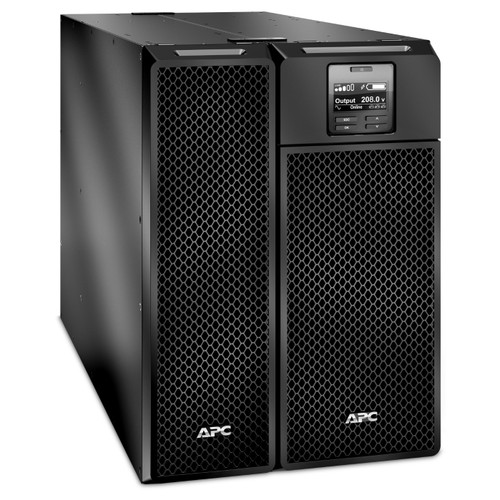
Both the APC Smart-UPS SRT6KXLT-5KTF and the Vertiv GXT5-6000RT208 are rack-mount, double-conversion online UPS systems rated at or near 6000VA, targeted at critical IT and facility loads requiring true online topology, hardwire input, and runtime extension via external battery modules. This comparison examines power conversion architecture and electrical characteristics, input/output flexibility and installation requirements, and monitoring and management capabilities — the three axes most relevant to a B2B installer or IT buyer selecting a 6kVA online UPS.
In This Guide
- How do the two UPS units compare in power conversion quality and electrical performance?
- Which unit offers greater input/output voltage flexibility and installation adaptability?
- What management, monitoring, and operational intelligence does each unit support?
- Which should you choose: the SRT6KXLT-5KTF or the GXT5-6000RT208?
- Side-by-Side Specs
- FAQ
How do the two UPS units compare in power conversion quality and electrical performance?
The APC SRT6KXLT-5KTF is specified as a double-conversion (online) unit delivering 6000 VA / 6000 W at a unity (1.0) power factor, with a sine-wave output and a crest factor of 3:1. Input THD is specified at 2%, indicating a near-unity input power quality that reduces harmonic loading on upstream circuits and generators. Surge energy rating is documented at 480 J with dedicated surge protection noted.
The Vertiv GXT5-6000RT208 is also a double-conversion (online) topology unit. The model table provided lists the 6000 VA GXT5-6000MVRT4UXLN variant at 6000 VA / 6000 W (1.0 power factor). However, two 4,900 VA / 4,600 W variants (GXT5-6KL630RT5UXLN and GXT5-5KL630RT3UXLN) appear in the spec table, indicating power-factor derating in specific configurations. Input THD, crest factor, surge energy rating, and noise level are not provided in the supplied specification data for the Vertiv unit.
On documented electrical quality metrics, the APC unit carries measurable advantages: 2% input THD is an explicit, low figure suitable for generator-backed and sensitive shared-panel installations. The Vertiv's equivalent figures are absent from the provided specifications and cannot be assumed.
Which unit offers greater input/output voltage flexibility and installation adaptability?
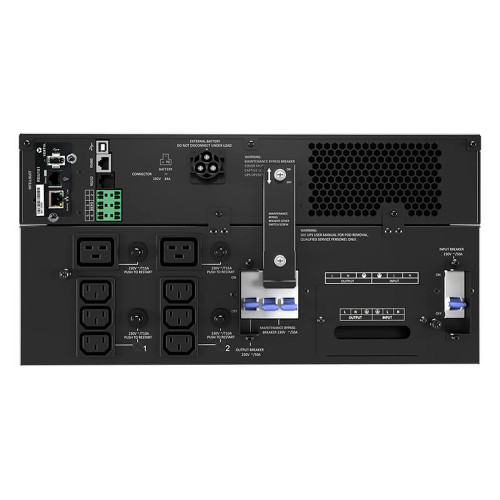
The APC SRT6KXLT-5KTF includes an integrated 208/240V-to-120V step-down transformer, giving it a documented input operating range of 100–275 V across a 40–70 Hz input frequency window. Output is switchable between 120 V and 240 V, covering both North American 120 V receptacle loads and 240 V hardwire circuits from a single unit. Emergency Power Off (EPO) is specified as present, a code-required feature in many data center and raised-floor environments.
The GXT5-6000RT208 is specified as a hardwire-input unit. The model designation '208' indicates a 208 V nominal input, consistent with a three-phase-derived 208 V single-phase data center feed. Specific input voltage range, input frequency tolerance, output voltage options, and EPO capability are not stated in the provided specifications for this unit.
For installers requiring documented wide-range input tolerance, frequency flexibility (useful in generator or international-grid environments), or EPO integration, the APC unit provides confirmed specification coverage. The Vertiv's installation envelope cannot be fully evaluated from the available data.
What management, monitoring, and operational intelligence does each unit support?
The APC SRT6KXLT-5KTF specifies web-based management, audible alarms, and auto-restart capability. Web-based management enables browser-accessible monitoring without a dedicated management card dependency on the spec sheet (though network card specifics are not detailed). Auto-restart allows the UPS to recover loads automatically after a utility restoration without manual intervention, reducing administrative overhead in unmanned or remote installations.
The Vertiv GXT5-6000RT208 specification data provided does not include any management interface details — web-based management, SNMP, serial, USB, audible alarm, or auto-restart capabilities are not stated in the supplied specs. Vertiv GXT5-series units are known in the industry to support management options, but this comparison is restricted to the provided specification data, and no management claims can be confirmed for this unit.
Based solely on supplied specifications, the APC unit documents a richer management and operational-continuity feature set. Buyers requiring confirmed web management or auto-restart should verify Vertiv's capabilities through the manufacturer's current datasheet before selection.
Which should you choose: the SRT6KXLT-5KTF or the GXT5-6000RT208?
Our take: The SRT6KXLT-5KTF is the stronger choice when documented electrical quality, input-range flexibility, and confirmed management features are required at the 6000 VA class. On the three most decision-relevant axes, the APC unit holds a clear specification lead: it documents 2% input THD versus no THD figure for the Vertiv; it specifies a 100–275 V input operating range with integrated 208/240-to-120 V step-down transformer versus an unspecified input range for the Vertiv; and it confirms web-based management, audible alarms, and auto-restart versus no management specifications in the Vertiv's supplied data. The Vertiv GXT5-6000RT208 is a hardwire-input unit with a double-conversion topology at the same 6000 VA / 6000 W rating, but insufficient specification data is provided to confirm parity or advantage on key electrical, installation, or management dimensions. Buyers already standardized on Vertiv infrastructure or requiring the GXT5's specific battery-extension pod ecosystem should consult Vertiv's full datasheet before ruling it out.
Side-by-Side Comparison
Spec-for-spec, from manufacturer data.
| Specification | APC by Schneider Electric SRT6KXLT-5KTF | Vertiv GXT5-6000RT208 |
|---|---|---|
| UPS Topology | Double-conversion (Online) | Double-conversion (Online) |
| Output Power Capacity | 6000 VA | 6000 VA (GXT5-6000MVRT4UXLN variant) |
| Output Power (Watts) | 6000 W | 6000 W (GXT5-6000MVRT4UXLN variant) |
| Power Factor (Output) | 1.0 (6000 W / 6000 VA) | 1.0 (6000 W / 6000 VA); 0.94 on derated variants |
| Output Waveform | Sine wave | — |
| Input Voltage Range | 100–275 V | — |
| Input Frequency Range | 40–70 Hz | — |
| Input THD | 2% | — |
| Output Voltage | 120 V / 240 V (selectable) | 208 V nominal (hardwire input indicated) |
| Surge Energy Rating | 480 J | — |
| Crest Factor | 3:1 | — |
| Emergency Power Off (EPO) | Yes | — |
| Noise Level | 55 dB | — |
| Web-Based Management | Yes | — |
| Audible Alarm(s) | Yes | — |
| Auto-Restart | Yes | — |
Frequently Asked Questions
Which should you choose: the SRT6KXLT-5KTF or the GXT5-6000RT208?
The SRT6KXLT-5KTF is the stronger choice when documented electrical quality, input-range flexibility, and confirmed management features are required at the 6000 VA class. On the three most decision-relevant axes, the APC unit holds a clear specification lead: it documents 2% input THD versus no THD figure for the Vertiv; it specifies a 100–275 V input operating range with integrated 208/240-to-120 V step-down transformer versus an unspecified input range for the Vertiv; and it confirms web-based management, audible alarms, and auto-restart versus no management specifications in the Vertiv's supplied data. The Vertiv GXT5-6000RT208 is a hardwire-input unit with a double-conversion topology at the same 6000 VA / 6000 W rating, but insufficient specification data is provided to confirm parity or advantage on key electrical, installation, or management dimensions. Buyers already standardized on Vertiv infrastructure or requiring the GXT5's specific battery-extension pod ecosystem should consult Vertiv's full datasheet before ruling it out.
Is the SRT6KXLT-5KTF or the GXT5-6000RT208 better suited for a generator-backed data center installation?
Based on provided specifications, the SRT6KXLT-5KTF documents a wide input frequency range of 40–70 Hz and an input voltage range of 100–275 V, both of which are important tolerances when a generator is the upstream source due to frequency droop and voltage variation at startup. The GXT5-6000RT208's input frequency and voltage tolerances are not stated in the supplied specifications, so a direct comparison on generator compatibility cannot be made from the available data.
Does either unit support Emergency Power Off (EPO) for raised-floor or code-compliant data center use?
EPO is explicitly specified as present on the APC SRT6KXLT-5KTF. EPO capability is not stated in the provided specification data for the Vertiv GXT5-6000RT208. Installers with a code or facility requirement for EPO should confirm Vertiv's EPO support via the manufacturer's current product documentation before specifying the GXT5-6000RT208.
Which UPS is easier to monitor remotely — the SRT6KXLT-5KTF or the GXT5-6000RT208?
The APC SRT6KXLT-5KTF specifies web-based management and auto-restart in its provided specifications, enabling browser-based remote monitoring and automated load restoration after outages. The GXT5-6000RT208's provided specifications do not include any management interface details. Buyers requiring confirmed remote monitoring capabilities should verify the Vertiv unit's management options through Vertiv's official product datasheet.
More UPS Comparisons
- APC by Schneider Electric SRT6KXLT vs Vertiv GXT5-6000RT208
- APC by Schneider Electric SRT6KXLT vs Vertiv GXT5LI-6000MVRT3UXLN
- APC by Schneider Electric SRT6KXLT vs Vertiv GXT5LI-6000GVRT3UXLN
- APC by Schneider Electric SRT6KXLT vs APC by Schneider Electric SRT6KRMXLI
- APC by Schneider Electric SRT6KXLT vs APC by Schneider Electric SRT6KRMXLIM
- APC by Schneider Electric SRT6KRMXLI vs Vertiv GXT5-6000RT208
UPS Buying Guides
Get a Second Opinion on Your Camera Choice
Share your site layout, coverage goals, and budget. Our team will validate the camera selection, flag anything we would change, and recommend products that match the use case.