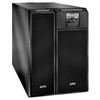
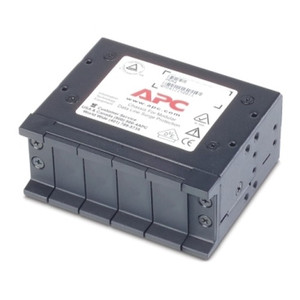
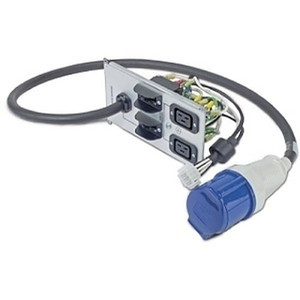
APC by Schneider Electric SRT6KXLT-5KTF 6kVA Online UPS with 208/240V to 120V Step-Down Transformer
Overview
The APC by Schneider Electric SRT6KXLT-5KTF is a 6 kVA / 6000 W double-conversion online UPS with an integrated step-down transformer — purpose-built for sites where the facility supplies 208 or 240V but the connected equipment runs on 120V. Rather than sourcing a separate isolation transformer and a separate UPS, this unit handles both voltage conversion and power conditioning in a single cabinet. That matters most in data center rows, server rooms, and AV/security head-end closets that were wired for three-phase 208V service but need to protect mixed 120V loads without adding another layer of single-phase infrastructure.
The SRT6KXLT-5KTF (often searched as SRT6KXLT 5KTF) accepts input anywhere from 100V to 275V and across a wide frequency window of 40–70 Hz — which means it handles international input feeds and generator output without immediately switching to battery. That range is worth noting if you are commissioning equipment in a facility that runs a diesel backup generator, since generator voltage and frequency can drift well outside the narrow bands that less tolerant UPS units reject.
Key Features
- Double-Conversion (Online) Topology: The load runs continuously off the inverter, not the raw utility feed. There is zero transfer time to battery on an outage — no 4ms, no 8ms, no tolerance question for sensitive switching power supplies or PLC equipment. Double-conversion also regenerates a clean sine wave output regardless of what comes in on the input side, which is the correct choice for head-end security infrastructure, network switches, and servers where brownouts and waveform distortion cause hard-to-diagnose soft failures.
- 6000 W / 6 kVA Output at Unity Power Factor: The kVA and watt ratings match, meaning this unit does not derate on modern switch-mode power supplies the way older UPS units did. A rack drawing 5.8 kW of actual load is a 5.8 kW load here — no multiplication gymnastics required when sizing.
- Integrated 208/240V to 120V Step-Down Transformer: Eliminates a separate transformer purchase and simplifies the one-line diagram. Input accepts 208V or 240V from a standard facility PDU or panel; output feeds 120V equipment directly. Critical in retrofits where adding a transformer enclosure means a permit, panel space, or conduit run you do not have budget for.
- True Sine Wave Output: Unlike line-interactive UPS units that produce a stepped approximation waveform under battery conditions, this unit delivers a pure sine wave at all times. Sine wave output is required by active PFC power supplies — which are standard on virtually all current server and networking hardware — to prevent overcurrent shutdowns or component stress during transfer events.
- Input Voltage Range 100–275V, 40–70 Hz: This tolerance range means the unit absorbs generator frequency variation, building voltage sag, and wide international input feeds without bouncing to battery. In surveillance deployments covering warehouse or industrial sites with long feeder runs and voltage drop, this keeps the UPS on utility power instead of discharging the battery unnecessarily.
- Input THD of 2%: The UPS draws near-sinusoidal current from the supply — relevant when the facility has sensitive equipment on the same panel or where the electrical contract specifies harmonic limits. Many competing online UPS units draw 10–15% THD, which can trip harmonic filters or cause neutral conductor heating in shared circuits.
- 480 J Surge Energy Rating with Surge Protection: Handles transient spike energy from switching events, near-miss lightning coupling, and utility switching. At 480 joules, this is not a token suppressor — it provides meaningful protection for the connected load while the double-conversion topology handles continuous line noise independently.
- 3:1 Crest Factor Support: Handles loads with a current crest factor up to 3:1 — the ratio of peak to RMS current draw. This is directly relevant for non-linear loads like switching power supplies that draw current in sharp peaks. Many older or cheaper UPS inverters clip at 1.5:1 or 2:1, causing distorted output or overload faults when connected to servers. This unit handles it without complaint.
- Emergency Power Off (EPO): Hardwired EPO input for integration into the facility's emergency shutdown circuit — required in most data center and server room builds per NFPA 75 / NFPA 76 or local electrical code. Plan the EPO wiring in your initial rough-in; retrofitting it after drywall is closed is avoidable labor.
- Web-Based Management: Remote monitoring and configuration via network interface — no local access required for routine status checks, load readings, or battery health review. Integrates into NOC dashboards and NMS platforms that support SNMP or HTTP polling, which is the operational baseline for managed infrastructure deployments.
- Audible Alarm and Auto-Restart: On-battery and fault alarms give local personnel an immediate indication without requiring a monitoring screen. Auto-restart returns the unit to service after a utility restoration without manual intervention — important for unmanned remote sites or after-hours outages where a technician dispatch would otherwise be required.
- 55 dB Noise Level: Measured at a typical distance, 55 dB is comparable to a standard office HVAC fan — acceptable in a dedicated server room or utility closet but worth noting if the head-end cabinet is located in an open office or a low-ambient-noise environment where audible fan noise is a constraint.
Integration & Compatibility
The SRT6KXLT-5KTF is part of APC's Smart-UPS SRT line, which supports the full range of APC network management cards and environmental monitoring accessories for SNMP, Modbus, and EnergyWise integration. The wide input range (100–275V) makes the unit viable for both domestic 208V three-phase feeds and international 230–240V single-phase feeds. Output voltage is selectable between 120V and 240V, providing flexibility when load configurations change after initial installation. For facilities requiring Power over Ethernet protection downstream, pair this UPS with a PoE switch on the 120V output — the clean sine wave and zero-transfer-time topology provide the most stable power baseline available for network infrastructure. For broader power and UPS selection including smaller capacity or rack-mounted variants in the APC Smart-UPS line, the full category covers options from single-phase 1500VA through 3-phase installations. When deploying surveillance head-ends, pair with a network video recorder on the protected output to ensure continuous recording through utility interruptions.
Frequently Asked Questions
Q: What is the difference between a double-conversion online UPS and a line-interactive UPS, and why does it matter for this application?
A: A double-conversion online UPS like the SRT6KXLT-5KTF runs the load entirely off the inverter at all times — the utility feed charges the batteries and the inverter powers the load continuously. There is zero transfer time on an outage. A line-interactive UPS passes utility power directly to the load and switches to inverter only on an outage, with a transfer time of 2–8ms. For servers with active PFC power supplies and network infrastructure, zero transfer time eliminates any possibility of a micro-interruption causing a reset or fault condition.
Q: Does the SRT6KXLT-5KTF accept both 208V and 240V input?
A: Yes. The input operating voltage range spans 100V to 275V, so the unit accepts standard North American 208V three-phase-derived single-phase feeds as well as 240V single-phase feeds from domestic or international utility sources. Input frequency tolerance is 40–70 Hz, which also accommodates generator output variation.
Q: What output voltage does this UPS provide?
A: The integrated step-down transformer outputs 120V for North American equipment loads. The output voltage range is specified as 120V to 240V, providing configuration flexibility depending on the connected load requirements.
Q: Does the SRT6KXLT-5KTF require an EPO connection?
A: The EPO (Emergency Power Off) input is provided as a hardwired connection point. Whether it is required depends on local electrical code and the authority having jurisdiction — NFPA 75 and NFPA 76 typically mandate EPO for data centers and IT equipment rooms above certain thresholds. The EPO input should be wired during initial installation; retrofitting after construction is complete adds unnecessary labor cost.
Q: What is the input current harmonic distortion (THD) of the SRT6KXLT-5KTF?
A: Input current THD is 2%, which is significantly lower than many competing online UPS units that draw 10–15% THD. This reduces harmonic loading on the upstream electrical distribution, which matters when the UPS shares a panel with other sensitive equipment or where the facility's electrical specifications include harmonic limits.
Q: Can the SRT6KXLT-5KTF be monitored remotely?
A: Yes. The unit includes web-based management capability, allowing remote access for status monitoring, load readings, and configuration. APC's Smart-UPS SRT platform supports optional network management card accessories for SNMP integration into NMS or NOC monitoring platforms.
The SRT6KXLT-5KTF solves a problem that comes up constantly on commercial security and AV head-end builds: the facility panel is 208V, the equipment is 120V, and the project scope doesn't have room for a separate isolation transformer plus a separate UPS on the one-line. The integrated step-down transformer in this unit eliminates that extra device, and the double-conversion topology means the 120V output is regenerated clean regardless of what the 208V feed looks like — generator harmonics, voltage sag, brownouts — none of it reaches the connected load.
Technical Highlights:
- 2% Input THD: At 6 kVA of double-conversion load, most competing units draw 10–15% input THD and require upstream harmonic filtering on shared panels. This unit's 2% THD keeps the upstream distribution clean, which matters when the UPS shares a subpanel with other instrumentation or building controls.
- 100–275V / 40–70 Hz Input Tolerance: Wide enough to ride through generator frequency variation and building voltage sag without bouncing to battery. In sites with long feeder runs or unstable utility feeds, this tolerance directly extends battery life by keeping the unit on bypass rather than cycling through avoidable battery discharges.
- 3:1 Crest Factor: Supports peak current draw up to three times the RMS load current — the practical requirement for server and networking hardware with switch-mode power supplies. Units that clip at 1.5:1 or 2:1 exhibit output voltage distortion or nuisance overload trips under real server loads.
Deployment Considerations:
- Plan EPO wiring during rough-in. The SRT6KXLT-5KTF includes an EPO input that most jurisdictions require for server rooms and data center spaces under NFPA 75/76. Retrofitting EPO conduit after construction is closed is an avoidable cost — wire it in at the start even if the EPO circuit is not yet active.
- At 55 dB of acoustic output, this is not a silent unit. It is appropriate for a dedicated equipment room or utility closet, not an open office or noise-sensitive environment. Verify the installation space can tolerate continuous fan noise at this level before specifying.
Best fit for a commercial security head-end, data closet, or AV equipment room fed from a 208V panel that needs clean, zero-transfer-time 120V power protection without a separate transformer in the equipment stack.