
APC by Schneider Electric SRT10KRMXLT-5KTF2 vs APC by Schneider Electric SRTL10KRM4UT-5KTF2: Specification Comparison
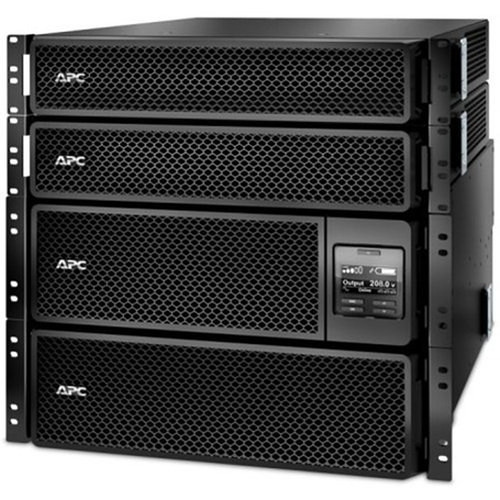
Both the SRT10KRMXLT-5KTF2 and SRTL10KRM4UT-5KTF2 are APC Smart-UPS 10 kVA rack-mount double-conversion (online) UPS units bundled with two 5 kVA 208V-to-120V step-down transformers, targeting the same data center and critical-load rackmount market segment. The primary differentiators are battery chemistry—lead-acid versus lithium-ion—rack unit footprint, input voltage range, and onboard network management integration. This comparison evaluates both units across power architecture, battery and runtime characteristics, and physical/management integration to help installers and IT buyers choose the right platform.
In This Guide
- How do the two units differ in input voltage range, output capacity, and power quality?
- What are the battery chemistry, recharge time, and runtime extension differences between these two UPS units?
- How do the two units compare in rack footprint, onboard management, and environmental ratings?
- Which should you choose: the SRT10KRMXLT-5KTF2 or the SRTL10KRM4UT-5KTF2?
- Side-by-Side Specs
- FAQ
How do the two units differ in input voltage range, output capacity, and power quality?
Both units deliver 10,000 W / 10 kVA of double-conversion online output with a true sine waveform and a 3:1 crest factor, so load-handling quality is equivalent on paper. Output THD is specified at 2% for the SRT10KRMXLT-5KTF2; no THD figure is provided for the SRTL10KRM4UT-5KTF2.
The SRT10KRMXLT-5KTF2 has a notably wide input voltage window of 100–275 V at 40–70 Hz, making it tolerant of heavily distorted utility power and international voltage swings. The SRTL10KRM4UT-5KTF2 specifies input as 208 V AC or 240 V AC (1-phase), with no published minimum/maximum voltage range, so its input tolerance cannot be confirmed from available specs.
Output voltage on the SRT10KRMXLT-5KTF2 spans 120–208 V (served via the included step-down transformers), while the SRTL10KRM4UT-5KTF2 outputs 208 V / 240 V AC natively—the step-down transformers in the bundle handle 120 V loads downstream. Surge energy rating (480 J) and EPO support are documented only for the SRT10KRMXLT-5KTF2; neither spec is published for the SRTL10KRM4UT-5KTF2.
What are the battery chemistry, recharge time, and runtime extension differences between these two UPS units?
This is the most consequential differentiator. The SRTL10KRM4UT-5KTF2 uses lithium-ion (Li-Ion) chemistry at a 180 V battery voltage, with a specified typical recharge time of 1.5 hours and a battery charging power of 1,200 W. Lithium-ion chemistry generally offers longer calendar life, lighter weight, and faster recharge compared to traditional VRLA lead-acid cells—though neither cycle-life figures nor runtime curves are provided in the available specs.
The SRT10KRMXLT-5KTF2 does not specify battery chemistry, battery voltage, or recharge time in the provided data. Runtime extension capability is not documented for the SRT10KRMXLT-5KTF2; the SRTL10KRM4UT-5KTF2 lists 'Extendable Runtime: 0,' indicating no external battery pack support per the published spec.
Buyers planning to extend runtime via external battery cabinets should verify compatibility independently for both models, as the SRTL10KRM4UT-5KTF2 explicitly states no runtime extension, and the SRT10KRMXLT-5KTF2 does not address the question in the available data.
How do the two units compare in rack footprint, onboard management, and environmental ratings?
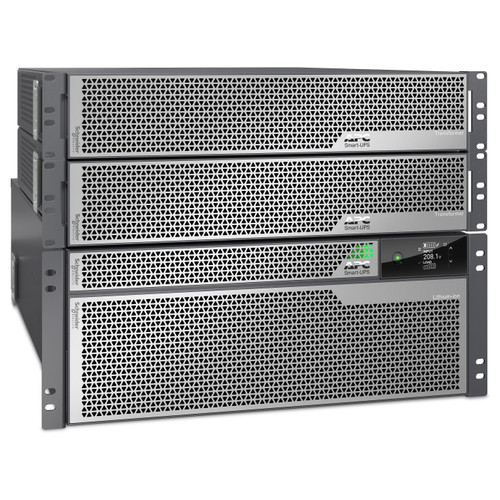
The SRTL10KRM4UT-5KTF2 occupies 4U of rack space and is rack/tower convertible with an included kit. It ships with an embedded network management card (NMC3), a multi-function LCD status and control console, USB port, serial port, and an available expansion slot—providing out-of-box remote monitoring without additional accessories. Color is specified as silver grey. Packaged weight is 397.9 lb (180.5 kg); shipping carton dimensions are 41.5 × 25.6 × 39.4 in.
The SRT10KRMXLT-5KTF2 does not specify rack unit height or physical dimensions in the provided data. It confirms web-based management support, audible alarms, and EPO; however, whether an NMC is included or must be added separately is not stated in the available specs.
Environmental ratings are documented only for the SRTL10KRM4UT-5KTF2: IP20 ingress protection, 0–95% non-condensing relative humidity (operating and storage), operating altitude 0–10,000 ft, storage altitude 0–50,000 ft, and storage temperature 5–113 °F (−15–45 °C). Noise level is 55 dB for both units. No IP rating or altitude figures are published for the SRT10KRMXLT-5KTF2.
Which should you choose: the SRT10KRMXLT-5KTF2 or the SRTL10KRM4UT-5KTF2?
Our take: The SRTL10KRM4UT-5KTF2 is the stronger choice when battery longevity, fast recharge, and out-of-box network management are priorities—its lithium-ion chemistry recharges in 1.5 hours at 1,200 W, the embedded NMC3 eliminates an accessory purchase, and its 4U rack footprint and IP20/altitude ratings are fully documented. The SRT10KRMXLT-5KTF2 has a decisive advantage in input voltage tolerance (100–275 V, 40–70 Hz versus an unspecified range for the SRTL), a published 480 J surge energy rating, EPO support, and a confirmed 2% output THD—making it the better fit for facilities with unstable or wide-ranging utility power. Buyers requiring runtime extension should note that the SRTL10KRM4UT-5KTF2 explicitly states no external battery support; the SRT10KRMXLT-5KTF2 does not address this in available specs. For stable 208 V data center environments prioritizing battery life and integrated management, the Li-Ion SRTL unit leads; for utility-variable or mixed-voltage sites, the SRT10KRMXLT-5KTF2's broader input window is the deciding factor.
Side-by-Side Comparison
Spec-for-spec, from manufacturer data.
| Specification | APC by Schneider Electric SRT10KRMXLT-5KTF2 | APC by Schneider Electric SRTL10KRM4UT-5KTF2 |
|---|---|---|
| UPS Topology | Double-conversion (Online) | On-Line (Double-conversion) |
| Output Power (kVA) | 10 kVA | 10 kVA |
| Output Power (W) | 10,000 W | 10,000 W |
| Waveform | Sine | Sine wave |
| Crest Factor | 3:1 | 3:1 |
| Input Voltage Range | 100–275 V | 208 V AC / 240 V AC (range not specified) |
| Input Frequency | 40–70 Hz | 50/60 Hz |
| Output Frequency | 50/60 Hz | 50/60 Hz ±3 Hz sync to mains |
| Output Voltage | 120 V / 208 V (via step-down transformers) | 208 V / 240 V AC (step-down transformers included) |
| Output THD | 2% | — |
| Battery Chemistry | — | Li-Ion (Lithium-Ion) |
| Battery Voltage | — | 180 V |
| Typical Recharge Time | — | 1.5 h |
| Battery Charging Power | — | 1,200 W |
| Surge Energy Rating | 480 J | — |
| Emergency Power Off (EPO) | Yes | — |
| Network Management | Web-based (NMC inclusion not specified) | Embedded NMC3 + USB + Serial port |
| Rack Units | — | 4U |
| Mounting | — | Rack/tower convertible |
| Noise Level | 55 dB | 55 dB |
| IP Protection | — | IP20 |
| Operating Altitude | — | 0–10,000 ft |
| Extendable Runtime | — | No (0) |
| Audible Alarm | Yes | Yes (prioritized by severity) |
| Package Weight | — | 397.9 lb (180.5 kg) |
Frequently Asked Questions
Which should you choose: the SRT10KRMXLT-5KTF2 or the SRTL10KRM4UT-5KTF2?
The SRTL10KRM4UT-5KTF2 is the stronger choice when battery longevity, fast recharge, and out-of-box network management are priorities—its lithium-ion chemistry recharges in 1.5 hours at 1,200 W, the embedded NMC3 eliminates an accessory purchase, and its 4U rack footprint and IP20/altitude ratings are fully documented. The SRT10KRMXLT-5KTF2 has a decisive advantage in input voltage tolerance (100–275 V, 40–70 Hz versus an unspecified range for the SRTL), a published 480 J surge energy rating, EPO support, and a confirmed 2% output THD—making it the better fit for facilities with unstable or wide-ranging utility power. Buyers requiring runtime extension should note that the SRTL10KRM4UT-5KTF2 explicitly states no external battery support; the SRT10KRMXLT-5KTF2 does not address this in available specs. For stable 208 V data center environments prioritizing battery life and integrated management, the Li-Ion SRTL unit leads; for utility-variable or mixed-voltage sites, the SRT10KRMXLT-5KTF2's broader input window is the deciding factor.
Is the SRT10KRMXLT-5KTF2 or SRTL10KRM4UT-5KTF2 better for sites with unstable or wide-ranging utility power?
The SRT10KRMXLT-5KTF2 is the documented choice here. Its specs confirm an input voltage range of 100–275 V at 40–70 Hz, which accommodates significant utility variance. The SRTL10KRM4UT-5KTF2 lists its input as 208 V AC or 240 V AC with no published minimum/maximum operating voltage, so its tolerance to out-of-range utility conditions cannot be confirmed from available data.
Does the SRTL10KRM4UT-5KTF2 include a network management card, or do I need to buy one separately?
Per the published specs, the SRTL10KRM4UT-5KTF2 includes an embedded network management card 3 (NMC3) plus USB and serial ports, so remote monitoring is available out of box. The SRT10KRMXLT-5KTF2 confirms web-based management support, but whether an NMC is bundled or must be purchased separately is not stated in the available specifications.
Can either unit be connected to external battery cabinets to extend runtime?
The SRTL10KRM4UT-5KTF2 explicitly specifies 'Extendable Runtime: 0,' meaning no external battery pack support is listed in its published specs. Runtime extension capability is not addressed in the available specifications for the SRT10KRMXLT-5KTF2. Buyers with extended-runtime requirements should verify compatibility directly with APC before purchasing either model.
More UPS Comparisons
- APC by Schneider Electric SRTL10KRM4UT-5KTF2 vs Panduit U10N32V
- APC by Schneider Electric SRTL10KRM4UT-5KTF2 vs Panduit U10N11V
- APC by Schneider Electric SRTL10KRM4UT-5KTF2 vs Panduit U10N12V
- APC by Schneider Electric SRTL10KRM4UT-5KTF2 vs Vertiv GXT5-10KHVRT5UXLN
- APC by Schneider Electric SRTL10KRM4UT-5KTF2 vs APC by Schneider Electric E3SUPS10KFBS
- APC by Schneider Electric SRTL10KRM4UT-5KTF2 vs APC by Schneider Electric SRT10KRMXLT-10KTF
UPS Buying Guides
Get a Second Opinion on Your Camera Choice
Share your site layout, coverage goals, and budget. Our team will validate the camera selection, flag anything we would change, and recommend products that match the use case.