
APC by Schneider Electric SMTL1500RM3UC vs APC by Schneider Electric SMX1500RMI2U: Specification Comparison
Both the SMTL1500RM3UC and SMX1500RMI2U are 1500VA line-interactive rack-mount UPS units from APC by Schneider Electric's Smart-UPS family, making them direct cross-shop candidates for IT buyers protecting servers, network switches, and similar loads. The comparison spans three decision-critical dimensions: power output and battery chemistry, physical form factor and environmental ratings, and communications plus management capabilities. Key differentiators include battery technology (lithium-ion vs. lead-acid), rack unit height, input voltage class (120V North American vs. 230V international), and recharge time.
In This Guide
- Which model delivers more usable power and how does battery chemistry affect lifecycle and recharge?
- How do the two units differ in rack footprint, operating environment, and deployment region?
- What management interfaces and certifications does each model offer for enterprise IT environments?
- Which should you choose: the SMTL1500RM3UC or the SMX1500RMI2U?
- Side-by-Side Specs
- FAQ
Which model delivers more usable power and how does battery chemistry affect lifecycle and recharge?
The SMTL1500RM3UC is rated at 1,350W / 1,440VA maximum configurable output, while the SMX1500RMI2U is rated at 1,200W / 1,500VA. On raw wattage the SMTL1500RM3UC supplies 150W more usable power; the SMX1500RMI2U carries a slightly higher VA ceiling but lower watt ceiling.
Battery chemistry is the starkest divide. The SMTL1500RM3UC uses lithium-ion with an expected battery life of 5–10 years, a 2-hour typical recharge time, and a battery charging power of 154W. The SMX1500RMI2U uses a sealed lead-acid (VRLA) battery rated 3–5 years life, a 3-hour typical recharge time, and a battery charging power of 103W. Lithium-ion provides roughly double the expected service life, faster recharge, and lower weight (19.5 kg vs. 24.82 kg).
Both units produce a sine-wave output with less than 5% harmonic distortion and operate at 50/60 Hz ±3 Hz synchronized to mains—identical waveform quality. Surge energy ratings are close: 680 J (SMTL1500RM3UC) vs. 645 J (SMX1500RMI2U), a 35 J edge for Product A.
How do the two units differ in rack footprint, operating environment, and deployment region?
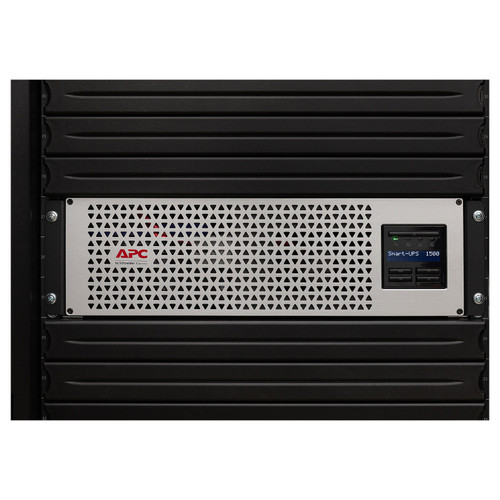
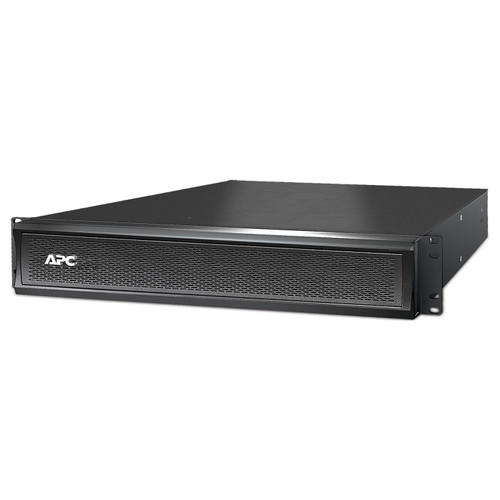
The SMTL1500RM3UC occupies 3U of rack space (131 mm height, 438 mm width, 302 mm depth) and weighs 19.5 kg. The SMX1500RMI2U is a 2U unit (89 mm height stated; 438 mm width implied by rack standard) and weighs 24.82 kg. Buyers with constrained rack space gain one rack unit with the SMX1500RMI2U, despite its greater weight.
Input voltage is a hard regional separator. The SMTL1500RM3UC is a 120V AC unit designed for North American infrastructure, with an IEC/NEMA input. The SMX1500RMI2U operates at 230V AC single-phase with an IEC 320 C14 input and 8× IEC 320 C13 plus 2× IEC jumper outputs—configured for international (primarily European and Asia-Pacific) markets. These two units are not interchangeable on voltage without a transformer.
Operating altitude is identical at 0–10,000 ft (0–3,000 m). Operating relative humidity is identical at 0–95% non-condensing. Storage temperature differs: SMTL1500RM3UC is rated −10°C to 40°C; SMX1500RMI2U is rated −15°C to 45°C, a slightly wider cold and warm storage window. Storage altitude of the SMX1500RMI2U (0–15,240 m) substantially exceeds the SMTL1500RM3UC's stated 0–7,500 m. Acoustic level is only specified for the SMX1500RMI2U at 40 dBA; the SMTL1500RM3UC spec sheet does not state an acoustic figure. Heat dissipation is comparable: 135 BTU/hr (SMTL1500RM3UC) vs. 133 BTU/hr (SMX1500RMI2U).
What management interfaces and certifications does each model offer for enterprise IT environments?
The SMTL1500RM3UC provides an RJ-45 Serial port, a USB port, and one Smart-Slot expansion bay for optional network management cards. Its control panel is a multi-function LCD. Audible alarms include on-battery notification, a distinctive low-battery alarm, and configurable delays.
The SMX1500RMI2U provides a Serial port, a USB port, and one available expansion slot (described as 'Free Slot: 1'). Its control panel is also a multi-function LCD. Alarm coverage includes on-battery, low-battery, and an overload continuous-tone alarm—the overload alarm is listed in the SMX1500RMI2U spec but is not explicitly listed for the SMTL1500RM3UC. The SMX1500RMI2U spec notes 'Extended Run' capability, implying external battery pack support; the SMTL1500RM3UC spec does not include this designation.
On certifications, the SMTL1500RM3UC carries CSA C22.2 No. 107.3, FCC Part 15 Class A, NOM, UL 1778, UL 1973, and RoHS compliance. The SMX1500RMI2U carries CE, CSA, EAC, RCM, and UK PSTI, plus EN/IEC 62040-1:2019/A11:2021 and EN/IEC 62040-2 standards, and EU RoHS compliance by exemption. The two certification sets reflect their respective target markets (North American vs. international). The SMX1500RMI2U also discloses a lifecycle carbon footprint of 1,249 kg CO₂ eq. and 51% recyclability potential; these figures are not provided for the SMTL1500RM3UC.
Both units ship with CD software, documentation, installation guide, rack mounting rails, RS-232 signalling cable, and USB cable. The SMX1500RMI2U additionally includes removable support feet. Replacement battery for the SMX1500RMI2U is documented as APCRBC115; no replacement battery part number is stated in the SMTL1500RM3UC spec.
Which should you choose: the SMTL1500RM3UC or the SMX1500RMI2U?
Our take: The SMTL1500RM3UC is the stronger choice when deploying in a 120V North American environment and prioritizing battery longevity and lower total cost of ownership, while the SMX1500RMI2U is the correct selection for 230V international installations. Three concrete spec deltas matter most: (1) battery life—the SMTL1500RM3UC's lithium-ion chemistry is rated 5–10 years versus 3–5 years for the SMX1500RMI2U's lead-acid, nearly doubling replacement intervals; (2) usable wattage—the SMTL1500RM3UC delivers 1,350W versus 1,200W, a 150W advantage for power-dense loads; (3) recharge time—2 hours versus 3 hours means the SMTL1500RM3UC returns to full protection faster after a discharge event. Conversely, the SMX1500RMI2U requires only 2U of rack space versus 3U and supports external battery packs for extended runtime—advantages for space-constrained, runtime-critical 230V sites. Input voltage incompatibility makes these units non-interchangeable across voltage regions.
Side-by-Side Comparison
Spec-for-spec, from manufacturer data.
| Specification | APC by Schneider Electric SMTL1500RM3UC | APC by Schneider Electric SMX1500RMI2U |
|---|---|---|
| Model | SMTL1500RM3UC | SMX1500RMI2U |
| Input Voltage | 120V AC | 230V AC |
| Input Connection | Not stated in spec | IEC 320 C14 |
| Max Output Power (W) | 1,350 W | 1,200 W |
| Max Output Power (VA) | 1,440 VA | 1,500 VA |
| UPS Topology | Line Interactive | Line Interactive |
| Waveform Type | Sine wave | Sine wave |
| Output Harmonic Distortion | Less than 5% | Less than 5% |
| Battery Type | Lithium-ion | Lead-acid (VRLA) |
| Expected Battery Life | 5–10 years | 3–5 years |
| Typical Recharge Time | 2 hours | 3 hours |
| Battery Charging Power | 154 W | 103 W |
| Rack Height | 3U (131 mm) | 2U (89 mm) |
| Unit Weight | 19.5 kg (43 lb) | 24.82 kg |
| Surge Energy Rating | 680 J | 645 J |
| Interface Ports | RJ-45 Serial, Smart-Slot, USB | Serial, USB, Expansion Slot |
| Transfer Time | 6 ms typical / 10 ms max | — |
| Operating Temperature | 0°C to 40°C | Not explicitly stated |
| Storage Temperature | -10°C to 40°C | -15°C to 45°C |
| Operating Altitude | 0–10,000 ft (0–3,000 m) | 0–10,000 ft (0–3,048 m) |
| Heat Dissipation | 135 BTU/hr | 133 BTU/hr |
| Acoustic Level | — | 40 dBA |
| Extended Runtime Support | — | Yes (Extended Run) |
| Replacement Battery Part No. | — | APCRBC115 |
| Certifications | CSA, FCC Part 15 Class A, NOM, UL 1778, UL 1973 | CE, CSA, EAC, RCM, UK PSTI, EN/IEC 62040-1/-2 |
| RoHS | Compliant | Compliant by Exemption |
Frequently Asked Questions
Which should you choose: the SMTL1500RM3UC or the SMX1500RMI2U?
The SMTL1500RM3UC is the stronger choice when deploying in a 120V North American environment and prioritizing battery longevity and lower total cost of ownership, while the SMX1500RMI2U is the correct selection for 230V international installations. Three concrete spec deltas matter most: (1) battery life—the SMTL1500RM3UC's lithium-ion chemistry is rated 5–10 years versus 3–5 years for the SMX1500RMI2U's lead-acid, nearly doubling replacement intervals; (2) usable wattage—the SMTL1500RM3UC delivers 1,350W versus 1,200W, a 150W advantage for power-dense loads; (3) recharge time—2 hours versus 3 hours means the SMTL1500RM3UC returns to full protection faster after a discharge event. Conversely, the SMX1500RMI2U requires only 2U of rack space versus 3U and supports external battery packs for extended runtime—advantages for space-constrained, runtime-critical 230V sites. Input voltage incompatibility makes these units non-interchangeable across voltage regions.
Is the SMTL1500RM3UC or SMX1500RMI2U better for a data center rack with limited space?
The SMX1500RMI2U occupies 2U versus 3U for the SMTL1500RM3UC, giving it a one rack-unit advantage in space-constrained deployments. However, the SMX1500RMI2U is a 230V unit and cannot be used on 120V North American circuits without a step-up transformer, so the space saving is only relevant to international installations.
Which model has a longer-lasting battery and lower replacement cost over time?
The SMTL1500RM3UC uses a lithium-ion battery rated for 5–10 years, versus the SMX1500RMI2U's lead-acid battery rated for 3–5 years. All else being equal, the lithium-ion unit is expected to require fewer battery replacements over a 10-year service life. The SMX1500RMI2U's replacement battery is documented as APCRBC115; no equivalent part number is stated in the SMTL1500RM3UC spec sheet.
Can either model support extended runtime with additional battery packs?
The SMX1500RMI2U spec includes an 'Extended Run' designation, indicating support for external battery packs to increase runtime. The SMTL1500RM3UC spec does not include this designation, so extended runtime capability via external packs cannot be confirmed for that model based on the provided specifications.
More UPS Comparisons
- APC by Schneider Electric SMX1500RMI2U vs CyberPower PRL1500RT2UC
- APC by Schneider Electric SMX1500RMI2U vs CyberPower BRG1500AVRLCD2
- APC by Schneider Electric SMX1500RMI2U vs CyberPower PR1500LCD
- APC by Schneider Electric SMX1500RMI2U vs APC by Schneider Electric BR1500MS2
- APC by Schneider Electric SMX1500RMI2U vs APC by Schneider Electric SMTL1500RM3UCUS
- CyberPower PRL1500RT2UC vs APC by Schneider Electric BR1500MS2
UPS Buying Guides
Get a Second Opinion on Your Camera Choice
Share your site layout, coverage goals, and budget. Our team will validate the camera selection, flag anything we would change, and recommend products that match the use case.