
APC by Schneider Electric SMT750R2X122 vs Vertiv GXT5-750LVRT2UXL: Specification Comparison
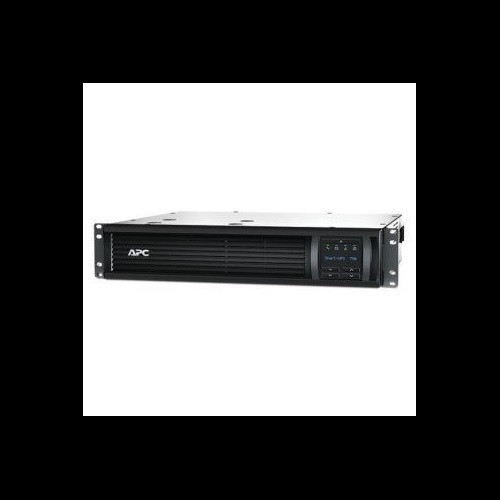
Both the APC SMT750R2X122 and the Vertiv GXT5-750LVRT2UXL are 750VA, 2U rackmount uninterruptible power supplies designed for server rooms, network closets, and edge deployments requiring protected 120V AC output. They share the same VA rating and form factor, making them direct cross-shop candidates for buyers evaluating rack UPS solutions at this capacity tier. The comparison turns on fundamental topology differences — line-interactive vs. true online double-conversion — plus real-world watt capacity, battery manageability, connectivity, and output waveform quality.
In This Guide
- Which UPS topology and runtime best protect sensitive loads?
- How do battery serviceability, outlet configuration, and physical dimensions compare?
- What management interfaces, monitoring options, and certifications does each unit carry?
- Which should you choose: the SMT750R2X122 or the GXT5-750LVRT2UXL?
- Side-by-Side Specs
- FAQ
Which UPS topology and runtime best protect sensitive loads?
The APC SMT750R2X122 uses a line-interactive topology. Its specifications do not state the topology explicitly, but the transfer time to battery is not listed as zero, which is consistent with line-interactive operation rather than online double-conversion. The Vertiv GXT5-750LVRT2UXL is explicitly rated as True Online Double Conversion with a stated zero transfer time, meaning the load runs continuously from the inverter and the utility never directly feeds the output — eliminating transfer time entirely during a power event.
At the watt level, the gap is significant: the APC unit is rated 500W (a 0.67 power factor), while the Vertiv is rated 750W at a power factor of 0.9–1.0. For the same 750VA nameplate, the Vertiv delivers 50% more real power capacity. Buyers running servers or network equipment that draw close to 600–700W at 120V will find the APC unit undersized at full VA load. Runtime specs are provided only for the APC: 5 minutes at full load (500W) and 16 minutes at half load (250W). The Vertiv's runtime figures are not provided in the supplied specifications.
The Vertiv specifies a Pure Sine Wave output waveform. The APC's output waveform is not stated in the provided specifications. Sensitive loads — servers with active PFC power supplies, medical equipment, and precision networking gear — generally require pure sine wave output. Buyers should verify the APC's waveform from the manufacturer datasheet before deploying it with such equipment.
How do battery serviceability, outlet configuration, and physical dimensions compare?
The Vertiv GXT5-750LVRT2UXL specifies hot-swappable internal batteries and supports external battery cabinet expansion — both features absent from the APC SMT750R2X122's provided specifications. Hot-swap capability allows battery replacement without shutting down the protected load, a critical operational requirement in high-availability environments. The APC specifies a 3-hour recharge time and Lead Acid chemistry; the Vertiv's battery chemistry and recharge time are not stated in the provided specifications.
Both units provide 6 output receptacles. The APC outputs are 6× NEMA 5-15R. The Vertiv also provides 6× NEMA 5-15R, but specifies that 4 are programmable (outlet-level switching) and 2 are non-programmable — a granularity the APC spec does not mention. Programmable outlets allow staged shutdown sequencing and remote load shedding.
On input plug, the units differ: the APC uses a NEMA L5-15P (twist-lock) input, while the Vertiv uses a NEMA 5-15P (standard straight-blade) input. Installers must confirm the existing PDU or wall circuit has the matching receptacle. The APC dimensions are 17" W × 26.3" D × 3.3" H; the Vertiv is 16.9" W × 15.7" D × 3.4" H. The Vertiv is notably shallower (15.7" vs. 26.3"), which matters in short-depth cabinets. The Vertiv is also rack/tower convertible per its specifications; the APC is listed as 2U rackmount only. The Vertiv's weight is stated at 37 lb; the APC's weight is not provided in the supplied specifications.
What management interfaces, monitoring options, and certifications does each unit carry?
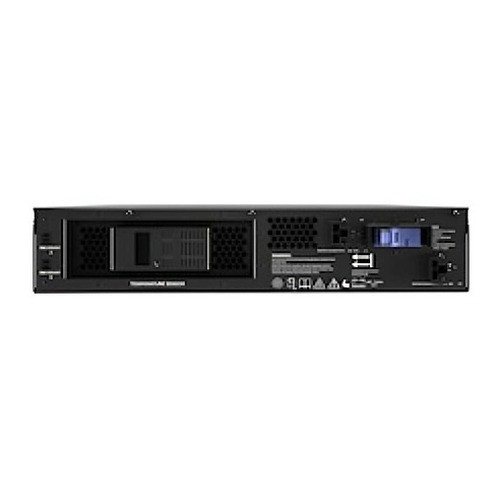
The Vertiv GXT5-750LVRT2UXL provides a substantially richer connectivity profile per its specifications: USB, RS232, RS485, a dry-contact terminal block for building management system integration, and an optional IntelliSlot SNMP/web card (RDU120) enabling network management, SNMP traps, and web-based monitoring. A gravity-sensing color LCD display is specified for local status. The APC SMT750R2X122's provided specifications do not list any communication ports, network management card slots, or display type, so a direct comparison on these points cannot be made from the supplied data alone.
The Vertiv carries a stated list of certifications: ENERGY STAR 2.0, UL 1778 4th edition, CSA 22.2 No. 107.1, RoHS2, REACH, and WEEE. The APC's provided specifications list circuit breaker overcurrent protection but do not enumerate certifications. Buyers in regulated environments (healthcare, government, education) frequently require UL listing documentation at procurement; the absence of certification data in the APC spec sheet does not mean it lacks certifications, but buyers must source that verification separately.
The Vertiv also specifies an input voltage operating range of 60–150V nominal and a configurable output voltage (110/115/120/125VAC ±3%), providing flexibility for sites with marginal utility power quality. The APC input and output are both listed as 120V with no range stated in the provided specifications, and no output configurability is mentioned.
Which should you choose: the SMT750R2X122 or the GXT5-750LVRT2UXL?
Our take: The GXT5-750LVRT2UXL is the stronger choice when load criticality, real power capacity, or serviceability requirements are primary. Its True Online Double Conversion topology delivers zero transfer time versus the APC's unspecified (line-interactive-consistent) transfer gap — a direct spec delta for sensitive active-PFC server loads. Its 750W real power rating is 50% higher than the APC's 500W at the same 750VA nameplate, meaning it can support loads the APC cannot safely carry at rated VA. Hot-swappable batteries and external expansion capability, both absent from the APC's provided specifications, enable maintenance without downtime. The APC SMT750R2X122 is better positioned where input plug compatibility (NEMA L5-15P twist-lock circuits), a known 5/16-minute runtime reference, or a shallower budget is the deciding factor — and where line-interactive topology is acceptable for the connected load type.
Side-by-Side Comparison
Spec-for-spec, from manufacturer data.
| Specification | APC by Schneider Electric SMT750R2X122 | Vertiv GXT5-750LVRT2UXL |
|---|---|---|
| UPS Topology | Not stated in provided specs | True Online Double Conversion |
| Capacity (VA) | 750VA | 750VA |
| Capacity (Watts) | 500W | 750W |
| Power Factor | 0.67 (derived) | 0.9–1.0 (stated) |
| Output Waveform | Not stated in provided specs | Pure Sine Wave |
| Transfer Time | Not stated in provided specs | Zero (continuous online) |
| Input Plug | NEMA L5-15P (twist-lock) | NEMA 5-15P (straight-blade) |
| Output Receptacles | 6× NEMA 5-15R | 6× NEMA 5-15R (4 programmable, 2 non-programmable) |
| Form Factor | 2U Rackmount | 2U Rack/Tower Convertible |
| Dimensions (W×D×H) | 17 × 26.3 × 3.3 in | 16.9 × 15.7 × 3.4 in |
| Weight | Not stated in provided specs | 37 lb (16.8 kg) |
| Battery Serviceability | Not stated in provided specs | Hot-swappable; external expansion supported |
| Battery Recharge Time | 3 hours | Not stated in provided specs |
| Runtime at Full Load | 5 min (500W) | Not stated in provided specs |
| Runtime at Half Load | 16 min (250W) | Not stated in provided specs |
| Connectivity / Management | Not stated in provided specs | USB, RS232, RS485, dry-contact, optional SNMP card |
| Display | Not stated in provided specs | Gravity-sensing color LCD |
| Efficiency | Not stated in provided specs | Up to 98% (Active ECO mode) |
| Certifications | Not stated in provided specs | ENERGY STAR 2.0, UL 1778, CSA 22.2 No. 107.1, RoHS2, REACH, WEEE |
Frequently Asked Questions
Which should you choose: the SMT750R2X122 or the GXT5-750LVRT2UXL?
The GXT5-750LVRT2UXL is the stronger choice when load criticality, real power capacity, or serviceability requirements are primary. Its True Online Double Conversion topology delivers zero transfer time versus the APC's unspecified (line-interactive-consistent) transfer gap — a direct spec delta for sensitive active-PFC server loads. Its 750W real power rating is 50% higher than the APC's 500W at the same 750VA nameplate, meaning it can support loads the APC cannot safely carry at rated VA. Hot-swappable batteries and external expansion capability, both absent from the APC's provided specifications, enable maintenance without downtime. The APC SMT750R2X122 is better positioned where input plug compatibility (NEMA L5-15P twist-lock circuits), a known 5/16-minute runtime reference, or a shallower budget is the deciding factor — and where line-interactive topology is acceptable for the connected load type.
Is the SMT750R2X122 or GXT5-750LVRT2UXL better for powering servers with active PFC power supplies?
The GXT5-750LVRT2UXL specifies a Pure Sine Wave output waveform, which is required by most servers with active power factor correction (active PFC) power supplies. The APC SMT750R2X122's output waveform is not stated in the provided specifications, so buyers with active PFC loads should confirm the APC's waveform directly with the manufacturer before deployment. The Vertiv's zero-transfer-time online topology also means the inverter continuously conditions the output, adding an additional layer of protection for sensitive loads.
Can I replace the battery without taking the UPS offline?
Only the Vertiv GXT5-750LVRT2UXL specifies hot-swappable batteries in the provided specifications, allowing battery replacement while the UPS continues to power the connected load. The APC SMT750R2X122's provided specifications do not indicate hot-swap capability. If no-downtime battery maintenance is a requirement, the Vertiv is the only unit of the two with that feature confirmed in the supplied data.
Which unit supports SNMP or network monitoring cards for remote management?
The Vertiv GXT5-750LVRT2UXL explicitly lists an optional IntelliSlot-compatible SNMP/web card (RDU120) and native interfaces including USB, RS232, and RS485 in its provided specifications. The APC SMT750R2X122's provided specifications do not list any communication ports or expansion card slots, so a direct comparison cannot be made from the supplied data. Buyers requiring SNMP integration for NMS platforms should verify APC SmartSlot or Network Management Card compatibility separately from the manufacturer.
More UPS Comparisons
- APC by Schneider Electric SMT750C vs CyberPower PR750RTXL2UC
- APC by Schneider Electric SMT750C vs Vertiv GXT5-750LVRT2UXL
- APC by Schneider Electric SMT750C vs CyberPower PR750LCDRT1U
- APC by Schneider Electric SMT750C vs CyberPower AVRG750U
- APC by Schneider Electric SMT750C vs APC by Schneider Electric SMT750CUS
- APC by Schneider Electric SMT750CUS vs CyberPower PR750RTXL2UC
UPS Buying Guides
Get a Second Opinion on Your Camera Choice
Share your site layout, coverage goals, and budget. Our team will validate the camera selection, flag anything we would change, and recommend products that match the use case.