
APC by Schneider Electric SMT750C vs Vertiv GXT5-750LVRT2UXL: Specification Comparison
Both the APC Smart-UPS SMT750C and the Vertiv Liebert GXT5-750LVRT2UXL are 750VA-class uninterruptible power supplies designed to protect sensitive loads from power disturbances. The APC is a line-interactive tower unit with cloud monitoring, while the Vertiv is a true online double-conversion rack/tower convertible. Buyers in the SMB, IT closet, and light data-center segments commonly cross-shop these two at the same VA rating, making a direct comparison meaningful for evaluating topology trade-offs, form factor, and management depth.
In This Guide
- How do the UPS topologies and runtime capabilities differ between these two models?
- What are the differences in usable output power, form factor, and receptacle configuration?
- How do the two units compare in connectivity, monitoring, and management integration?
- Which should you choose: the SMT750C or the GXT5-750LVRT2UXL?
- Side-by-Side Specs
- FAQ
How do the UPS topologies and runtime capabilities differ between these two models?
The SMT750C uses a line-interactive topology with a 6 ms typical / 10 ms maximum transfer time to battery, delivering a pure sine wave output at 500 W / 750 VA. Its 24 V, 7.0 Ah lead-acid battery is not hot-swappable per spec, and external battery expansion is not listed. Rated runtime energy is stated as 146 VAh; recharge time is 3 hours. The replacement battery is the RBC48.
The GXT5-750LVRT2UXL uses true online double-conversion topology with a zero-millisecond transfer time — the load runs from the inverter continuously, so there is no transfer event at all. Output capacity is 750 W / 750 VA (unity power factor), compared to the SMT750C's 500 W derated output at the same 750 VA rating. The GXT5 supports hot-swappable internal batteries and external cabinet expansion for extended runtime; specific Ah rating and recharge time are not provided in the supplied specifications.
For loads requiring absolute zero-transfer protection — medical monitoring, precision manufacturing controls, or always-on server clusters — the GXT5's online topology eliminates any transfer gap entirely. For general IT equipment tolerant of a brief 6–10 ms switchover, the SMT750C's line-interactive design is proven and its battery specs are fully documented.
What are the differences in usable output power, form factor, and receptacle configuration?
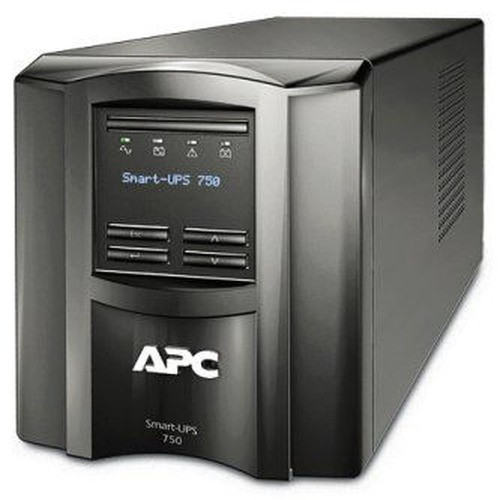
The SMT750C is rated at 500 W real power output despite its 750 VA label, reflecting a 0.67 power factor. It is a desktop/tower unit only — the spec explicitly states 'Not rack-mountable' — and ships with 6 NEMA 5-15R output receptacles. It weighs 29.0 lbs (13.18 kg) and measures 161 mm (6.34 in) in the stated dimension.
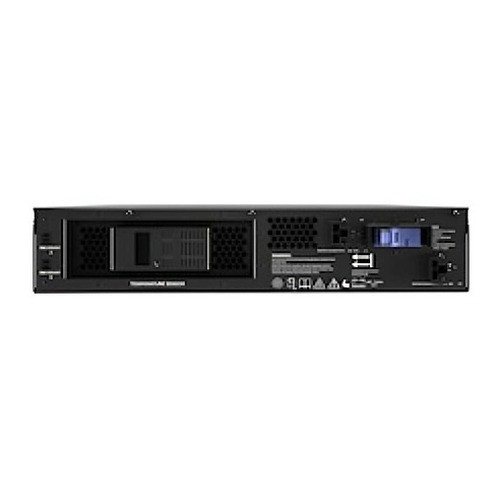
The GXT5-750LVRT2UXL delivers the full 750 W at a power factor of 0.9–1.0, providing 50% more real wattage from the same VA rating. It is a 2U rack/tower convertible measuring 430 × 400 × 85 mm (W×D×H) and weighing 37 lb (16.8 kg). Its 6 NEMA 5-15R outlets include 4 programmable (individually switchable) and 2 non-programmable, enabling load-shedding or sequenced shutdown without additional software.
For installations where rack density matters or where load segments need independent outlet control, the GXT5 offers clear structural advantages. For a standalone workstation or small network closet without rack infrastructure, the SMT750C's tower form factor and lighter weight are practical benefits.
How do the two units compare in connectivity, monitoring, and management integration?
The SMT750C provides a SmartConnect Ethernet port for cloud-based monitoring (availability subject to terms of use), plus alarm outputs for on-battery, low-battery, and overload conditions with configurable delays. Its LED status display shows on-line, on-battery, replace-battery, and overload states. No RS232, RS485, dry-contact, or SNMP slot is listed in the supplied specifications.
The GXT5-750LVRT2UXL includes USB, RS232, RS485, and a dry-contact terminal block as standard connectivity. An optional IntelliSlot SNMP/web card (model RDU120) adds full network management and remote web access. Its gravity-sensing color LCD provides local status. The unit also carries ENERGY STAR 2.0 certification and claims up to 98% efficiency in Active ECO mode; no comparable efficiency figure or ENERGY STAR certification is listed for the SMT750C.
For data-center NMS integration, DCIM platforms, or facilities requiring SNMP traps and RS485 bus connectivity, the GXT5's port set and optional SNMP card provide substantially more integration depth. The SMT750C's cloud Ethernet path suits smaller environments already invested in APC's EcoStruxure or SmartConnect ecosystem.
Which should you choose: the SMT750C or the GXT5-750LVRT2UXL?
Our take: The GXT5-750LVRT2UXL is the stronger choice when zero-transfer protection, full rated wattage, and deep management integration are required. Three concrete spec deltas drive this: first, the GXT5 delivers 750 W real power versus the SMT750C's 500 W — a 50% advantage at the same VA class; second, the GXT5's true online double-conversion topology eliminates all transfer time (0 ms) versus the SMT750C's 6–10 ms window; third, the GXT5 includes USB, RS232, RS485, dry-contact, and an optional SNMP slot versus the SMT750C's Ethernet-only cloud port with no RS485 or dry-contact listed. Conversely, the SMT750C is the stronger choice for cost-sensitive, non-rack tower deployments where APC SmartConnect cloud monitoring meets site requirements, battery specs are needed upfront (24 V / 7.0 Ah / RBC48 documented), and the 6–10 ms transfer window is acceptable for the connected load profile.
Side-by-Side Comparison
Spec-for-spec, from manufacturer data.
| Specification | APC by Schneider Electric SMT750C | Vertiv GXT5-750LVRT2UXL |
|---|---|---|
| UPS Topology | Line Interactive | True Online Double Conversion |
| Capacity (VA) | 750 VA | 750 VA |
| Capacity (Watts) | 500 W | 750 W |
| Power Factor (Output) | 0.67 (derived) | 0.9–1.0 |
| Transfer Time | 6 ms typical / 10 ms max | Zero (continuous online) |
| Waveform | Sine wave | Pure Sine Wave |
| Input Voltage | 120V (110–125V range) | 120V nominal (60–150V range) |
| Output Voltage | 120V (110–125V) | 110/115/120/125VAC ±3% (user-configurable) |
| Input Plug | NEMA 5-15P | NEMA 5-15P |
| Output Receptacles | 6x NEMA 5-15R | 6x NEMA 5-15R (4 programmable, 2 non-programmable) |
| Form Factor | Tower only (not rack-mountable) | Rack/Tower Convertible, 2U |
| Weight | 29.0 lb (13.18 kg) | 37 lb (16.8 kg) |
| Battery | Lead-acid, 24V / 7.0 Ah, RBC48 | Hot-swappable internal; external expansion supported |
| Recharge Time | 3 hours | — |
| Connectivity / Management | SmartConnect Ethernet (cloud); LED display | USB, RS232, RS485, dry-contact; optional SNMP card; color LCD |
| Certifications | — | ENERGY STAR 2.0, UL 1778, CSA 22.2, RoHS2, REACH, WEEE |
Frequently Asked Questions
Which should you choose: the SMT750C or the GXT5-750LVRT2UXL?
The GXT5-750LVRT2UXL is the stronger choice when zero-transfer protection, full rated wattage, and deep management integration are required. Three concrete spec deltas drive this: first, the GXT5 delivers 750 W real power versus the SMT750C's 500 W — a 50% advantage at the same VA class; second, the GXT5's true online double-conversion topology eliminates all transfer time (0 ms) versus the SMT750C's 6–10 ms window; third, the GXT5 includes USB, RS232, RS485, dry-contact, and an optional SNMP slot versus the SMT750C's Ethernet-only cloud port with no RS485 or dry-contact listed. Conversely, the SMT750C is the stronger choice for cost-sensitive, non-rack tower deployments where APC SmartConnect cloud monitoring meets site requirements, battery specs are needed upfront (24 V / 7.0 Ah / RBC48 documented), and the 6–10 ms transfer window is acceptable for the connected load profile.
Can either UPS be rack-mounted in a standard 19-inch cabinet?
Only the GXT5-750LVRT2UXL supports rack mounting — it is a 2U rack/tower convertible. The SMT750C spec explicitly states 'Not rack-mountable,' so it is a tower-only unit.
Which unit supports runtime extension with external battery cabinets?
The GXT5-750LVRT2UXL spec lists external cabinet expansion support and hot-swappable internal batteries. The SMT750C spec does not list external battery expansion; its replacement battery is the RBC48 internal pack.
Does either UPS support SNMP network management for integration with a NMS or DCIM platform?
The GXT5-750LVRT2UXL supports an optional IntelliSlot SNMP/web card (RDU120) for full SNMP and web-based management. The SMT750C spec lists a SmartConnect Ethernet port for cloud monitoring only; no SNMP slot or dry-contact terminal is listed in the supplied specifications.
More UPS Comparisons
- APC by Schneider Electric SMT750C vs CyberPower PR750RTXL2UC
- APC by Schneider Electric SMT750C vs CyberPower PR750LCDRT1U
- APC by Schneider Electric SMT750C vs CyberPower AVRG750U
- APC by Schneider Electric SMT750C vs APC by Schneider Electric SMT750CUS
- APC by Schneider Electric SMT750CUS vs CyberPower PR750RTXL2UC
- APC by Schneider Electric SMT750CUS vs Vertiv GXT5-750LVRT2UXL
UPS Buying Guides
Get a Second Opinion on Your Camera Choice
Share your site layout, coverage goals, and budget. Our team will validate the camera selection, flag anything we would change, and recommend products that match the use case.