
APC by Schneider Electric BR700G vs CyberPower SL700U: Specification Comparison
The APC BR700G and CyberPower SL700U are both 700VA tower UPS units designed for desktop and small-office protection of 120V AC loads. Both target the same general market segment — workstations, networking equipment, and light AV or security gear — making them legitimate cross-shop candidates. The comparison turns on topology (line-interactive vs. standby), waveform quality, surge-energy rating, runtime battery capacity, and the physical form factor differences that affect deployment flexibility.
In This Guide
- How do the topology and protection architecture differ between the BR700G and SL700U?
- Which unit delivers more usable wattage and how do the battery specs compare?
- How do surge energy ratings and output/data-line protection outlets compare?
- Which should you choose: the BR700G or the SL700U?
- Side-by-Side Specs
- FAQ
How do the topology and protection architecture differ between the BR700G and SL700U?
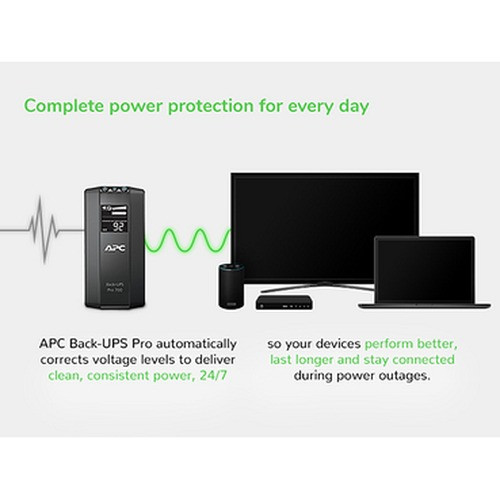
The APC BR700G uses a Line-Interactive topology, meaning it employs an automatic voltage regulator (AVR) that continuously corrects brownouts and overvoltages without switching to battery. This allows the inverter to be active in the AC path at all times, resulting in a stepped-approximation sinewave output and a rated transfer time of 8 ms typical / 12 ms maximum when a true outage occurs. The input acceptance window is specified as 88–143 V.
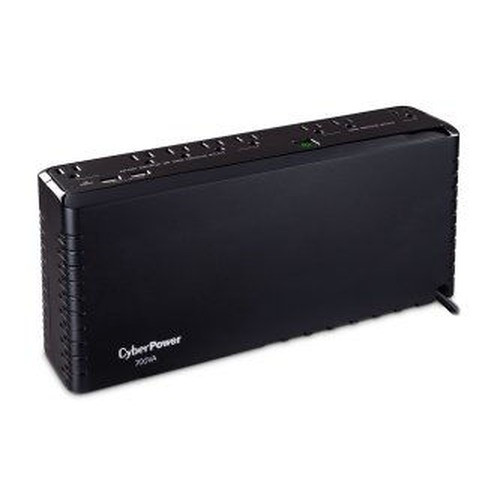
The CyberPower SL700U uses a Standby (Offline) topology. In normal operation, the load runs directly from utility power; the inverter only engages on a power failure. CyberPower specifies the response time as 8 ms and lists a sinewave waveform output. The input operating voltage window is stated as 96–140 V, slightly narrower on the low end (96 V vs. 88 V) and slightly narrower on the high end (140 V vs. 143 V) compared to the BR700G. CyberPower also lists Automatic Voltage Regulation (AVR) as a feature, though with a standby topology this typically refers to boost/buck switching rather than continuous inline regulation.
The practical consequence: the BR700G's line-interactive design provides more continuous conditioning and will remain on utility power through a broader voltage excursion range, potentially reducing unnecessary battery cycling in areas with frequent brownouts.
Which unit delivers more usable wattage and how do the battery specs compare?
Both units are rated at 700VA. The APC BR700G is rated at 420W (60% power factor), while the CyberPower SL700U is rated at 370W (52.9% power factor). The BR700G therefore supports 50W more of real load — a meaningful difference when protecting equipment that draws close to the UPS ceiling.
The APC BR700G specifies its internal battery in detail: a 12V, 9.0 Ah lead-acid module with 102 VAh capacity and 86 VAh runtime capacity, a typical recharge time of 12 hours, and a user-replaceable battery identified as RBC17. The CyberPower SL700U provides no battery voltage, Ah rating, VAh capacity, or recharge-time figures in the supplied specifications. Installers cannot independently calculate runtime for the SL700U from the provided data without consulting additional documentation.
The BR700G also specifies a heat dissipation of 48.5 Btu/h and an acoustic noise level of 45 dBA, providing concrete environmental planning data. The SL700U does not provide equivalent figures in the supplied spec set.
How do surge energy ratings and output/data-line protection outlets compare?
Surge energy rating is a direct, comparable data point: the CyberPower SL700U is rated at 890 J, versus 354 J for the APC BR700G — the SL700U's surge rating is more than twice as high. For installations where transient surge protection is the primary concern alongside battery backup, this is a significant numerical advantage for the SL700U.
On outlet count and configuration, the APC BR700G provides six total NEMA 5-15R receptacles: three battery-backed and three surge-only. It also includes dedicated coaxial (CATV/SATV/modem/audio-video) data-line protection, and specifies full-time multi-pole noise filtering with 5% of IEEE surge let-through and zero clamping response time. The BR700G also includes a free management/communications slot for optional expansion.
The CyberPower SL700U specification as supplied does not enumerate individual outlet counts or configurations, does not specify data-line protection ports, and does not detail noise-filtering topology beyond confirming EMI/RFI filtering is present. Installers requiring outlet-count or data-line protection detail for the SL700U must consult the manufacturer's full datasheet.
Which should you choose: the BR700G or the SL700U?
Our take: The BR700G is the stronger choice when continuous voltage regulation, detailed battery runtime planning, and multi-port outlet configuration with data-line protection are priorities. Its line-interactive topology accepts a wider input voltage window (88–143 V vs. 96–140 V), its 420W real-power rating outpaces the SL700U's 370W, and it provides full battery specification data (9.0 Ah, 12 V, RBC17 replacement, 12-hour recharge) that the SL700U's supplied specs entirely lack. The SL700U holds a clear advantage in rated surge energy (890 J vs. 354 J), making it preferable where transient spike protection is the dominant concern rather than brownout ride-through. The SL700U's standby topology is also simpler, which can mean lower idle heat and noise, though neither heat nor acoustic data are available for the SL700U to confirm this numerically. For security-system NVRs, PoE switches, or access-control panels in variable-voltage environments, the BR700G's line-interactive design is the more appropriate platform.
Side-by-Side Comparison
Spec-for-spec, from manufacturer data.
| Specification | APC by Schneider Electric BR700G | CyberPower SL700U |
|---|---|---|
| UPS Topology | Line-Interactive | Standby (Offline) |
| Rated Power (VA) | 700 VA | 700 VA |
| Rated Power (Watts) | 420 W | 370 W |
| Input Voltage Range | 88–143 V | 96–140 V |
| Input Connection | NEMA 5-15P | — |
| Output Voltage | 120 V | 120 V |
| Output Waveform | Stepped approximation to sinewave | Sine |
| Transfer / Response Time | 8 ms typical; 12 ms maximum | 8 ms |
| Surge Energy Rating | 354 J | 890 J |
| EMI/RFI Noise Filtering | Yes (full-time multi-pole) | Yes |
| Data-Line Protection | Coaxial (CATV/SATV/modem/AV) | — |
| Output Outlets (Battery-backed) | 3 × NEMA 5-15R | — |
| Output Outlets (Surge-only) | 3 × NEMA 5-15R | — |
| Battery | 12 V, 9.0 Ah lead-acid (RBC17) | — |
| Battery Recharge Time | 12 h | — |
| Acoustic Noise Level | 45 dBA | — |
| Weight | 15.76 lb (7.15 kg) | — |
| Form Factor | Tower (not rack-mountable) | Compact |
Frequently Asked Questions
Which should you choose: the BR700G or the SL700U?
The BR700G is the stronger choice when continuous voltage regulation, detailed battery runtime planning, and multi-port outlet configuration with data-line protection are priorities. Its line-interactive topology accepts a wider input voltage window (88–143 V vs. 96–140 V), its 420W real-power rating outpaces the SL700U's 370W, and it provides full battery specification data (9.0 Ah, 12 V, RBC17 replacement, 12-hour recharge) that the SL700U's supplied specs entirely lack. The SL700U holds a clear advantage in rated surge energy (890 J vs. 354 J), making it preferable where transient spike protection is the dominant concern rather than brownout ride-through. The SL700U's standby topology is also simpler, which can mean lower idle heat and noise, though neither heat nor acoustic data are available for the SL700U to confirm this numerically. For security-system NVRs, PoE switches, or access-control panels in variable-voltage environments, the BR700G's line-interactive design is the more appropriate platform.
Which UPS will keep my equipment running longer during an outage — the BR700G or the SL700U?
Based on the supplied specifications, only the APC BR700G provides the data needed to estimate runtime: a 9.0 Ah / 12 V battery with 86 VAh runtime capacity. The CyberPower SL700U specification does not include battery voltage, amp-hour rating, or runtime capacity figures, so a direct runtime comparison cannot be made from the provided data. Consult CyberPower's full datasheet for SL700U runtime curves before making a decision on battery endurance.
Is the CyberPower SL700U better at handling power surges than the APC BR700G?
On the single surge-energy metric provided, yes: the SL700U is rated at 890 J versus the BR700G's 354 J — more than twice the rating. However, the BR700G additionally specifies full-time multi-pole noise filtering and coaxial data-line surge protection, which the SL700U's supplied specs do not address. If raw joule rating is the decisive factor, the SL700U leads; if data-line or broadband protection is also required, the BR700G specifies that capability and the SL700U does not.
Which unit is better suited for environments with frequent brownouts or voltage fluctuations?
The APC BR700G's line-interactive topology is purpose-designed for brownout environments: it actively regulates voltage inline across an 88–143 V input window without switching to battery. The CyberPower SL700U uses a standby topology with a 96–140 V input window; while it lists AVR as a feature, standby-topology AVR typically involves discrete switching steps rather than continuous inline regulation. For sites with frequent or sustained undervoltage below 96 V, the BR700G's wider 88 V lower threshold provides additional headroom that the SL700U's supplied specs do not match.
More UPS Comparisons
- APC by Schneider Electric BR700G vs CyberPower OR700LCDRM1U
- APC by Schneider Electric BR700G vs APC by Schneider Electric BE700G3
- APC by Schneider Electric BR700G vs APC by Schneider Electric SMT700X167
- CyberPower OR700LCDRM1U vs APC by Schneider Electric BE700G3
- CyberPower OR700LCDRM1U vs APC by Schneider Electric SMT700X167
- CyberPower OR700LCDRM1U vs CyberPower SL700U
UPS Buying Guides
Get a Second Opinion on Your Camera Choice
Share your site layout, coverage goals, and budget. Our team will validate the camera selection, flag anything we would change, and recommend products that match the use case.