
APC by Schneider Electric BR700G vs CyberPower OR700LCDRM1U: Specification Comparison
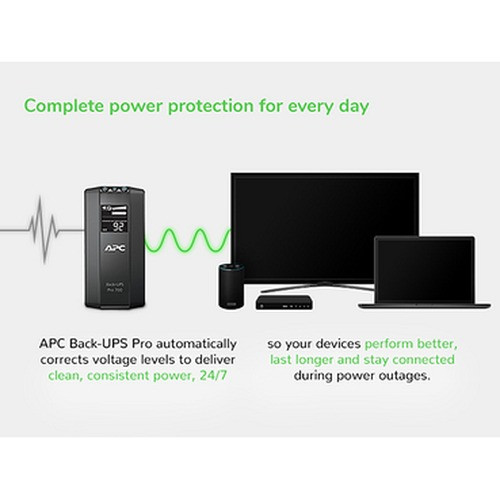
Both the APC BR700G and CyberPower OR700LCDRM1U are 700VA line-interactive UPS units drawing 120V input with lead-acid batteries, so a buyer evaluating a 700VA uninterruptible power supply for a small server room, NVR, or network closet would legitimately cross-shop them. The central tradeoff is form factor: the BR700G is a desktop tower while the OR700LCDRM1U is a 1U rackmount, which immediately separates their target environments. This comparison examines power and runtime capacity, physical deployment and management interfaces, and protection features to help installers and IT buyers select the right unit for their specific installation context.
In This Guide
Which UPS delivers more usable power and runtime under load?
The APC BR700G is rated at 700VA / 420W, giving it a 0.60 power factor. The CyberPower OR700LCDRM1U is rated at 700VA / 400W, yielding a 0.57 power factor. On raw wattage the BR700G edges ahead by 20W, meaning it can sustain a marginally heavier load before hitting capacity.
Runtime data is only directly specified for the OR700LCDRM1U: 3 minutes at full load (400W) and 11 minutes at half load (200W). APC's specs do not publish runtime tables for the BR700G at full or half load; the battery is listed as 12V / 9.0Ah with 102 VAh gross and 86 VAh runtime capacity, but no explicit minute figures appear in the provided data. The OR700LCDRM1U uses two 6V/8Ah cells in series (96 VAh gross); the BR700G uses one 12V/9.0Ah cell (108 VAh gross). Neither runtime figure for the BR700G can be confirmed without manufacturer runtime tables.
Transfer time strongly favors the OR700LCDRM1U at less than 4ms versus the BR700G's 8ms typical / 12ms maximum. For sensitive network or storage equipment, sub-4ms transfer is a meaningful protection advantage.
Recharge time is stated only for the BR700G at 12 hours; no recharge time is published in the provided OR700LCDRM1U specs.
Which unit fits the target installation and offers better management visibility?
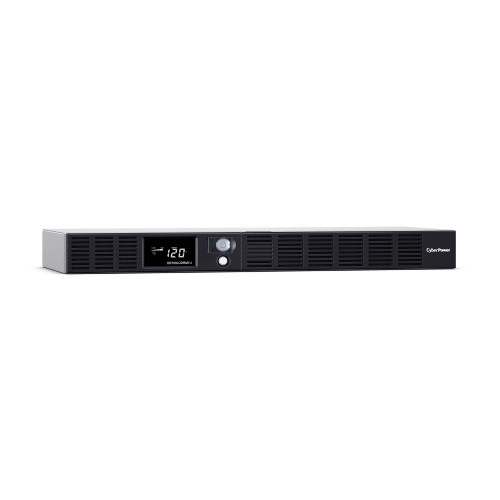
Form factor is the sharpest differentiator. The BR700G is tower-only (Not Rack-Mountable per spec) with dimensions of 7.48 in height and a weight of 15.76 lb (7.15 kg). It is designed for placement alongside or under a desk or on a shelf. The OR700LCDRM1U occupies 1U of rack space at 17.05 × 1.75 × 9.25 in and weighs 18.5 lb (8.39 kg). Installers building a rack-mounted security or network enclosure have no practical way to use the BR700G in that context.
Management interfaces also differ materially. The OR700LCDRM1U provides a multifunction LCD panel showing load percentage, input/output voltage, and estimated runtime, plus USB and DB-9 serial ports for software monitoring, and an optional SNMP card (RMCARD205, sold separately) for network management. The BR700G offers only an LED status display with four indicators: On Line, On Battery, Replace Battery, and Building Wiring Fault. No USB, serial, or SNMP interface is listed in the BR700G specs.
The OR700LCDRM1U carries UL1778, cUL 107.1, FCC DOC Class B, RoHS, and ENERGY STAR certifications. No equivalent certifications are listed in the provided BR700G specs.
Which unit provides broader surge, data-line, and warranty protection?
Surge energy rating is documented only for the BR700G at 354 joules with full-time multi-pole noise filtering described as 5% of IEEE surge let-through and zero clamping response time. The OR700LCDRM1U does not include a joule rating in the provided specifications.
Data-line protection differs by topology. The BR700G protects a single coaxial line (CATV/SATV/modem/audio-video). The OR700LCDRM1U protects RJ-11 (telephone/modem) and RJ-45 (10/100 Mbps Ethernet) ports, which is more relevant to IP security and network deployments.
Outlet count and segmentation: the BR700G provides 3 battery-backed NEMA 5-15R plus 3 surge-only NEMA 5-15R (6 total). The OR700LCDRM1U provides 4 battery-backed NEMA 5-15R plus 2 surge-only NEMA 5-15R (6 total), giving one additional battery-protected outlet.
Warranty coverage is stated only for the OR700LCDRM1U: 3 years on electronics and battery, plus a $75,000 connected-equipment guarantee (registration required). No warranty term or equipment guarantee is listed in the provided BR700G specs.
The BR700G includes an Emergency Power Off (EPO) option and user-configurable alarm delays. Neither feature is listed in the OR700LCDRM1U specs as provided.
Which should you choose: the BR700G or the OR700LCDRM1U?
Our take: The OR700LCDRM1U is the stronger choice when the installation is rack-based and requires active management visibility. Its 1U rackmount form factor makes it the only viable option for equipment racks; the BR700G is explicitly not rack-mountable. The OR700LCDRM1U also delivers a faster transfer time — under 4ms versus the BR700G's 8ms typical / 12ms maximum — which meaningfully reduces risk of dropouts on sensitive IP cameras or NVR hardware. It ships with a stated 3-year warranty and a $75,000 connected-equipment guarantee, neither of which appears in the provided BR700G specs. Conversely, the BR700G suits desktop or shelf deployments where rack space is unavailable: it delivers 20W more capacity (420W vs. 400W), includes a documented 354J surge rating, and protects a coaxial data line. Buyers deploying networked IP security equipment in a rack enclosure should select the OR700LCDRM1U; those needing a compact tower UPS beside a standalone DVR or workstation should consider the BR700G.
Side-by-Side Comparison
Spec-for-spec, from manufacturer data.
| Specification | APC by Schneider Electric BR700G | CyberPower OR700LCDRM1U |
|---|---|---|
| Topology | Line Interactive | Line Interactive with AVR |
| Capacity (VA) | 700 VA | 700 VA |
| Capacity (Watts) | 420 W | 400 W |
| Power Factor | 0.60 | 0.57 |
| Input Voltage | 120V (88–143V range) | 120 VAC (90–140 VAC range) |
| Transfer Time | 8ms typical / 12ms maximum | <4 ms |
| Form Factor | Tower (not rack-mountable) | Rackmount 1U |
| Total Outlets | 6 × NEMA 5-15R | 6 × NEMA 5-15R |
| Battery-Backed Outlets | 3 | 4 |
| Surge-Only Outlets | 3 | 2 |
| Battery | 12V / 9.0Ah sealed lead-acid (×1) | 2 × 6V / 8Ah sealed lead-acid |
| Runtime at Full Load | — | 3 min (400W) |
| Runtime at Half Load | — | 11 min (200W) |
| Surge Energy Rating | 354 J | — |
| Data-Line Protection | Coaxial (CATV/SATV/modem/AV) | RJ-11, RJ-45 (10/100 Mbps) |
| Management Interfaces | LED indicators only | LCD panel, USB, DB-9 Serial, optional SNMP |
| Waveform | Stepped sine approximation | — |
| Recharge Time | 12 hours | — |
| Operating Temperature | — | 32–104°F (0–40°C) |
| Weight | 15.76 lb (7.15 kg) | 18.5 lb (8.39 kg) |
| Certifications | — | UL1778, cUL 107.1, FCC Class B, RoHS, ENERGY STAR |
| Warranty | — | 3 Year (electronics and battery) |
| Connected Equipment Guarantee | — | $75,000 (registration required) |
Frequently Asked Questions
Which should you choose: the BR700G or the OR700LCDRM1U?
The OR700LCDRM1U is the stronger choice when the installation is rack-based and requires active management visibility. Its 1U rackmount form factor makes it the only viable option for equipment racks; the BR700G is explicitly not rack-mountable. The OR700LCDRM1U also delivers a faster transfer time — under 4ms versus the BR700G's 8ms typical / 12ms maximum — which meaningfully reduces risk of dropouts on sensitive IP cameras or NVR hardware. It ships with a stated 3-year warranty and a $75,000 connected-equipment guarantee, neither of which appears in the provided BR700G specs. Conversely, the BR700G suits desktop or shelf deployments where rack space is unavailable: it delivers 20W more capacity (420W vs. 400W), includes a documented 354J surge rating, and protects a coaxial data line. Buyers deploying networked IP security equipment in a rack enclosure should select the OR700LCDRM1U; those needing a compact tower UPS beside a standalone DVR or workstation should consider the BR700G.
Can either of these UPS units be mounted in a standard equipment rack?
Only the CyberPower OR700LCDRM1U supports rack mounting — it occupies 1U (1.75 in) of a standard 19-inch rack. The APC BR700G is explicitly listed as 'Not Rack-Mountable' in its specifications and is a tower-only unit.
Which UPS is better for protecting IP cameras and network switches that need Ethernet data-line surge protection?
The OR700LCDRM1U includes RJ-45 (10/100 Mbps) and RJ-11 data-line protection ports, which directly cover Ethernet-connected IP cameras and PoE switches. The BR700G provides coaxial (CATV/SATV/modem/audio-video) data-line protection only; no Ethernet data-line protection is listed in its specifications.
How do the transfer times compare, and does it matter for security equipment?
The OR700LCDRM1U switches to battery in under 4ms; the BR700G switches in 8ms typical and up to 12ms maximum. For most modern IP cameras and NVRs, either transfer time is within tolerance, but sub-4ms provides a larger margin against equipment that is sensitive to even brief power interruptions. Neither spec guarantees zero-interruption transfer — that requires a true online double-conversion topology, which neither unit employs.
More UPS Comparisons
- APC by Schneider Electric BR700G vs CyberPower SL700U
- APC by Schneider Electric BR700G vs APC by Schneider Electric BE700G3
- APC by Schneider Electric BR700G vs APC by Schneider Electric SMT700X167
- CyberPower OR700LCDRM1U vs APC by Schneider Electric BE700G3
- CyberPower OR700LCDRM1U vs APC by Schneider Electric SMT700X167
- CyberPower OR700LCDRM1U vs CyberPower SL700U
UPS Buying Guides
Get a Second Opinion on Your Camera Choice
Share your site layout, coverage goals, and budget. Our team will validate the camera selection, flag anything we would change, and recommend products that match the use case.