APC by Schneider Electric BR700G Line-Interactive Tower UPS — 700VA / 420W
Overview
The APC by Schneider Electric BR700G is a 700VA / 420W line-interactive tower UPS designed to keep small servers, network closets, POS stations, and security equipment running through power events that would otherwise cause downtime or data loss. At 15.76 lbs in a desktop tower form factor, the BR700G installs in equipment rooms or under desks without requiring rack space — important when you're protecting gear that lives outside the server room. Line-interactive topology means it actively regulates voltage fluctuations (sags and surges) without switching to battery, which extends battery life and keeps connected equipment from seeing dirty power in the first place. Explore the full APC by Schneider Electric power protection lineup for higher-capacity and rack-mount alternatives.
Key Features
- 700VA / 420W Capacity: Sized for a small workstation, NVR, or network switch — enough headroom to handle typical inrush current at startup without immediately hitting the load ceiling. Plan actual connected wattage at 70–80% of the 420W rating for reliable runtime.
- Line-Interactive Topology with AVR: Unlike basic standby UPS units that do nothing until power fails, line-interactive automatic voltage regulation corrects under- and over-voltages continuously. Equipment running off a line with chronic voltage sags won't burn through battery cycles unnecessarily — a meaningful lifespan benefit in older facilities or areas with variable utility power.
- 8ms Typical Transfer Time (12ms Max): The switch from line to battery happens fast enough that virtually all connected IT equipment stays up without a hiccup. Most ATX power supplies and enterprise network gear tolerate up to 20ms; the BR700G's 8ms typical keeps a comfortable margin. If you're running equipment with a tighter hold-up tolerance, verify with your hardware vendor.
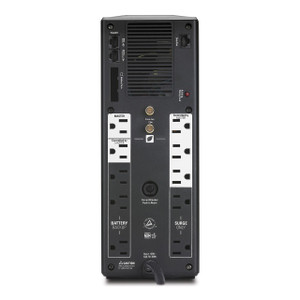
- 6 Protected Outlets — 3 Battery + Surge, 3 Surge Only: The three battery-backed NEMA 5-15R outlets handle your mission-critical loads (recorder, switch, server). The three surge-only NEMA 5-15R outlets protect peripherals (monitors, chargers) that don't need runtime. Separating these from the start prevents battery drain on non-critical loads.
- 354 Joule Surge Energy Rating with Full-Time Noise Filtering: Multi-pole noise filtering runs continuously — not just on surge events — holding conducted noise to 5% of IEEE surge let-through with zero clamping response time. For security recorders and NAS devices that are sensitive to power-line noise, this matters more than the joule rating alone.
- Coaxial Data Line Protection (CATV / SATV / Modem / Audio-Video): Built-in coax port protects the cable TV or satellite feed running into a connected DVR or display — a protection point that's easy to overlook when hardening a security closet against lightning-induced surges on the coax run.
- Stepped Sinewave Output: The BR700G outputs a stepped approximation to a sinewave (not pure sine) when on battery. This is compatible with most conventional power supplies and standard IT equipment. If you're connecting active PFC power supplies (common in newer servers and some NAS units), verify compatibility — some active PFC units require a true sinewave UPS to operate correctly on battery.
- LED Status Display with Fault Alarms: The front panel shows On Line, On Battery, Replace Battery, and Building Wiring Fault status at a glance. The wiring fault indicator is a practical diagnostic for older installations — it flags missing safety ground or reversed polarity without needing a separate outlet tester.
- RBC17 Hot-Swap Replacement Battery: Battery replacement uses the RBC17 module, a widely available APC replacement cartridge. The 12V / 9.0Ah sealed lead-acid battery carries a 12-hour recharge time from a full discharge. Plan battery replacement on a 3–5 year cycle in typical environments.
- 102 VAh Capacity / 86 VAh Runtime: Actual runtime depends on connected load — lighter loads run proportionally longer. At full 420W, expect a few minutes of runtime; at 50% load (~210W), runtime extends significantly. Use APC's runtime calculator with your actual load numbers before committing to this model if runtime is the primary spec driving the decision.
- Optional Emergency Power Off (EPO): EPO support is available, relevant for installations in facilities that require a single-point emergency shutdown of connected equipment — data centers, secure rooms, or installations under NFPA 75 compliance requirements.
Integration and Compatibility
The BR700G connects via a standard NEMA 5-15P input plug on a 6 ft (1.83 m) power cord, compatible with any 15A 120V circuit — no dedicated circuit or special receptacle required. Maximum input current draw is 12A, well within a standard 15A circuit with appropriate derating. The unit accepts 50/60 Hz input with auto-sensing, so it works in both North American and some international 120V environments without reconfiguration. For UPS and battery backup selection guidance, match the UPS output frequency to your downstream equipment's tolerance; the BR700G syncs output frequency to mains (±3 Hz) and allows ±0.1 Hz adjustment. The free interface slot accommodates optional management cards for remote monitoring or network shutdown — relevant for unmanned equipment rooms where you want automated graceful shutdown before battery depletes. Pair with a managed PoE switch or NVR on the battery-backed outlets to keep your surveillance infrastructure online during brief outages.
Environmental and Operational Notes
Operating range spans 5–95% relative humidity (non-condensing) and 0–10,000 ft altitude — covers most building environments without restriction. Acoustic output is rated at 45 dBA, audible in a quiet office but not disruptive in an equipment closet or server room. Heat dissipation is 48.5 Btu/h — low enough that it adds negligible thermal load to a small equipment space. Storage temperature range is -15°C to 45°C, with storage altitude to 15,240m, relevant when units ship to or are warehoused in extreme climates. For replacement batteries and power accessories, the RBC17 is the verified replacement module for this unit.
Frequently Asked Questions
Q: What is the transfer time of the APC BR700G when switching from line power to battery?
A: The BR700G has a typical transfer time of 8ms and a maximum of 12ms. Most standard IT equipment and ATX power supplies tolerate up to 20ms, so this provides a comfortable margin for uninterrupted operation.
Q: Is the BR700G compatible with active PFC power supplies?
A: The BR700G produces a stepped approximation to a sinewave (not a pure sinewave) when running on battery. Some active PFC power supplies — common in newer servers and certain NAS units — require a true sinewave UPS to operate correctly on battery. Verify your equipment's compatibility before deploying the BR700G with active PFC loads.
Q: Can I rack-mount the BR700G?
A: No. The BR700G is a desktop tower form factor and is not rack-mountable. It does not support two-post or four-post rack installation. If you need a rack-mount UPS, consider a different model in the APC Smart-UPS or Back-UPS Pro rack lineup.
Q: What is the replacement battery for the BR700G?
A: The verified replacement battery is the APC RBC17, a 12V / 9.0Ah sealed lead-acid module. Typical recharge time from full discharge is 12 hours. Plan for periodic battery replacement on a 3–5 year cycle under normal operating conditions.
Q: How many outlets does the BR700G provide, and which are battery-backed?
A: The BR700G provides six NEMA 5-15R outlets total: three are battery-backed with surge protection (for mission-critical loads) and three provide surge protection only (for non-critical peripherals). This split prevents non-essential loads from draining battery runtime during an outage.
Q: Does the BR700G include data line protection for coaxial cable?
A: Yes. The BR700G includes a coaxial cable protection port suitable for CATV, SATV, modem, and audio-video connections. This guards against surge events traveling into connected equipment via the coax feed — a protection point often overlooked in security and AV installations.
The BR700G sits in a crowded segment of small tower UPS units, but the spec I keep coming back to for small security and network deployments is the 8ms typical transfer time combined with the split outlet configuration — three battery-backed, three surge-only. On most installs I see, someone plugs everything into the battery outlets, runs the battery flat in minutes, and wonders why runtime is so short. The outlet split enforces discipline: your NVR and switch get the battery, your monitor and phone charger get surge-only protection. Done correctly, that 420W capacity and 86 VAh runtime stretches meaningfully at real security-closet loads of 150–200W.
Technical Highlights:
- Line-Interactive AVR: Continuous voltage regulation handles sags and swells without burning a battery cycle — extends lead-acid service life noticeably in facilities with chronic voltage variation, where a basic standby UPS would cycle to battery dozens of times per day.
- 354J Surge Rating + Full-Time Noise Filtering: The multi-pole noise filtering holds conducted noise to 5% of IEEE surge let-through with zero clamping response. This is active conditioning, not just a MOV-based clamp — relevant for NVRs and managed switches that are sensitive to power-line hash.
- Coax Data Line Protection: Built-in coaxial port guards CATV/SATV/modem runs. In a typical security install with a cable feed into a DVR or IP gateway, the coax is the most commonly unprotected surge path. Having it integrated removes the need for a separate coax arrester.
Deployment Considerations:
- The stepped sinewave output is the single most important compatibility check before deployment. Verify that every connected device's power supply is compatible with modified/stepped sinewave on battery — check the manufacturer's UPS compatibility notes, not just the power supply wattage rating.
- At 45 dBA acoustic output, the BR700G is quieter than most equipment rooms but will be noticeable in a small, quiet office. The 12-hour recharge time from full discharge means you need line power back overnight to be fully protected the next day — not a concern in most outage scenarios, but worth noting for sites with frequent extended outages.
This unit is the right fit for a small network closet protecting a PoE switch, a 4–8 channel NVR, and a cable modem — the kind of stack you find in a retail location or small branch office where rack space isn't available and 420W covers the actual connected load with room to spare.