
APC by Schneider Electric BR1500MS vs CyberPower PR1500LCD: Specification Comparison
Both the APC BR1500MS and CyberPower PR1500LCD are 1500VA line-interactive, true sine wave UPS units targeting small-business workstations, network closets, and active PFC power supplies on 120V North American circuits. This comparison evaluates the three dimensions that matter most in this class: power capacity and runtime behavior, battery and recharge characteristics, and connectivity plus management features—drawing strictly from each manufacturer's published specifications.
In This Guide
- How do the BR1500MS and PR1500LCD differ in usable power capacity and load efficiency?
- What runtime and battery management capabilities separate these two units?
- Which unit offers broader connectivity, monitoring, and protection features?
- Which should you choose: the BR1500MS or the PR1500LCD?
- Side-by-Side Specs
- FAQ
How do the BR1500MS and PR1500LCD differ in usable power capacity and load efficiency?
The CyberPower PR1500LCD is rated at 1500VA / 1500W, yielding a unity power factor (1.0 W/VA). The APC BR1500MS is also rated 1500VA but delivers only 900W, a 0.6 power factor. For loads drawing near 900W or above, the BR1500MS will reach its watt ceiling while still having VA headroom, meaning the PR1500LCD can sustain heavier resistive or active-PFC loads without clipping.
The PR1500LCD explicitly lists Active PFC compatibility as a feature. The BR1500MS spec sheet does not mention Active PFC compatibility. Installers supplying modern server PSUs or high-end workstations with Active PFC power supplies should weigh this difference carefully, as mismatched UPS topology can cause nuisance shutdowns.
Both units output 120V at 60Hz on a true sine wave and are line-interactive. Transfer time differs: the PR1500LCD specifies less than 4ms, while the BR1500MS lists 8ms typical / 10ms maximum. For most IT loads either figure is acceptable, but sub-4ms is the tighter spec.
What runtime and battery management capabilities separate these two units?
The PR1500LCD publishes explicit runtime figures: 4.7 minutes at full 1500W load and 15.1 minutes at half load (750W). The BR1500MS does not include runtime figures in the provided specifications. Buyers who need predictable ride-through windows for graceful shutdown must factor in this data gap when evaluating the APC unit.
The PR1500LCD uses two 12V/17Ah sealed lead-acid batteries and supports hot-swap replacement—batteries can be exchanged without powering down connected equipment. The BR1500MS specifies a single lead-acid battery pack rated 257VAh (equivalent capacity metric), with a recharge time of 16 hours and a charger output of 16W. The BR1500MS spec sheet does not mention hot-swap capability.
APC states a battery design life of 3–5 years. CyberPower does not specify battery design life in the provided specs. Both units carry a 3-year product warranty.
Which unit offers broader connectivity, monitoring, and protection features?
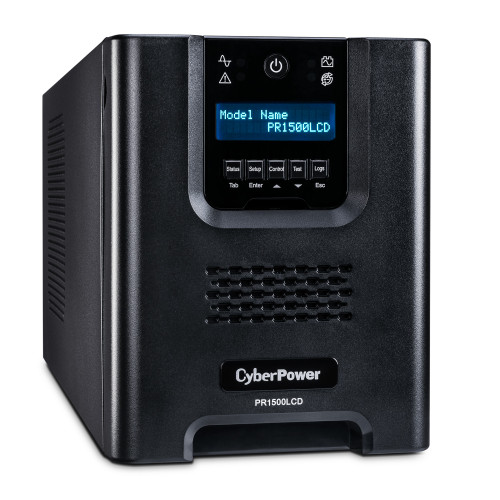
The PR1500LCD provides USB, serial, and SNMP connectivity, an extendable multifunction LCD panel, and EMI/RFI filtration. SNMP support enables integration with network management systems and remote monitoring without an add-on card, which is significant for managed IT environments. The BR1500MS does not list SNMP, serial, or a display panel in its specifications.
The BR1500MS includes two USB charging ports (device-charging, not data/management) and RJ45 10/100/1000 Base-T Ethernet data-line surge protection—a feature not mentioned in the PR1500LCD specifications. For installations protecting networked gear from line surges, this Ethernet port protection is a tangible differentiator.
Outlet count differs: BR1500MS provides 10 total outlets (6 NEMA 5-15R battery-backed per output spec, 10 total per overview) versus PR1500LCD's 8 NEMA 5-15R, all battery and surge protected. The PR1500LCD carries a $375,000 connected equipment guarantee; no equivalent figure is stated for the BR1500MS. Certifications also diverge: BR1500MS holds ENERGY STAR V2.0, NOM, and C-US; PR1500LCD holds UL1778, cUL 107.3, FCC Class A, Energy Star, and RoHS.
Which should you choose: the BR1500MS or the PR1500LCD?
Our take: The PR1500LCD is the stronger choice when usable watt capacity, remote manageability, and published runtime data are the primary criteria. Its 1500W output versus the BR1500MS's 900W ceiling is a 67% watt advantage at identical VA ratings, directly relevant for Active PFC server PSUs or dual-workstation loads. Its sub-4ms transfer time is tighter than the BR1500MS's 10ms maximum, and its SNMP/serial connectivity suits managed network closets without add-on hardware. Hot-swap batteries reduce planned downtime further. Conversely, the BR1500MS is the better fit when outlet count (10 vs. 8), Ethernet data-line surge protection, and a documented 16-hour recharge cycle matter—such as protecting a small PoE switch or NVR with a passthrough network connection. The BR1500MS also carries ENERGY STAR V2.0 and NOM certification, relevant for certain compliance environments. The PR1500LCD lacks a stated battery design-life figure; the BR1500MS publishes 3–5 years.
Side-by-Side Comparison
Spec-for-spec, from manufacturer data.
| Specification | APC by Schneider Electric BR1500MS | CyberPower PR1500LCD |
|---|---|---|
| VA Rating | 1500 VA | 1500 VA |
| Watt Rating | 900 W | 1500 W |
| Power Factor | 0.60 | 1.00 |
| Topology | Line Interactive | Line Interactive |
| Output Waveform | Sine Wave | True Sine Wave |
| Transfer Time | 8 ms typical / 10 ms max | < 4 ms |
| Total Outlets | 10 | 8 × NEMA 5-15R |
| Battery-Backed Outlets | 6 NEMA 5-15R | 8 NEMA 5-15R (all) |
| Hot-Swap Battery | — | Yes |
| Battery Recharge Time | 16 h | — |
| Battery Design Life | 3–5 years | — |
| Ethernet Data-Line Protection | RJ45 10/100/1000 | — |
| Management Connectivity | 2 × USB charging only | USB / Serial / SNMP |
| Display | — | Extendable LCD Panel |
| Connected Equipment Guarantee | — | $375,000 |
| Warranty | 3-Year Repair or Replace | 3-Year Limited |
Frequently Asked Questions
Which should you choose: the BR1500MS or the PR1500LCD?
The PR1500LCD is the stronger choice when usable watt capacity, remote manageability, and published runtime data are the primary criteria. Its 1500W output versus the BR1500MS's 900W ceiling is a 67% watt advantage at identical VA ratings, directly relevant for Active PFC server PSUs or dual-workstation loads. Its sub-4ms transfer time is tighter than the BR1500MS's 10ms maximum, and its SNMP/serial connectivity suits managed network closets without add-on hardware. Hot-swap batteries reduce planned downtime further. Conversely, the BR1500MS is the better fit when outlet count (10 vs. 8), Ethernet data-line surge protection, and a documented 16-hour recharge cycle matter—such as protecting a small PoE switch or NVR with a passthrough network connection. The BR1500MS also carries ENERGY STAR V2.0 and NOM certification, relevant for certain compliance environments. The PR1500LCD lacks a stated battery design-life figure; the BR1500MS publishes 3–5 years.
Can the PR1500LCD handle a server with an Active PFC power supply where the BR1500MS cannot?
The PR1500LCD explicitly lists Active PFC compatibility as a supported feature. The BR1500MS specification does not mention Active PFC compatibility. For servers or workstations with Active PFC PSUs, the PR1500LCD is the documented choice based on available specs.
Does either UPS support hot-swappable batteries so I don't have to shut down equipment during battery replacement?
Yes—the PR1500LCD specifies hot-swappable batteries (2 × 12V/17Ah SLA). The BR1500MS specification does not mention hot-swap capability. If zero-downtime battery replacement is required, the PR1500LCD has the stated advantage.
Which unit protects my network switch or NVR's Ethernet port from surge damage?
The BR1500MS includes RJ45 10/100/1000 Base-T Ethernet data-line surge protection. The PR1500LCD specification does not list Ethernet data-line protection. For installations where a network cable runs through the UPS to a switch or recorder, the BR1500MS provides that documented protection point.
More UPS Comparisons
- APC by Schneider Electric SMX1500RMI2U vs CyberPower PRL1500RT2UC
- APC by Schneider Electric SMX1500RMI2U vs CyberPower BRG1500AVRLCD2
- APC by Schneider Electric SMX1500RMI2U vs CyberPower PR1500LCD
- APC by Schneider Electric SMX1500RMI2U vs APC by Schneider Electric BR1500MS2
- APC by Schneider Electric SMX1500RMI2U vs APC by Schneider Electric SMTL1500RM3UCUS
- CyberPower PRL1500RT2UC vs APC by Schneider Electric BR1500MS2
UPS Buying Guides
Get a Second Opinion on Your Camera Choice
Share your site layout, coverage goals, and budget. Our team will validate the camera selection, flag anything we would change, and recommend products that match the use case.