
APC by Schneider Electric BR1500MS vs CyberPower BRG1500AVRLCD2: Specification Comparison
Both the APC BR1500MS and CyberPower BRG1500AVRLCD2 are 1500VA / 900W line-interactive tower UPS units designed for desktop workstations, small servers, and network edge equipment running on 120V North American power. This comparison examines the three dimensions most consequential to a B2B installer or IT buyer: output power quality and protection capability, outlet layout and interface features, and long-term serviceability including warranty and management options.
In This Guide
- Which UPS delivers cleaner output power and broader input voltage tolerance?
- Which unit provides more outlets, better USB charging, and more useful status feedback?
- Which unit offers better long-term support, management, and runtime assurance?
- Which should you choose: the BR1500MS or the BRG1500AVRLCD2?
- Side-by-Side Specs
- FAQ
Which UPS delivers cleaner output power and broader input voltage tolerance?
The APC BR1500MS produces a true sine wave output at 120V, which is the specification most relevant to active PFC power supplies found in modern servers, workstations, and network switches. The CyberPower BRG1500AVRLCD2 produces a simulated sine wave (stepped approximation), which may cause audible noise or efficiency losses in active PFC loads and is generally considered a lower-quality output waveform for sensitive electronics.
On input voltage tolerance, the CyberPower accepts a wider range: 57–120VAC before switching to battery, compared to the APC's 88–147V window. The CyberPower's Automatic Voltage Regulation (AVR) provides ±10% boost/buck correction, meaning the unit can regulate browndowns to approximately 57V without discharging the battery. The APC spec sheet lists its input tolerance as 88–147V but does not separately quantify its AVR boost/buck range.
Surge suppression favors the CyberPower at 1500 joules versus the APC's 1080 joules. Both units include RJ-45 Ethernet data-line protection and FCC Class B EMI/RFI compliance. The APC spec does not confirm EMI/RFI filter hardware explicitly; the CyberPower confirms EMI/RFI filtration as a listed feature.
Which unit provides more outlets, better USB charging, and more useful status feedback?
The CyberPower BRG1500AVRLCD2 offers 12 total NEMA 5-15R outlets — 6 with battery backup plus surge protection, and 6 with surge protection only. The APC BR1500MS provides 10 total outlets but specifies only 6 NEMA 5-15R outlets in the battery-backed/protected output section; the remaining 4 are identified in product naming but the spec sheet does not individually classify all 10 as battery-backed vs. surge-only. Buyers needing the maximum number of protected connections should verify APC's full outlet breakdown before specifying.
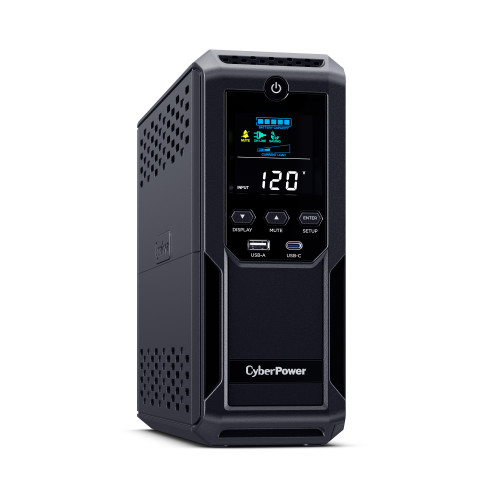
USB charging ports are 2 on both units. The CyberPower explicitly specifies 1× USB-A at 2.4A and 1× USB-C at 18W Power Delivery. The APC lists 2 USB charging ports but does not specify port types, amperage, or wattage per port in the provided spec sheet.
The CyberPower includes a multifunction LCD display showing load, runtime, voltage, battery status, and faults. The APC spec sheet does not mention an LCD or multifunction display. The CyberPower also includes a DB9 serial port alongside USB connectivity; the APC spec sheet does not list a serial interface. CyberPower bundles PowerPanel Personal software (Windows/Mac/Linux); no equivalent bundled software is listed for the APC.
Which unit offers better long-term support, management, and runtime assurance?
Warranty is a clear differentiator: the CyberPower BRG1500AVRLCD2 carries a 5-year warranty versus the APC BR1500MS's 3-year warranty. CyberPower also includes a $500,000 Connected Equipment Guarantee; no equivalent connected equipment guarantee is listed in the APC spec sheet provided.
The CyberPower supports optional SNMP/HTTP management via its RMCARD accessory series, enabling remote monitoring and shutdown integration into NMS or DCIM platforms. The APC BR1500MS spec sheet does not list an optional network management card or equivalent remote management capability, which is a meaningful gap for IT buyers managing distributed UPS assets.
Battery runtime is specified for the CyberPower only: 12 minutes at half load (450W) and 2 minutes at full load (900W). The APC spec sheet does not provide runtime figures; buyers must consult APC's runtime calculators or separate datasheets. The APC does specify battery charger power (16W) and recharge time (16 hours); the CyberPower does not list these values in the provided spec. Battery design life is stated as 3–5 years for the APC; the CyberPower lists its battery as 2× 12V/9Ah sealed lead-acid but does not state a design life in the provided spec.
Which should you choose: the BR1500MS or the BRG1500AVRLCD2?
Our take: The BRG1500AVRLCD2 is the stronger choice when outlet count, warranty depth, surge headroom, and integrated management capability are the primary decision drivers. The CyberPower provides 12 outlets versus 10, a 5-year warranty versus 3 years, and 1500J surge suppression versus 1080J. For sites requiring remote UPS monitoring, CyberPower's optional SNMP/HTTP card support is a significant advantage the APC spec sheet does not address. However, the BR1500MS holds a definitive edge for loads with active PFC power supplies: it delivers a true sine wave output, while the BRG1500AVRLCD2 outputs a simulated sine wave — a meaningful distinction for server rooms or AV equipment sensitive to waveform quality. Specify the APC BR1500MS where output waveform purity is non-negotiable (rack servers, medical-grade workstations, audio/video production). Specify the CyberPower BRG1500AVRLCD2 where outlet density, warranty term, management scalability, and surge rating take priority over waveform fidelity.
Side-by-Side Comparison
Spec-for-spec, from manufacturer data.
| Specification | APC by Schneider Electric BR1500MS | CyberPower BRG1500AVRLCD2 |
|---|---|---|
| Capacity (VA) | 1500 VA | 1500 VA |
| Capacity (Watts) | 900 W | 900 W |
| Topology | Line-Interactive | Line-Interactive |
| Output Waveform | Sine Wave | Simulated Sine Wave |
| Total Outlets | 10 | 12 |
| Battery-Backed Outlets | 6 NEMA 5-15R (spec-listed) | 6 NEMA 5-15R |
| Surge-Only Outlets | Not specified in provided spec | 6 NEMA 5-15R |
| Surge Suppression | 1080 J | 1500 J |
| Input Voltage Range | 88–147 V | 57–120 VAC |
| USB Charging Ports | 2 (type/amperage not specified) | 2 (USB-A 2.4A + USB-C 18W PD) |
| LCD Display | Not listed in provided spec | Multifunction LCD |
| Data Line Protection | RJ-45 10/100/1000 Ethernet | RJ-45 Ethernet |
| Runtime at Half Load | Not specified in provided spec | 12 min at 450W |
| Remote Management | Not listed in provided spec | Optional SNMP/HTTP (RMCARD) |
| Warranty | 3 year | 5 year |
| Connected Equipment Guarantee | Not listed in provided spec | $500,000 |
Frequently Asked Questions
Which should you choose: the BR1500MS or the BRG1500AVRLCD2?
The BRG1500AVRLCD2 is the stronger choice when outlet count, warranty depth, surge headroom, and integrated management capability are the primary decision drivers. The CyberPower provides 12 outlets versus 10, a 5-year warranty versus 3 years, and 1500J surge suppression versus 1080J. For sites requiring remote UPS monitoring, CyberPower's optional SNMP/HTTP card support is a significant advantage the APC spec sheet does not address. However, the BR1500MS holds a definitive edge for loads with active PFC power supplies: it delivers a true sine wave output, while the BRG1500AVRLCD2 outputs a simulated sine wave — a meaningful distinction for server rooms or AV equipment sensitive to waveform quality. Specify the APC BR1500MS where output waveform purity is non-negotiable (rack servers, medical-grade workstations, audio/video production). Specify the CyberPower BRG1500AVRLCD2 where outlet density, warranty term, management scalability, and surge rating take priority over waveform fidelity.
Is the BR1500MS or BRG1500AVRLCD2 safe to use with a server that has an active PFC power supply?
The APC BR1500MS is the safer choice for active PFC power supplies because it produces a true sine wave output. The CyberPower BRG1500AVRLCD2 produces a simulated sine wave, which can cause compatibility issues, audible buzzing, or reduced efficiency with active PFC supplies. If your server or workstation PSU specifies active PFC, verify waveform compatibility before deploying the CyberPower.
Which UPS gives me more time to perform a graceful shutdown during a power outage?
The CyberPower BRG1500AVRLCD2 specifies runtime of 12 minutes at half load (450W) and 2 minutes at full load (900W). The APC BR1500MS spec sheet provided does not include runtime figures; APC publishes runtime curves separately. For planning purposes, only the CyberPower provides directly quotable runtime data in the available specifications.
Can either of these UPS units be monitored remotely across a network?
The CyberPower BRG1500AVRLCD2 supports optional SNMP and HTTP management via CyberPower's RMCARD accessory series, enabling integration with network management systems and automated shutdown software. The APC BR1500MS spec sheet provided does not list a network management card slot or remote monitoring option. Buyers who require centralized UPS monitoring should confirm APC's accessory compatibility independently or select the CyberPower.
More UPS Comparisons
- APC by Schneider Electric SMX1500RMI2U vs CyberPower PRL1500RT2UC
- APC by Schneider Electric SMX1500RMI2U vs CyberPower BRG1500AVRLCD2
- APC by Schneider Electric SMX1500RMI2U vs CyberPower PR1500LCD
- APC by Schneider Electric SMX1500RMI2U vs APC by Schneider Electric BR1500MS2
- APC by Schneider Electric SMX1500RMI2U vs APC by Schneider Electric SMTL1500RM3UCUS
- CyberPower PRL1500RT2UC vs APC by Schneider Electric BR1500MS2
UPS Buying Guides
Get a Second Opinion on Your Camera Choice
Share your site layout, coverage goals, and budget. Our team will validate the camera selection, flag anything we would change, and recommend products that match the use case.