
Altronix NETWAYSP4BTWPX vs Axis D8004: Specification Comparison
Both the Altronix NETWAYSP4BTWPX and the Axis D8004 are 4-port PoE Gigabit switches designed to power IP cameras and edge devices over structured cabling. Despite sharing the same port count and PoE function, they occupy very different deployment tiers: the NETWAYSP4BTWPX is a hardened outdoor unit with high-power PoE++ and fiber uplinks, while the D8004 is a compact indoor unmanaged switch running off AC mains. Buyers choosing between them are typically deciding between a field-hardened edge node and a simple indoor distribution switch.
In This Guide
Which switch delivers more PoE power, and to what standard?
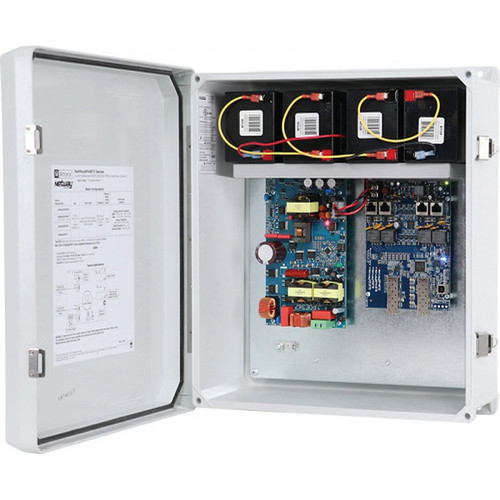
The NETWAYSP4BTWPX operates to IEEE 802.3bt (PoE++), providing a total budget of 240 W with up to 90 W per port across all four Gigabit PoE ports. This supports high-draw endpoints such as multi-sensor PTZ cameras, pan-tilt-zoom units with heaters, or access control readers with electric locks.
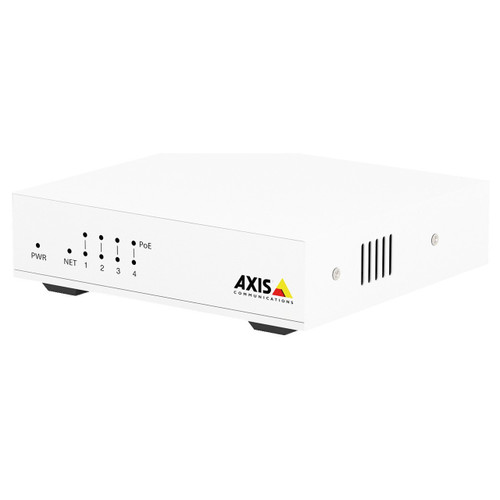
The Axis D8004 operates to IEEE 802.3af/at (PoE/PoE+), with a maximum output of 60 W shared across four PoE ports—15 W or 30 W per port depending on the connected device class. Input power is drawn from a 100–240 V AC adapter rated at 62.4 W maximum.
The power delta is substantial: the NETWAYSP4BTWPX offers 4× the total PoE budget (240 W vs. 60 W) and 3× the per-port ceiling (90 W vs. 30 W). For single-sensor fixed cameras drawing 12–15 W, the D8004's budget is adequate. For multi-imager or high-power PTZ endpoints, only the NETWAYSP4BTWPX meets the power requirement.
Which switch is rated for outdoor or harsh-environment installation?
The NETWAYSP4BTWPX is explicitly rated for outdoor deployment. Its enclosure carries NEMA 4/4X and IP66 ratings, meaning it is protected against windblown dust, rain, and hose-directed water. The operating temperature range is -40 °C to 60 °C (-40 °F to 140 °F), and storage is rated from -30 °C to 85 °C. The enclosure is described as stainless/powder-coated and supports wall, pole, and rack mounting. An integrated LiFePO4 battery charger enables backup power capability in the field.
The Axis D8004 is rated for indoor use only. Its operating temperature range is 0 °C to 50 °C (32 °F to 122 °F), with storage from -10 °C to 50 °C at 5–95 % RH non-condensing. No IP or NEMA enclosure rating is listed. The unit is a compact white metal desktop/bracket-mount device measuring 90 × 80 × 21 mm and weighing 172 g. No battery backup capability is specified.
For any installation subject to weather, temperature extremes, or power interruptions at the edge, the NETWAYSP4BTWPX is the only option of the two. The D8004 is not specified for any outdoor or uncontrolled-environment use.
How do the uplink options and management capabilities compare?
The NETWAYSP4BTWPX provides dual 1G SFP fiber uplinks alongside its four copper PoE ports. This enables single-mode fiber backbone connectivity over extended distances—critical for edge nodes in parking structures, perimeter fencing, or campus deployments where copper runs exceed 100 m. Management is available via Altronix LINQ integration and standard SNMP/managed switch CLI.
The Axis D8004 provides one RJ45 10BASE-T/100BASE-TX Gigabit uplink port (copper only) in addition to the four PoE data ports. No fiber uplink or SFP slot is specified. The unit is described as unmanaged—it requires no SNMP configuration or CLI setup; it functions as a plug-and-play device after connecting power and the uplink cable.
For managed deployments or fiber backbone runs, the NETWAYSP4BTWPX is the sole option. The D8004's unmanaged design is an advantage in small, simple installations where configuration overhead is undesirable and the uplink run is within copper distance. The D8004 carries CE, FCC Part 15 Class B, RoHS, and WEEE approvals; the NETWAYSP4BTWPX's regulatory certifications are not listed in the provided specs.
Which should you choose: the NETWAYSP4BTWPX or the D8004?
Our take: The NETWAYSP4BTWPX is the stronger choice when the installation site is outdoors, exposed to temperature extremes, or requires high-power PoE endpoints and fiber backbone connectivity. Its 240 W total PoE budget (vs. 60 W on the D8004) and 90 W per-port ceiling (vs. 30 W) support PTZ cameras and multi-sensor heads the D8004 cannot power. Its NEMA 4/4X IP66 enclosure and -40 °C to 60 °C operating range make it deployable in environments where the D8004—rated 0 °C to 50 °C, indoor only—would be out of specification. Dual 1G SFP fiber uplinks and SNMP/LINQ management add backbone flexibility unavailable on the D8004. Conversely, the D8004 suits small-scale, climate-controlled indoor closets where simplicity, low cost, and zero-configuration operation are the priority. Its lifetime warranty (NETWAYSP4BTWPX) versus 3-year warranty (D8004) favors the Altronix for long-horizon infrastructure.
Side-by-Side Comparison
Spec-for-spec, from manufacturer data.
| Specification | Altronix NETWAYSP4BTWPX | Axis D8004 |
|---|---|---|
| Product Type | PoE Switch (Outdoor Enclosure) | PoE Switch (Indoor) |
| PoE Standard | IEEE 802.3bt (PoE++) | IEEE 802.3af/at (PoE/PoE+) |
| PoE Budget (Total) | 240 W | 60 W |
| PoE Power Per Port (Max) | 90 W | 30 W |
| PoE Data Ports | 4× 10/100/1000 Gigabit PoE | 4× 10BASE-T/100BASE-TX PoE |
| Uplink Ports | 2× 1G SFP (fiber) | 1× RJ45 Gigabit (copper) |
| Fiber Uplink | Yes (Single-Mode SFP) | — |
| Management | SNMP / LINQ / Managed CLI | Unmanaged |
| Environment Rating | Outdoor — NEMA 4/4X, IP66 | Indoor only — no IP/NEMA rating listed |
| Operating Temperature | -40 °C to 60 °C | 0 °C to 50 °C |
| Storage Temperature | -30 °C to 85 °C | -10 °C to 50 °C |
| Input Power | 240 W PSU (spec does not list AC voltage range) | 100–240 V AC, 50–60 Hz, 62.4 W max |
| Battery Backup | Yes (LiFePO4 charger integrated) | — |
| Dimensions | 17.53" × 15.3" × 6.67" | 90 × 80 × 21 mm (3.54" × 3.15" × 0.83") |
| Weight | — | 172 g (0.38 lb) |
| Warranty | Lifetime | 3 Years |
Frequently Asked Questions
Which should you choose: the NETWAYSP4BTWPX or the D8004?
The NETWAYSP4BTWPX is the stronger choice when the installation site is outdoors, exposed to temperature extremes, or requires high-power PoE endpoints and fiber backbone connectivity. Its 240 W total PoE budget (vs. 60 W on the D8004) and 90 W per-port ceiling (vs. 30 W) support PTZ cameras and multi-sensor heads the D8004 cannot power. Its NEMA 4/4X IP66 enclosure and -40 °C to 60 °C operating range make it deployable in environments where the D8004—rated 0 °C to 50 °C, indoor only—would be out of specification. Dual 1G SFP fiber uplinks and SNMP/LINQ management add backbone flexibility unavailable on the D8004. Conversely, the D8004 suits small-scale, climate-controlled indoor closets where simplicity, low cost, and zero-configuration operation are the priority. Its lifetime warranty (NETWAYSP4BTWPX) versus 3-year warranty (D8004) favors the Altronix for long-horizon infrastructure.
Can either switch power a high-wattage PTZ camera that draws over 30 W?
Only the NETWAYSP4BTWPX supports this. It is rated to deliver up to 90 W per port via IEEE 802.3bt (PoE++). The Axis D8004 tops out at 30 W per port under 802.3at (PoE+) and a 60 W total shared budget, which is insufficient for endpoints exceeding 30 W.
Is either switch suitable for mounting at an outdoor camera pole or perimeter location?
Only the NETWAYSP4BTWPX is specified for outdoor use. It carries NEMA 4/4X and IP66 ratings and operates from -40 °C to 60 °C, with wall and pole mount support and an integrated battery charger. The Axis D8004 is rated for indoor use only (0 °C to 50 °C, no IP/NEMA rating) and is not specified for outdoor installation.
Which switch is easier to deploy for a small office or server-room IP camera installation with no network expertise on site?
The Axis D8004 is the simpler option for that scenario. It is unmanaged—no SNMP, CLI, or configuration is required; the installer connects the AC adapter and the uplink cable and the switch operates immediately. The NETWAYSP4BTWPX offers SNMP and LINQ management, which provides visibility and control but requires corresponding configuration effort.
More Network Switch Comparisons
- Vivotek GET-083A-120 vs TP-Link SG1005P
- Vivotek GET-083A-120 vs Axis T8504-E
- Vivotek GET-083A-120 vs Axis D8004
- Vivotek GET-083A-120 vs Ubiquiti N-SW
- TP-Link SG1005P vs Axis T8504-E
- TP-Link SG1005P vs Axis D8004
Network Switch Buying Guides
Get a Second Opinion on Your Camera Choice
Share your site layout, coverage goals, and budget. Our team will validate the camera selection, flag anything we would change, and recommend products that match the use case.