
Altronix NETWAY4EBTWPX vs Axis D8004: Specification Comparison
Both the Altronix NETWAY4EBTWPX and the Axis D8004 are unmanaged 4-port PoE Gigabit switches aimed at IP camera deployments, making them a legitimate cross-shop for installers sizing edge power distribution. The comparison turns on three axes where the products diverge sharply: PoE power budget and per-port delivery standard, physical deployment environment and enclosure rating, and uplink architecture with backup power capability. Understanding these differences is essential before specifying either unit on a project.
In This Guide
Which switch delivers more PoE power, and to what standard?
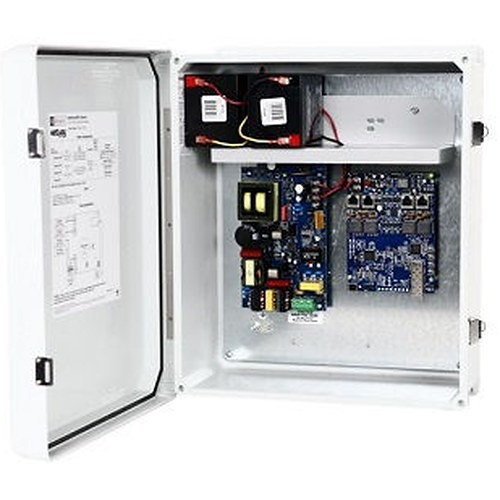
The NETWAY4EBTWPX operates at the 802.3bt (PoE++) standard, allocating up to 90 W per port with a total budget of 240 W across all four ports. This accommodates high-draw devices such as multi-sensor panoramic cameras, PTZ cameras with integrated heaters, or access control panels that require Type 3 or Type 4 power.
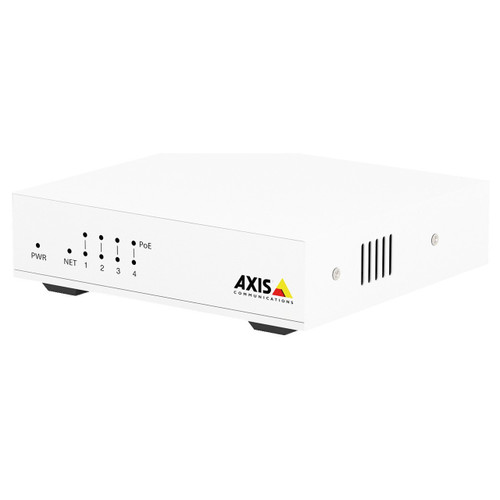
The Axis D8004 operates at the 802.3af/at (PoE/PoE+) standard, with a maximum output of 60 W total across its four PoE ports. Per-port delivery is capped at 30 W (802.3at) or 15 W (802.3af). This is adequate for single-sensor fixed cameras and most standard IP intercoms but will not power 802.3bt-class devices.
The gap is significant: 240 W vs. 60 W total, and 90 W vs. 30 W per port. A four-camera edge node requiring 45 W per camera cannot be served by the D8004 but fits within the NETWAY4EBTWPX budget. Installers must verify the powered device's PoE class before selecting either switch.
Where can each switch be physically installed?
The NETWAY4EBTWPX is housed in a NEMA 4/4X, IP66-rated outdoor enclosure. NEMA 4X adds corrosion resistance to the weatherproofing. The unit is designed explicitly for outdoor deployment. Mounting options include DIN-rail and pole mount. No operating temperature range is stated in the provided specifications.
The Axis D8004 is rated for indoor use only, with an operating temperature range of 0 °C to 50 °C and storage conditions of -10 °C to 50 °C at 5–95% RH non-condensing. Its metal enclosure measures 90 × 80 × 21 mm and weighs 172 g. Included accessories—feet and brackets—suggest desktop or surface mounting inside a cabinet or wiring closet.
The enclosure difference is categorical: the NETWAY4EBTWPX is field-deployable in harsh or wet environments; the D8004 is not. Specifying the D8004 in an exterior junction box or unheated enclosure would void its design intent and potentially its warranty.
What uplink and backup power options does each switch provide?
The NETWAY4EBTWPX includes one SFP fiber uplink port supporting single-mode and multi-mode fiber, enabling long-distance or electrically isolated runs back to the head-end. It also integrates a 240 W power supply with a battery charger, providing a path to UPS-style backup power for connected cameras during mains outages. No managed features are specified in the provided data.
The Axis D8004 provides one additional RJ45 Gigabit uplink port (copper, 10BASE-T/100BASE-TX) for connection to a upstream switch or NVR. Its input is 100–240 V AC via an included power cord and adapter. No fiber uplink option and no battery backup capability are present in the provided specifications.
For long cable runs or sites requiring optical isolation, only the NETWAY4EBTWPX offers a fiber path. For backup power continuity, the integrated battery charger on the NETWAY4EBTWPX is a distinct architectural advantage; the D8004 would require an external UPS. The D8004's copper uplink limits the fiber backhaul scenario entirely.
Which should you choose: the NETWAY4EBTWPX or the D8004?
Our take: The NETWAY4EBTWPX is the stronger choice when the deployment calls for outdoor installation, high-wattage 802.3bt-powered devices, fiber uplink, or integrated battery-backup capability. Spec deltas are decisive: 240 W total PoE budget vs. 60 W, 90 W per-port maximum vs. 30 W, and an IP66/NEMA 4X outdoor enclosure vs. an indoor-only metal chassis. The D8004 is appropriate for simple indoor wiring-closet or desktop deployments where devices are 802.3af/at class, mains power is reliable, and a short copper uplink to an upstream switch is sufficient. Platform-wise, the D8004 is offered by Axis and aligns naturally in all-Axis camera deployments with zero-configuration expectations, while the NETWAY4EBTWPX targets integrators who need rugged edge nodes, outdoor PoE aggregation, or site-hardened infrastructure regardless of camera brand.
Side-by-Side Comparison
Spec-for-spec, from manufacturer data.
| Specification | Altronix NETWAY4EBTWPX | Axis D8004 |
|---|---|---|
| Product Type | PoE Switch | PoE Switch |
| PoE Standard | 802.3bt (PoE++) | 802.3af/at (PoE/PoE+) |
| Total PoE Budget | 240 W | 60 W |
| Max Power Per Port | 90 W | 30 W |
| PoE Ports | 4× Gigabit | 4× Gigabit |
| Uplink Port | 1× SFP (single/multi-mode fiber) | 1× RJ45 Gigabit (copper) |
| Environment Rating | Outdoor | Indoor |
| Enclosure / IP Rating | NEMA 4/4X, IP66 | — |
| Input Voltage | — | 100–240 V AC, 50–60 Hz |
| Operating Temperature | — | 0 °C to 50 °C |
| Battery Backup | Yes (integrated charger) | — |
| Mounting | DIN-Rail, Pole | Desktop / surface (feet + brackets) |
| Dimensions | — | 90 × 80 × 21 mm |
| Weight | — | 172 g (0.38 lb) |
| Regulatory Approvals | IP66 | CE, FCC Part 15 Class B, RoHS, WEEE |
| Warranty | Lifetime | 3 years |
Frequently Asked Questions
Which should you choose: the NETWAY4EBTWPX or the D8004?
The NETWAY4EBTWPX is the stronger choice when the deployment calls for outdoor installation, high-wattage 802.3bt-powered devices, fiber uplink, or integrated battery-backup capability. Spec deltas are decisive: 240 W total PoE budget vs. 60 W, 90 W per-port maximum vs. 30 W, and an IP66/NEMA 4X outdoor enclosure vs. an indoor-only metal chassis. The D8004 is appropriate for simple indoor wiring-closet or desktop deployments where devices are 802.3af/at class, mains power is reliable, and a short copper uplink to an upstream switch is sufficient. Platform-wise, the D8004 is offered by Axis and aligns naturally in all-Axis camera deployments with zero-configuration expectations, while the NETWAY4EBTWPX targets integrators who need rugged edge nodes, outdoor PoE aggregation, or site-hardened infrastructure regardless of camera brand.
Can the Axis D8004 power a 60 W PTZ camera?
No. The D8004's total PoE output is 60 W across all four ports, so a single 60 W device would consume the entire budget, leaving nothing for the remaining three ports. Additionally, 802.3bt devices (Type 3/4) requiring more than 30 W per port are not supported by the D8004's 802.3af/at standard. The NETWAY4EBTWPX supports up to 90 W per port under 802.3bt.
Is the NETWAY4EBTWPX or D8004 better for a parking-garage pole mount?
The NETWAY4EBTWPX is the only option rated for that environment. It carries an IP66 and NEMA 4/4X enclosure rating and explicitly lists pole mount as a supported mounting type. The D8004 is rated for indoor use only and provides no environmental ingress protection rating in the supplied specifications.
Which switch offers a longer warranty?
The Altronix NETWAY4EBTWPX carries a lifetime warranty per the provided specifications. The Axis D8004 carries a 3-year warranty. No additional warranty terms are stated in the provided specs for either product.
More Network Switch Comparisons
- Vivotek GET-083A-120 vs TP-Link SG1005P
- Vivotek GET-083A-120 vs Axis T8504-E
- Vivotek GET-083A-120 vs Axis D8004
- Vivotek GET-083A-120 vs Ubiquiti N-SW
- TP-Link SG1005P vs Axis T8504-E
- TP-Link SG1005P vs Axis D8004
Network Switch Buying Guides
Get a Second Opinion on Your Camera Choice
Share your site layout, coverage goals, and budget. Our team will validate the camera selection, flag anything we would change, and recommend products that match the use case.