
How Many Cameras Does a Warehouse Need? A Square Footage Guide
The right camera count for a warehouse is not a simple ratio to square footage — it depends on ceiling height, aisle layout, dock-door count, perimeter length, and which zones need identification versus presence detection. This guide walks through the actual camera counts we specify for warehouses from 5,000 to 200,000 square feet, with zone-by-zone breakdowns and recommended products for each position.
Bottom Line
As a baseline, plan for one camera per 2,000 to 3,500 square feet of warehouse floor — but the zones drive the real count. A typical 50,000 sq ft warehouse runs 18 to 28 cameras: 4 to 6 dock-door cameras, 8 to 14 aisle/racking cameras, 4 to 6 perimeter positions, plus office and entry coverage. Multi-sensor cameras at warehouse corners reduce the count by roughly 30 percent versus a single-lens deployment.
Our team specifies camera counts for warehouse and distribution-center projects every week. The ranges below reflect real deployments, not theoretical ratios.
Best For
- Facility managers scoping a new warehouse camera system
- Security integrators sizing proposals for warehouse RFPs
- Operations leaders comparing quotes and checking camera-count logic
- Warehouse owners budgeting a phased rollout or tenant-improvement project
- IT directors planning PoE switch capacity and NVR sizing
Not For
- Residential or small retail deployments — use different sizing guides
- Cold-storage or food-grade wash-down environments (require specialized housings not covered here)
- Outdoor-yard-only deployments without an interior warehouse
In This Guide
What Actually Drives Camera Count
Square footage is a useful starting point but it is not the main driver of camera count. The real drivers are dock-door count, aisle layout, ceiling height, and perimeter length. A 50,000 square foot warehouse with 6 dock doors, 12 aisles, and a half-mile perimeter will need more cameras than a 100,000 square foot warehouse with 3 dock doors, 4 aisles, and shared-wall construction.
Dock doors: Plan for one camera per dock door, facing inbound, with a clear view of the trailer bay. For high-volume facilities with dock audits or loss-prevention requirements, add a second camera per door facing outbound. A 6-door warehouse typically needs 6 to 12 dock cameras.
Aisles and racking: One camera per 90 to 120 feet of aisle length covers most warehouse picking operations at standard 15 to 22 foot ceiling heights. For longer aisles or higher ceilings, add an intermediate camera or step up to a higher-resolution model. A warehouse with 12 aisles at 120 feet typically runs 12 to 16 aisle cameras.
Perimeter and yard: One outdoor bullet per 100 to 150 feet of perimeter fence, plus dedicated LPR coverage at gates and yard entry points. A mid-size warehouse with 800 feet of perimeter runs 6 to 8 perimeter cameras plus 1 to 2 LPR cameras at the gate.
Office and admin: 1 to 3 indoor domes for reception, shipping office, and employee entry points. Small warehouses can skip office cameras entirely; larger facilities with regulated tenants typically include them.
Sizing by Warehouse Size
The table below shows our typical camera-count recommendation by warehouse footprint. These numbers reflect a standard mid-complexity deployment — adjust up for high-loss-prevention facilities, down for basic coverage-only requirements.
| Warehouse Size | Dock Cameras | Aisle Cameras | Perimeter | Office/Entry | Typical Total |
|---|---|---|---|---|---|
| 5,000 sq ft (small) | 2-3 | 4-6 | 2-4 | 1-2 | 9-15 |
| 15,000 sq ft | 3-4 | 6-10 | 3-5 | 2-3 | 14-22 |
| 50,000 sq ft (typical) | 4-6 | 8-14 | 4-6 | 2-4 | 18-30 |
| 100,000 sq ft | 6-10 | 16-22 | 6-10 | 3-5 | 31-47 |
| 200,000 sq ft (DC-scale) | 10-16 | 28-40 | 10-14 | 4-7 | 52-77 |
Add 20 to 30 percent to these counts for facilities with high-value inventory (electronics, pharmaceuticals, bonded goods), food-grade wash-down zones, or regulated-tenant compliance requirements. Subtract 15 to 20 percent if the warehouse uses multi-sensor cameras at corners — one multi-sensor replaces three to four single-lens cameras at the corner position.
Using Multi-Sensor Cameras to Reduce Count
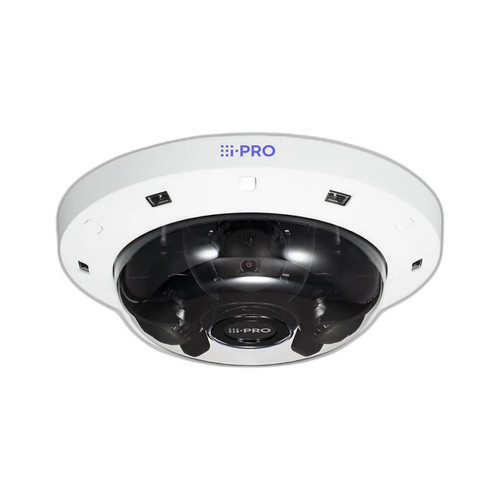
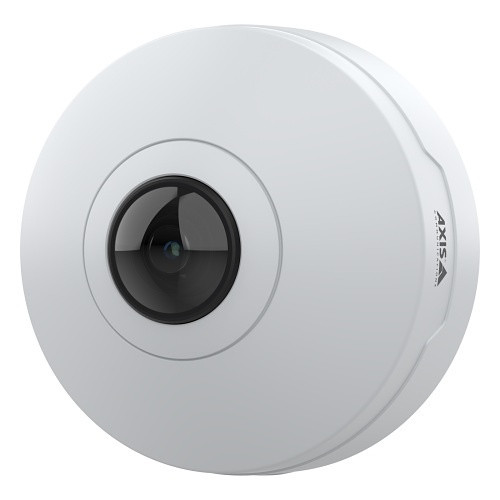
Multi-sensor cameras are the biggest camera-count lever in warehouse deployments. A four-channel multi-sensor (Hanwha PNM-9084RQZ, i-PRO WV-S8563L, Axis M4328-P) mounts at a warehouse corner and covers four adjacent aisles from a single housing. One PoE port, one IP address, one VMS license, four independent views.
For a warehouse with 12 aisles organized in a standard grid, four multi-sensor cameras at the corners (16 total imagers) replace 12 to 16 single-lens aisle cameras, reduce cable count by roughly 70 percent, and cut commissioning time by a third. The incremental cost of multi-sensor versus single-lens is typically recovered in the installation labor savings alone.
Multi-sensor is not the right choice everywhere. Individual aisles in mid-size warehouses with long straight runs still benefit from single-lens cameras mounted at the aisle ends, because a multi-sensor's 90-degree sector is wider than most warehouse aisles and wastes pixels on racking faces. Use multi-sensor at building corners where four directions need coverage; use single-lens down long aisles where one direction needs coverage.
Matching NVR and Storage to Camera Count
Once camera count is set, NVR and storage sizing follows a straightforward formula. For 4MP cameras at 15 fps with H.265+ continuous recording, budget roughly 10 to 14 GB per camera per day. A 24-camera warehouse at 30-day retention needs 7.2 to 10 TB of storage, plus redundancy (typically RAID 5 or RAID 6, which adds 25 to 33 percent overhead).
Channel count on the NVR should match the camera count with headroom for future expansion. A 24-camera warehouse pairs well with a 32-channel NVR (Hanwha XRN-3220 series or i-PRO WJ-NX310); a 12-camera warehouse pairs with a 16-channel (Hanwha XRN-1620B2 or Axis S3008 Mk II); a 6-camera warehouse fits on an 8-channel (Hanwha XRN-820S).
For facilities that may grow or add cameras through phased rollouts, size the NVR at 1.5 to 2x current camera count. The incremental cost of going from a 16-channel to 32-channel NVR is small relative to swapping recorders later.
Recommended NVR Kits by Warehouse Size
Start with the NVR that matches the warehouse size, then build the camera mix from the zone breakdown above. All three are NDAA-compliant Hanwha Wisenet recorders with RAID-capable storage expansion.
Hanwha
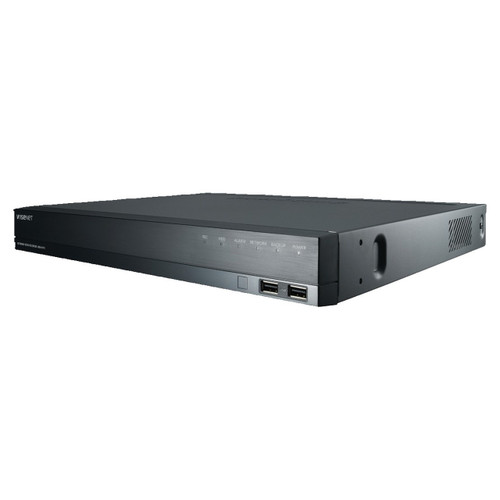
Hanwha XRN-820S 8-Channel 4K Network Video Recorder
XRN-820S
8-channel 4K NVR pairs with 6 to 8 cameras for a small warehouse. Right-sized for dock + aisle + entry coverage on a single recorder.
Hanwha
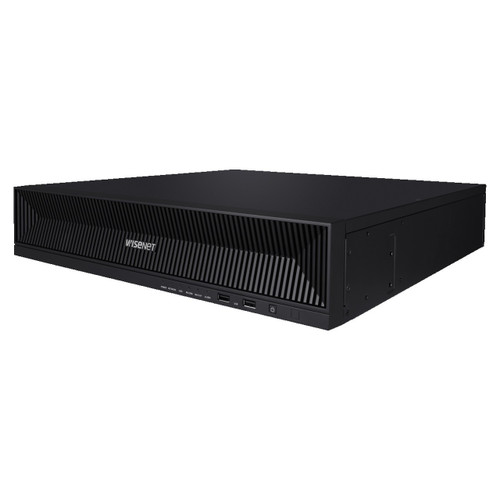
Hanwha XRN-1620B2 16-Channel 4K NVR
XRN-1620B2
16-channel 4K NVR pairs with 12 to 16 cameras for a standard warehouse. Enough headroom for dock doors, aisles, perimeter, and office cameras on one chassis.
Hanwha
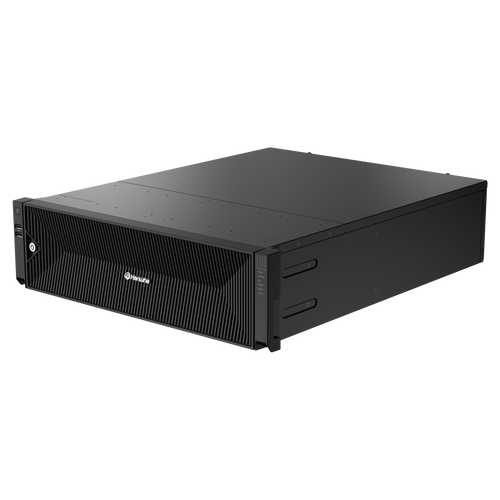
Hanwha XRN-3220B4 32-Channel 8K Network Video Recorder
XRN-3220B4
32-channel 8K NVR handles the full 24 to 32 camera load of a full-scale warehouse or distribution center, with headroom for expansion and 4K cameras across all positions.
Multi-Sensor Options to Reduce Camera Count
At warehouse corners where four directions need coverage, multi-sensor cameras replace three or four single-lens cameras. Same coverage, lower cable count, fewer VMS licenses, faster commissioning.
Hanwha
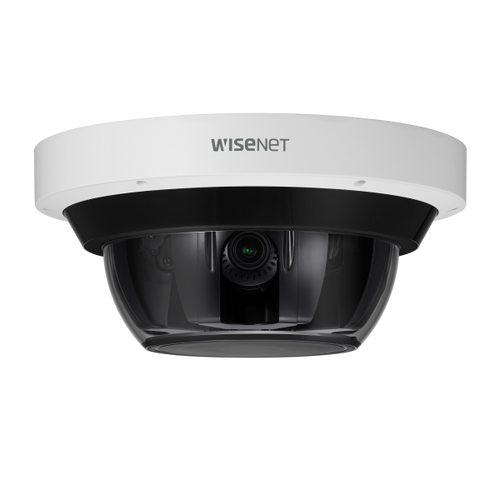
Hanwha PNM-9084RQZ 8MP 2MP x 4 Multi-Sensor, Multi-Directional PTRZ IP Camera
PNM-9084RQZ
Four 2MP imagers in one housing — replaces three or four single-lens aisle cameras at a warehouse corner. Cuts cable count and VMS licensing costs significantly.
i-PRO
i-PRO WV-S8563L 18MP Multi-Sensor Panoramic Outdoor Dome Camera
WV-S8563L
18MP panoramic multi-sensor for large warehouse corners. Broader coverage than four 2MP imagers for facilities with longer sight lines.
Axis
Axis M4328-P 12MP Multi-Sensor Panoramic IP Camera - 02637-004
02637-004
Axis 12MP panoramic multi-sensor for warehouses that have standardized on Axis elsewhere. Integrates natively with AXIS Camera Station and third-party VMS platforms.
Frequently Asked Questions
How many cameras does a 50,000 square foot warehouse need?
Typically 18 to 30 cameras, with 4 to 6 at dock doors, 8 to 14 along aisles and racking, 4 to 6 on the perimeter, and 2 to 4 covering offices and entry points. The exact count depends on dock-door count, aisle layout, and whether multi-sensor cameras are used at corners.
What is the average cost per camera installed in a warehouse?
For NDAA-compliant commercial-grade cameras, budget $400 to $1,200 per camera installed, inclusive of mounting hardware, PoE drop, and pro-rated switch and NVR cost. Blended average for a typical warehouse lands near $650 per camera.
Do I need one camera per dock door?
One camera per dock door is the baseline, facing inbound with a clear view of the trailer bay. For high-volume or loss-prevention-sensitive facilities, add a second camera per door facing outbound. Most 3PL and distribution-center deployments include the second camera.
Can multi-sensor cameras really reduce my camera count by 30 percent?
Yes, at warehouse corners where four aisles or sectors meet. A single four-channel multi-sensor replaces three to four single-lens cameras at that position, plus saves the cable count, PoE port count, and VMS licenses. The count reduction does not apply to long straight aisles where single-lens cameras are a better fit.
How does ceiling height affect camera count?
Higher ceilings allow wider coverage per camera. A 4MP dome at 15 feet covers roughly 90 feet of aisle; at 25 feet, the same camera covers 140 feet. Higher ceilings also let you use wider lenses or step down in resolution for the same usable image. For 30 foot or higher ceilings, PTZ or long-range bullet options start to make sense.
What NVR size should I buy for a 24-camera warehouse?
A 32-channel NVR is the right size for 24 cameras. It matches the current camera count with headroom for expansion and typically supports the storage capacity (10 to 14 TB for 30-day retention). Options include the Hanwha XRN-3220 series or the i-PRO WJ-NX310.
How many PoE switch ports do I need?
Plan for 1.25 ports per camera — the 25 percent headroom accounts for access points, intercoms, and other PoE devices. A 24-camera warehouse typically runs on a 24-port managed PoE+ switch plus a smaller uplink switch. Use our PoE Power Budget Calculator for precise wattage planning.
No Bots, Just Experts
No bots, just experts. Free pre-sales support for every customer — product questions, BOM quotes, compatibility checks, price confirmation — typically answered within one business day. Paid services available like full system design, remote installation, and more. Know what you need? Send us your BOM, free quote. Need camera placement designed from a floor plan? That is engineering work — $175 per hour, qty 1 = 1 hour. Typical single-site placement runs 3 to 4 hours. We scope the hours with you before you purchase. Hardware buyers get up to one hour ($175) credited back against their order as a thank-you.