
Best NDAA-Compliant Cameras for Warehouses
NDAA Section 889 compliance is no longer a federal-only concern. Insurance carriers, GSA-facing tenants, third-party logistics contracts, and a growing list of Fortune 500 customers now flag non-compliant cameras during vendor reviews. This guide walks through the cameras we recommend for warehouse deployments when compliance is on the table — organized by deployment zone and budget, with specific product picks and the reasoning behind each choice.
Bottom Line
For most warehouse deployments, the right NDAA-safe lineup is a mix of Hanwha Vision Q-series domes on the interior, Hanwha L-series bullets for aisle and perimeter runs, and either Axis P-series or Hanwha X-series 4K cameras at high-traffic zones. For multi-aisle warehouse corners, a four-channel multi-sensor replaces three or four single-lens cameras and pays back installation time within the first mounting.
Our commercial-surveillance team specifies cameras for warehouse, distribution center, and 3PL deployments every week. This guide reflects the product mix we actually recommend when NDAA compliance is a requirement — not a theoretical lineup.
Best For
- Warehouse operators whose tenants, insurers, or customers require NDAA Section 889 compliance
- 3PL and logistics facilities with federal-contractor or GSA-tenant exposure
- New warehouse construction or major renovations where camera selection is being set now
- Facility managers replacing legacy Hikvision or Dahua cameras after a compliance audit
- Security integrators standardizing on a brand lineup for multi-site warehouse portfolios
Not For
- Purely residential surveillance (NDAA compliance is not required for consumer installations)
- Retrofits where the existing NVR or VMS does not support Hanwha, Axis, or i-PRO ONVIF profiles
- Small 5-camera installations — compliance premium rarely justifies the camera cost at that scale
- Pure cost-driven installs where NDAA is explicitly not required by tenant or customer contract
In This Guide
What NDAA Section 889 Actually Requires
NDAA Section 889 Part B prohibits federal agencies and federal contractors from purchasing or using video surveillance and telecommunications equipment from five named Chinese companies: Hikvision, Dahua, Huawei, ZTE, and Hytera — including cameras sold under OEM relabels such as Honeywell Performance Series, LTS, and Alibi (some SKUs). The restriction applies not just to direct purchases but to any federally-funded project, grant, or lease, and extends to cameras used anywhere on a contractor's premises if that contractor does business with the federal government.
What this means in practice for warehouses: any facility that leases to federal-adjacent tenants, operates under GSA lease, processes federal shipments, runs a bonded facility, or handles defense logistics must use NDAA-compliant cameras throughout the surveillance deployment — not just in the tenant-occupied portion. The rule is binary: one non-compliant camera on the network is enough to fail a compliance review.
The five brands we recommend for warehouse NDAA compliance — Axis, Hanwha Vision, i-PRO, Bosch Security, and Pelco — all publish formal compliance statements and list their products in federal procurement catalogs. Using any of these brands gives you a defensible paper trail at audit time.
Why Warehouses Care About NDAA (Even Without Federal Contracts)
The Section 889 rule is federal, but the downstream pressure has reached commercial warehouses through several paths. First, insurance carriers have added NDAA compliance to cyber-insurance underwriting questionnaires, and some carriers now apply premium increases or deny renewal for non-compliant deployments. Second, third-party logistics (3PL) contracts increasingly include NDAA-compliance language borrowed from federal procurement templates, and tenants may require it as a condition of the lease. Third, tenant corporations with federal-contractor status (most Fortune 500) often require NDAA compliance across the facilities they lease, even if the landlord has no federal exposure.
The practical consequence is that warehouses with mixed-tenant or regulated-customer exposure should default to NDAA-compliant cameras for any new install. The price premium versus non-compliant alternatives has shrunk to roughly 15 to 25 percent on equivalent specs, which is routinely absorbed into operating budgets rather than treated as a special line item.
Compliance also gives facility managers a simple answer when a tenant due-diligence request comes in: "Every camera on the system is NDAA-compliant." That answer carries weight whether the question is coming from a tenant, an insurer, or a corporate audit team, and it avoids the slow process of pulling model lists and checking each against the blocked-brand roster.
Placement by Warehouse Zone
Warehouse surveillance works best when camera selection matches the specific function of each zone. The same camera model that excels at aisle-end coverage fails at dock-door positions, and the same dome that handles office areas underperforms in wash-down or outdoor-rated spaces. Below is the mapping we use during design walkthroughs.
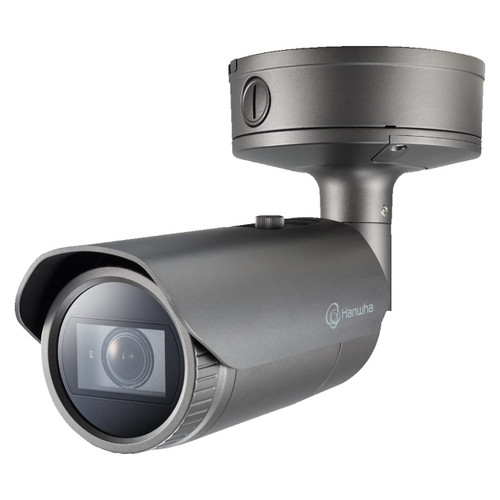
Perimeter fence line and yard: Outdoor bullet cameras with wide-angle lenses, IR illumination to 30 to 40 meters, and IP66 or better ingress protection. The Hanwha ANO-L7012R covers this position well at a budget-friendly price point; the Hanwha XNO-9082R 4K variant adds resolution for longer-distance identification (license plates, people at fence lines).
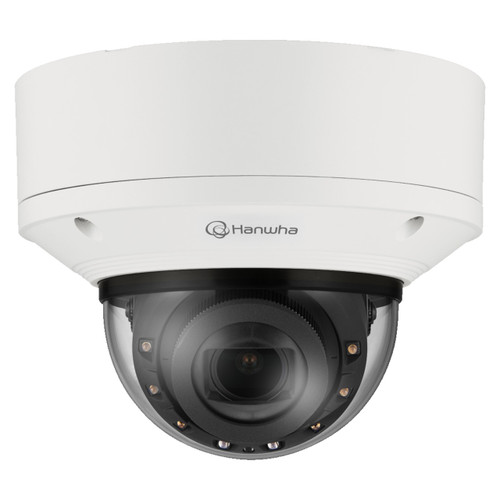
Dock doors and loading bays: Vandal-rated outdoor domes with IK10 impact rating. Dock doors see more physical contact than any other warehouse position — forklifts, pallet jacks, and trailer tails all strike housings that are not impact-rated. The Hanwha QNV-7082R is a proven dock-door camera; upgrade to the XND-9083RV 4K model for positions where license plate or facial-detail capture is a requirement.
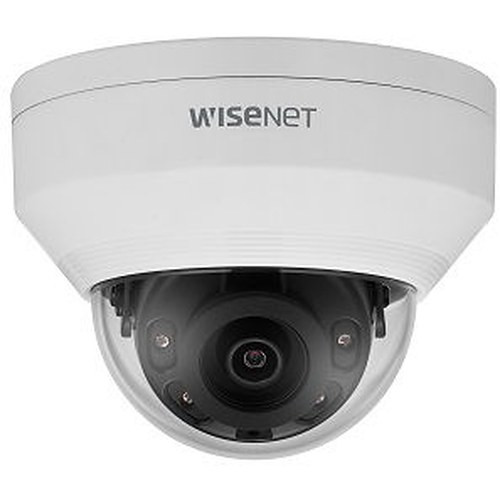
Main aisles and racking: Indoor domes with wide-angle fields of view. At roughly 15 to 22 foot ceilings, a 4MP dome with a 2.8mm to 3.6mm lens covers the width of a standard aisle plus 8 to 12 feet of vertical rack face. The Hanwha ANV-L7012R handles this position well and converts at a high rate in our catalog, which reflects its widespread deployment success.
Warehouse corners (multi-aisle views): Multi-sensor cameras that combine four independent imagers on one mounting. The Hanwha PNM-9084RQZ places four 2MP sensors in a single housing, each aimed at an adjacent aisle. One corner mount replaces three or four single-lens cameras, reduces cable count by 75 percent, and centralizes the mounting hardware. Commissioning is faster (one PoE port, one IP address, one licensing slot in the VMS).
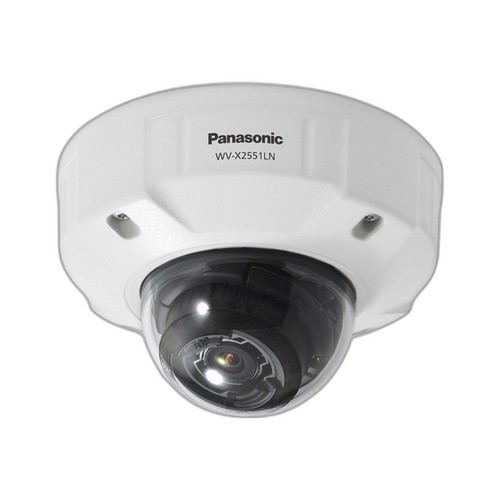
High-traffic zones (pick lines, shipping): AI-capable cameras that run on-board analytics for people counting, dwell time, and forklift detection. The i-PRO WV-X2551LN runs edge AI with enough processing headroom to operate multiple analytics simultaneously, and the Axis P3277-LVE combines AXIS Object Analytics with Lightfinder 2.0 for usable footage in mixed lighting.
Offices and break rooms: Discreet indoor domes. The i-PRO WV-U2132LA 2MP fixed dome is compact and priced for high-count office deployments. Resolution beyond 2MP is typically wasted in office areas where the coverage goal is presence detection, not identification.
Warehouse Camera Budget Planning
Budget planning for a warehouse surveillance system runs three distinct cost lines: cameras, network infrastructure (PoE switching, cable plant, UPS), and recording plus VMS licensing. Camera cost typically represents 45 to 55 percent of the total hardware investment, with infrastructure consuming 20 to 30 percent and NVR/VMS the remainder.
For NDAA-compliant cameras specifically, budget roughly $400 to $1,200 per camera installed, inclusive of mounting hardware, cable drop, and pro-rated switch and NVR cost. The spread reflects the tier mix: a warehouse that is 60 percent budget-tier positions and 40 percent premium or AI-capable positions lands near $650 per camera blended average.
Long-term cost considerations often change the short-term math. A warehouse with 100 cameras at $400 versus $650 per camera saves $25,000 on day one, but the $25,000 delta is usually recouped within 24 months through lower failure rates, longer inter-replacement cycles, and better footage quality during incidents — particularly the insurance-claim and OSHA-reportable incident scenarios where a better image can mean a faster settlement or a more accurate investigation.
Common Warehouse Camera Mistakes
Mismatching mount type and housing rating. Dock doors need vandal-rated IK10 housings, not standard outdoor housings. We see broken standard outdoor domes on dock-door retrofits regularly; vandal-rated models survive the same environment for years.
Ignoring the interior lighting mix. Warehouses with metal halide or sodium vapor lighting create color-cast problems for any camera without true day-night and dedicated IR. The Hanwha L-series bullets and ANV-L7012R dome both include day-night with IR that recovers usable color under mixed-lighting conditions; lower-tier cameras produce unusable orange or green tints.
Forgetting about forklift clearance. Standard 15-foot ceiling mounts interfere with forklift masts raised to full extension. Either mount cameras above 17 feet or select recessed domes that sit closer to the ceiling plane. Recessed mounts also resist forklift impact damage during accidental contact.
Sizing storage by live camera count, not retention requirement. A 32-camera system at 4MP and 15 fps with H.265+ continuous recording produces roughly 320 to 480 GB per camera per 30 days — so a 30-day retention policy requires 10 to 15 TB of active storage plus redundancy. Many facilities specify an NVR chassis adequate for camera count but underspec the drive capacity.
Assuming ONVIF alone handles VMS integration. ONVIF covers the basic video feed but often misses vendor-specific analytics, PTZ presets, and edge-AI metadata. For a mixed-vendor deployment, verify each camera model against the target VMS platform's certified-device list before commit.
Our Warehouse NDAA Camera Picks
Six cameras that cover 90 percent of warehouse positions. Each is NDAA Section 889 compliant, backed by a manufacturer compliance statement, and specified across our own warehouse deployments.
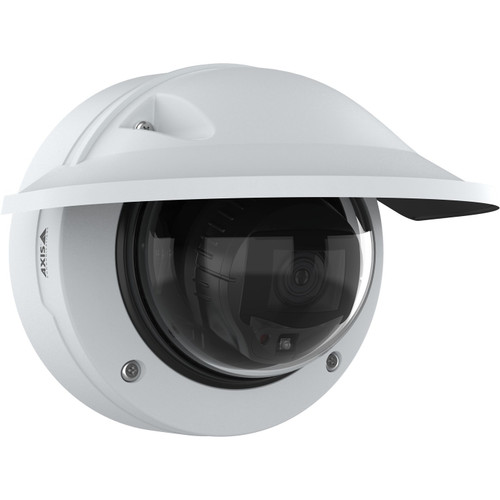
Axis
Axis P3277-LVE 5MP Outdoor AI IR Dome Camera
03153-001
AXIS Object Analytics for forklift detection, Lightfinder 2.0 for usable color in mixed warehouse lighting. Axis is unambiguously NDAA-compliant with a published statement; dependable on federal-exposure sites.
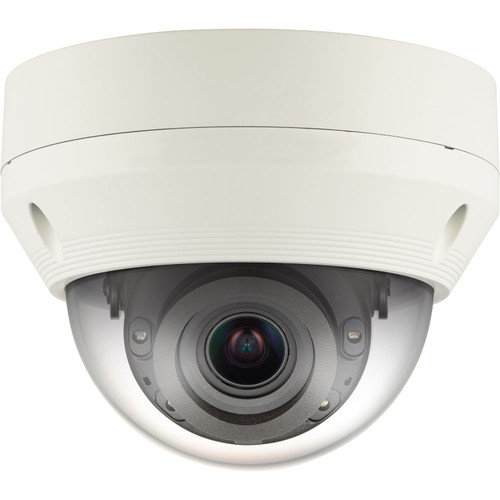
Hanwha Vision
Hanwha QNV-7082R 4MP Vandal Dome IP Camera
QNV-7082R
IK10 vandal housing for dock doors, 4MP resolution for identification tasks, and Hanwha Vision's NDAA statement covers federal-compliance needs. The workhorse interior/dock camera at a commercial-reasonable price.
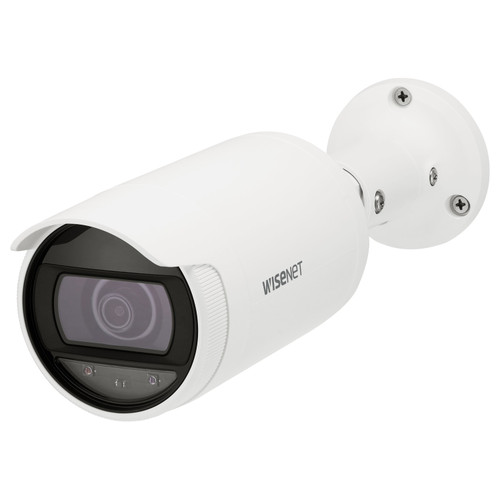
Hanwha Vision
Hanwha ANO-L7012R 4MP Wide-Angle Low Light Outdoor Bullet IP Camera
ANO-L7012R
Wide-angle 4MP with low-light sensor for aisle-end and perimeter coverage. The highest-converting bullet in our catalog by a wide margin, which reflects real-world warehouse success.
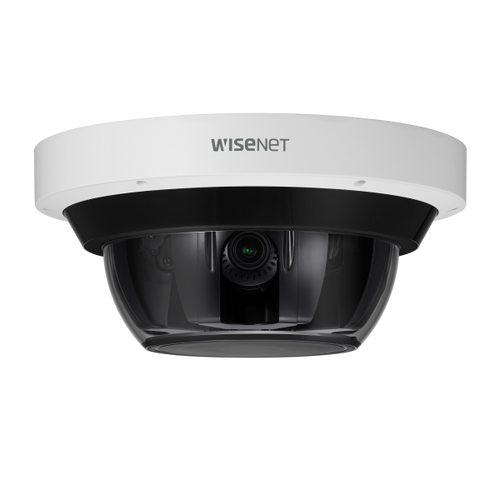
Hanwha Vision
Hanwha PNM-9084RQZ 8MP Multi-Sensor Multi-Directional IR Camera
PNM-9084RQZ
Four 2MP imagers in one housing — replaces three or four single-lens cameras at a warehouse corner. One cable, one IP address, one VMS license, four independent aisle views. Payback on install labor alone.
i-PRO
i-PRO WV-X2551LN 5MP AI-Enhanced Fixed Outdoor Dome IP Camera
WV-X2551LN
Edge AI for people counting, dwell analysis, and forklift detection. Pairs well with pick-line and shipping-zone analytics dashboards. i-PRO publishes NDAA compliance across its Extreme series.
Hanwha Vision
Hanwha ANV-L7012R 4MP Day/Night IR Outdoor Vandal Dome
ANV-L7012R
The budget-conscious pick for standard warehouse positions. Converts at over 50 percent on the product page, which is unusual for this price tier and reflects buyer confidence in the fit.
Also Consider: Higher-Resolution and Analytics-Capable Alternatives
For new builds or renovations where the incremental cost is justified by the use case. 4K resolution extends identification distance; AI-capable cameras unlock people counting and object analytics on-board.
Hanwha Vision
Hanwha XND-9083RV 8MP 4K IR Vandal-Resistant Dome
XND-9083RV
4K resolution for license-plate and facial capture at mid-range. Stepping up from 4MP to 8MP roughly doubles usable identification distance.
Hanwha Vision
Hanwha XNO-9082R 4K Outdoor IR Bullet Network Camera
XNO-9082R
4K bullet for long perimeter runs or yard coverage where identification distance matters. 30-meter IR range handles most outdoor warehouse lighting gaps.
i-PRO
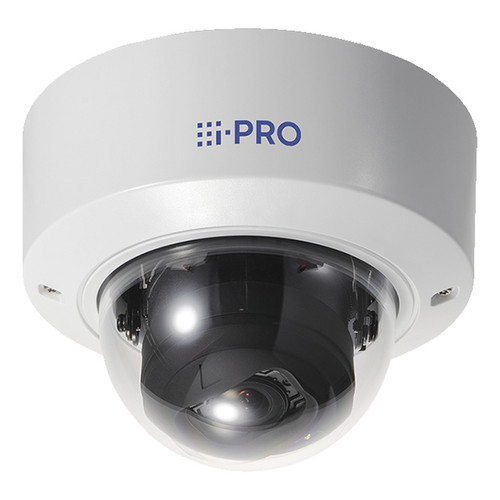
i-PRO WV-S22500-V3L 5MP AI Indoor Dome IP Camera
WV-S22500-V3L
Indoor AI dome for pick-line and shipping analytics. Pairs with the outdoor WV-X2551LN for mixed indoor/outdoor AI-capable deployments on a single platform.
Frequently Asked Questions
Is NDAA compliance legally required for a commercial warehouse?
Only for warehouses with federal-contractor, GSA-lease, bonded-facility, or defense-logistics exposure. However, insurance carriers, 3PL contract templates, and corporate-tenant due diligence increasingly require NDAA compliance as a contract or underwriting condition, even without a direct federal-procurement path. The practical answer for most commercial warehouses is that NDAA compliance is no longer optional once one tenant or customer requires it.
Can I mix NDAA-compliant and non-compliant cameras on the same system?
For federally-exposed deployments, no — the rule treats the system as non-compliant if any camera is on the blocked-brand list. For purely commercial deployments without federal exposure, a mixed system is technically possible, but our recommendation is still to standardize on compliant cameras. The audit risk and the insurance-questionnaire friction of a mixed system typically outweighs the savings on a few non-compliant cameras.
Which manufacturers are NDAA-compliant for warehouse cameras?
Axis Communications, Hanwha Vision (formerly Samsung/Hanwha Techwin), i-PRO (formerly Panasonic), Bosch Security Systems, and Pelco (by Motorola Solutions) all publish formal NDAA Section 889 compliance statements and list products in federal procurement catalogs. Hikvision, Dahua, Huawei, ZTE, and Hytera are the five blocked brands.
Are OEM relabels of Hikvision or Dahua NDAA-compliant?
No. NDAA Section 889 applies to cameras manufactured by the blocked entities regardless of the brand name on the housing. Common OEM relabels to watch for include Honeywell Performance Series cameras, LTS, Alibi, EZVIZ (Hikvision-owned), Lorex (Dahua-owned), and Swann. If your warehouse includes any of these, a compliance audit will flag them as non-compliant.
How do I check if my existing cameras are NDAA-compliant?
Pull a camera export from your VMS or NVR that includes model numbers and manufacturer names. Check each manufacturer against the Section 889 blocked list and the OEM-relabel watch list. For gray areas, ask the manufacturer directly for a written NDAA compliance statement — legitimate manufacturers will provide one within 24 to 48 hours.
What does NDAA compliance add to a warehouse camera budget?
At current (2026) pricing, NDAA-compliant cameras carry a roughly 15 to 25 percent premium over non-compliant equivalents on matched specs. For a 32-camera warehouse deployment, that is $3,500 to $8,000 of incremental camera cost — routinely absorbed by operating budgets, particularly once the insurance-premium and contract-compliance savings are factored in.
Should I replace all my Hikvision or Dahua cameras at once, or phase the rollout?
Depends on the exposure. For facilities with active federal-contractor or GSA-lease obligations, a full and fast replacement is the right call. For facilities with a mix of exposures, phase the rollout over 12 to 18 months and prioritize the positions most visible to tenants or customers (main entrances, dock doors, visitor areas) first. Offer an optional expedite if a tenant or insurer pushes the timeline.
Do I need a new NVR or VMS to go NDAA-compliant?
Not necessarily. Most mainstream VMS platforms (Genetec, Milestone, Avigilon, ExacqVision, Hanwha Wisenet WAVE) support NDAA-compliant cameras without system changes. Hikvision and Dahua NVRs themselves are also NDAA-blocked, so those would need replacement. If your current recorder is an Axis, Hanwha, i-PRO, or VMS-based recorder, camera-only replacement is typical.
No Bots, Just Experts
No bots, just experts. Free pre-sales support for every customer — product questions, BOM quotes, compatibility checks, price confirmation — typically answered within one business day. Paid services available like full system design, remote installation, and more. Replacing a specific Hikvision model? Send the model list, we return NDAA-compliant replacements with pricing free. Need a full NDAA audit and migration plan? Engineering time at $175/hour. Typical single-site audit runs 4 to 10 hours. Hardware buyers get up to one hour ($175) credited back against their order as a thank-you.