
Warehouse Surveillance Buying Checklist
Most warehouse camera systems are approved based on a proposal that leaves important questions unanswered. This checklist walks through the 30 questions we ask before a warehouse surveillance project is ready to go to install. Run through this before approving a quote — gaps here become budget overruns, re-work, and failed compliance audits later.
Bottom Line
A warehouse camera system is ready to install when you can answer yes to every question in the checklist below. If a proposal leaves more than two or three items unanswered, it is not yet a complete proposal — it is a starting point. Work through the gaps before sign-off.
Our commercial team walks through this checklist on every warehouse proposal before ink hits paper. It is the same list we use internally and with integrator partners.
Best For
- Facility managers reviewing proposals from security integrators
- Operations leaders signing off on warehouse surveillance budgets
- IT directors evaluating integration with existing networks and access control
- Security integrators using this as a pre-install sanity check
- Property managers reviewing tenant surveillance standards
Not For
- Residential or consumer surveillance purchases
- Small retail deployments — use a different checklist for those
In This Guide
Compliance and Brand Safety First
Before any camera selection, answer the compliance questions. If the warehouse has federal-contractor, GSA-lease, or regulated-tenant exposure, NDAA Section 889 compliance is a hard requirement — all cameras, all NVRs, all network gear on the surveillance VLAN. If a proposal includes Hikvision, Dahua, Honeywell Performance Series, LTS, Alibi, or any other Section 889 blocked brand, it fails the compliance test regardless of the other specifications.
The five brands that cover the majority of compliant warehouse deployments are Axis, Hanwha Vision, i-PRO, Bosch Security, and Pelco. Digital Watchdog and Vivotek are also compliant but less commonly specified. If a proposal uses a non-mainstream brand, ask for the manufacturer's written NDAA compliance statement.
Red Flags in a Warehouse Proposal
No retention period specified. Storage sizing depends on retention; a proposal without a specified retention period (typically 30, 60, or 90 days) is incomplete. The default for most commercial warehouses is 30 days.
Camera count without zone breakdown. A proposal that says "24 cameras" without mapping cameras to zones (dock doors, aisles, perimeter, offices) is guessing. Ask for the zone-by-zone breakdown before approving.
All-fixed or all-PTZ lineup. Warehouses need a mix: fixed domes for aisles and dock doors, fixed bullets for perimeter and yard, occasional PTZ for flexible coverage, and multi-sensor for corners. Any proposal that uses only one camera type is missing coverage.
No PoE budget calculation. Switch sizing depends on camera PoE draw. A proposal without a PoE-budget calculation will likely need a larger switch at install time, which is a change order.
No NVR expansion headroom. A 24-channel NVR for a 24-camera installation leaves no room for expansion. Size the NVR at 1.25 to 1.5x the current camera count for future flexibility.
Missing cable plant or labor estimate. Cable runs and install labor are 30 to 40 percent of the total system cost. A hardware-only proposal is only half the story.
No integration statement for access control or VMS. If the warehouse has existing access control or a VMS, the proposal needs to specify how the new cameras integrate. Missing integration statements are the number one source of post-install change orders.
No warranty or support terms. Commercial camera warranties range from 1 year (budget) to 5 years (enterprise). A proposal without explicit warranty terms leaves you with the minimum manufacturer default.
Recommended Starting Products for a Warehouse System
A proven starting lineup for warehouse deployments. Mix and match with LPR at gates, thermal at perimeters, and multi-sensor at corners based on your specific requirements.
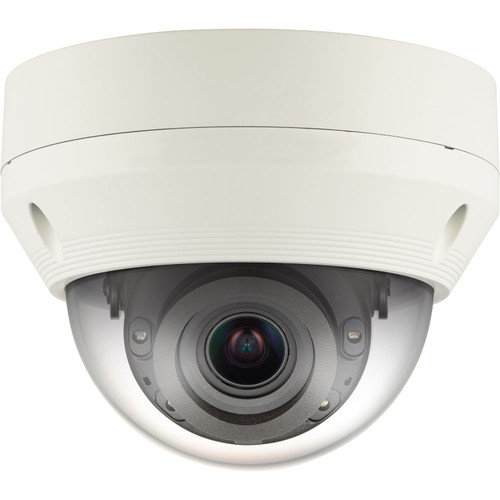
Hanwha
Hanwha QNV-7082R 4MP Vandal Dome IP Camera
QNV-7082R
The default warehouse dome. IK10 vandal-rated, 4MP, NDAA-safe. Reliable dock and aisle coverage at a price that scales to multi-site rollouts.
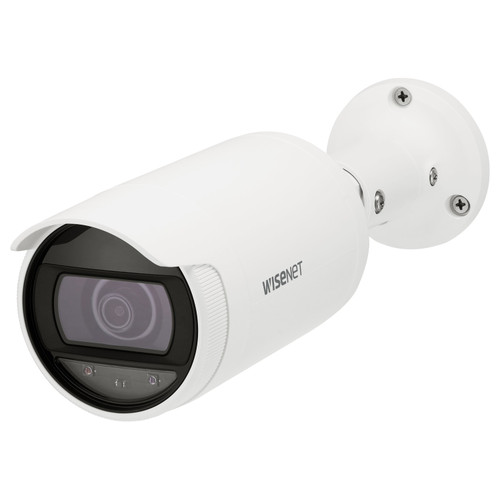
Hanwha
Hanwha ANO-L7012R 4MP Wide-Angle Low Light Outdoor Bullet IP Camera
ANO-L7012R
Perimeter, aisle-end, and yard coverage. Low-light sensor handles outdoor twilight without dropping to grayscale too early. The highest-converting bullet in our catalog.
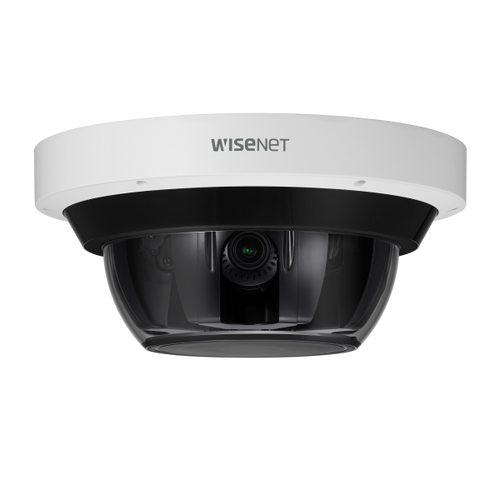
Hanwha
Hanwha PNM-9084RQZ 8MP 2MP x 4 Multi-Sensor, Multi-Directional PTRZ IP Camera
PNM-9084RQZ
Four 2MP imagers in one housing. Replaces three or four single-lens cameras at warehouse corners. One cable, one IP, four aisles covered.
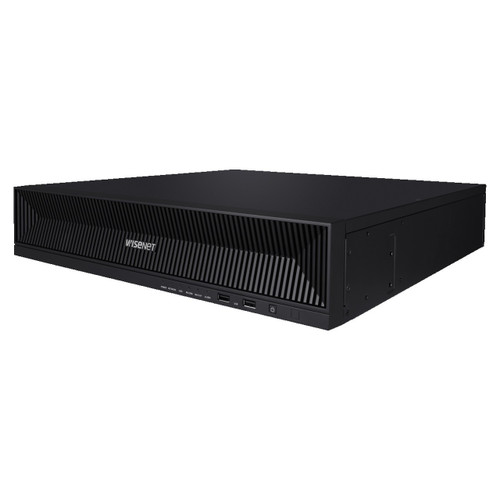
Hanwha
Hanwha XRN-1620B2 16-Channel 4K NVR
XRN-1620B2
16-channel 4K NVR for a typical warehouse camera count. RAID-capable, Hanwha WAVE integration, NDAA-safe. The default recorder for 12 to 16 camera warehouses.
The 30-Question Warehouse Surveillance Checklist
Work through this list before approving any warehouse surveillance proposal. A complete proposal answers every item; gaps become budget overruns and re-work later.
Is every camera on the NDAA Section 889 compliant-brand list?
If the warehouse has any federal-contractor or regulated-tenant exposure, this is a hard requirement.
Are all NVRs, switches, and recorders also NDAA-compliant?
The rule applies to the entire surveillance stack, not just cameras.
Has the required retention period been specified (30, 60, 90 days)?
Storage sizing follows from retention. No retention spec = no way to size the NVR correctly.
Does the camera count include a zone-by-zone breakdown?
Dock doors, aisles, perimeter, offices — each zone should have its own count.
Is the camera mix appropriate (fixed domes + fixed bullets + multi-sensor + PTZ)?
Warehouses need variety. All-one-type lineups miss coverage.
Is every dock door covered with at least one camera?
Dock doors are the highest-value surveillance position in most warehouses.
Is perimeter fence line covered (1 camera per 100-150 feet)?
Perimeter coverage is foundational for after-hours monitoring.
Are aisle-end cameras oriented to see down the aisle, not across?
Across-aisle coverage wastes pixels on racking faces. Along-aisle gets the usable footage.
Are multi-sensor cameras used at warehouse corners?
30% camera-count reduction at corners where four aisles meet.
Is there an LPR camera at each vehicle entry point?
Gate and dock entry LPR is baseline for commercial warehouses now.
Is IR illumination matched to the camera IR range and environment?
LPR and low-light cameras often need dedicated IR, not shared illumination.
Does the NVR have at least 25% channel headroom for expansion?
Size the NVR for future growth, not just current count.
Is storage sized for the full retention period plus RAID overhead?
RAID 5/6 adds 25-33% overhead beyond the raw retention calculation.
Is the PoE switch budget calculated (watts per camera x count x 1.25 headroom)?
PoE+ and PoE++ cameras draw more than base PoE. Budget deliberately.
Are all cable runs under 100 meters (or using PoE extenders/fiber)?
100m is the PoE standard. Longer runs need extension hardware or fiber.
Is UPS coverage included for the NVR and core PoE switch?
A power outage that takes the NVR offline is a documentation-gap incident.
Is VMS licensing counted per camera (or is the VMS included with the NVR)?
Mixed deployments often surprise on VMS licensing at scale.
Does the VMS integrate with your existing access control or alarm panel?
Camera-triggered door events and alarm-triggered recording are standard integrations.
Are cameras mapped to a facility floor plan?
Without a floor plan, you cannot verify coverage at approval time.
Is cable plant labor included in the proposal?
Cable labor is 30-40% of the hardware cost. Hardware-only quotes are incomplete.
Is commissioning and configuration labor included?
Cameras need to be named, positioned, tuned, and added to the VMS. Budget for the hours.
Is every camera warranty term stated explicitly?
Commercial warranties range from 1 to 5 years. Do not assume — ask.
Is there a spare-parts or replacement-camera plan for failures?
Plan to keep 5-10% spares on site for fast swap during failures.
Is the post-install monitoring and health check plan specified?
Cameras go offline silently. A health-check workflow catches failures before footage gaps.
Is the ONVIF or vendor-specific VMS compatibility verified for every camera model?
ONVIF alone does not cover vendor-specific analytics. Verify the full integration.
Is the IP addressing and VLAN plan documented?
Surveillance VLANs isolate cameras from production traffic and reduce attack surface.
Is firmware-update policy defined for cameras and NVR?
Monthly patch cadence is standard for commercial surveillance. Plan for it.
Is the cybersecurity baseline (admin password policy, cert management, logging) specified?
Factory-default passwords are a compliance failure on audit. Fix at install.
Is training for on-site personnel included?
2-3 hours of training prevents most "system is broken" support tickets in the first 6 months.
Is there a clear point of contact for post-install support?
Install teams and support teams are often different people. Know who to call.
Frequently Asked Questions
How long should a warehouse surveillance proposal take to review?
Plan for 2 to 4 hours of review time on a mid-size warehouse proposal (20 to 40 cameras). For 100+ camera facilities, block out a half-day. The time pays back in catching missed compliance items, undersized storage, or missing cable-labor line items.
What is the biggest cost surprise in a warehouse camera project?
Cable-plant labor is the most common cost surprise. A hardware-only proposal may show $35,000 of cameras and recorders; the full install with cable, labor, and commissioning typically lands at $55,000 to $75,000. Ask for the full-install number, not just the hardware.
Should I run the RFP myself or use an integrator?
For single-site warehouses under 40 cameras, running the RFP yourself with this checklist is reasonable. For multi-site, larger, or regulated-tenant deployments, bring in a commercial integrator — the design, compliance, and multi-vendor integration work benefits from a specialist.
What retention period should I specify?
30 days is the default for commercial warehouses. 60 days is common for 3PL contract warehouses. 90+ days is typical for regulated-tenant or bonded facilities. Longer retention is often required by insurance carriers; check with your carrier before specifying.
Do I need a VMS, or is the NVR enough?
For single-site warehouses under 30 cameras, the NVR's built-in VMS is usually enough. For multi-site, 30+ cameras, or integration-heavy deployments (access control, alarm panel, external analytics), a dedicated VMS platform gives you better search, federation, and integration than most NVR-native VMS.
Can I do a phased warehouse rollout?
Yes. Common phases: Phase 1 = dock doors, perimeter, main entries; Phase 2 = interior aisles and offices; Phase 3 = analytics and specialty (LPR, thermal). Phasing spreads the budget across fiscal years and lets you validate the first-phase specification before committing to the full count.
How often should warehouse cameras be replaced?
Commercial warehouse cameras typically run 7 to 10 years before replacement. Replacement drivers are usually resolution (upgrading from 2MP to 4K), analytics (adding AI capability), or brand compliance (replacing non-NDAA cameras). Budget for replacement every 7 to 10 years as a capital-expense line item.
No Bots, Just Experts
No bots, just experts. Free pre-sales support for every customer — product questions, BOM quotes, compatibility checks, price confirmation — typically answered within one business day. Paid services available like full system design, remote installation, and more. Got a list of products? Free BOM quote. Need help figuring out what to buy? Buy engineering time by the hour — $175/hour, qty 1 = 1 hour. Tell us about your project, we scope how many hours it needs, you purchase that quantity. Hardware buyers get up to one hour ($175) credited back against their order as a thank-you.