
Vertiv GXT5-3000LVRT2UXL vs Vertiv PSI5-3000SRT120LI: Specification Comparison
Both the Vertiv Liebert GXT5-3000LVRT2UXL and the Vertiv Liebert PSI5-3000SRT120LI are 3000VA / 2700W rack/tower UPS units targeting the same mid-range power-protection tier for IT and light-industrial loads. The GXT5 uses online double-conversion topology with VRLA battery chemistry, while the PSI5 uses line-interactive topology with lithium-ion battery chemistry. Despite identical VA/W ratings, the topological and battery-chemistry differences represent meaningful trade-offs in transfer time, efficiency, weight, and runtime flexibility that installers and IT buyers should evaluate carefully.
In This Guide
- Which UPS topology and output power quality better protects sensitive loads?
- How do battery chemistry, runtime scalability, and serviceability compare?
- Which unit offers broader connectivity, management options, and easier physical integration?
- Which should you choose: the GXT5-3000LVRT2UXL or the PSI5-3000SRT120LI?
- Side-by-Side Specs
- FAQ
Which UPS topology and output power quality better protects sensitive loads?
The GXT5-3000LVRT2UXL operates as an online double-conversion UPS: all output power passes through the inverter continuously, yielding zero transfer time to battery and complete galvanic isolation from the utility. Output voltage is pure sinewave at 110/115/120/125 VAC (user-configurable) ±3%, with output frequency held to ±0.1 Hz in battery mode. Efficiency in double-conversion mode reaches up to 94%, rising to 98%+ in optional ECO mode.
The PSI5-3000SRT120LI is line-interactive with automatic voltage regulation (AVR). Under normal utility conditions the inverter is not fully in-line, which means there is a measurable transfer time to battery (the spec sheet does not disclose the exact figure). Output is pure sinewave on battery. The PSI5 lists efficiency at 0.981 (98.1%), which reflects the efficiency advantage typical of line-interactive designs when utility power is clean. Output voltage defaults to 120 VAC with 100/110/115/125 VAC user-selectable.
For loads that demand zero transfer time and tight frequency regulation — medical equipment, precision industrial controls, or servers with narrow input tolerances — the GXT5's double-conversion architecture is the specified choice. The PSI5's line-interactive topology is appropriate where utility power quality is reasonably stable and the minor transfer gap is acceptable, and it returns a higher steady-state efficiency figure as a result.
How do battery chemistry, runtime scalability, and serviceability compare?
The GXT5-3000LVRT2UXL uses VRLA (valve-regulated lead-acid) batteries that are hot-swappable and, critically, scalable via external battery cabinets (EBCs). Runtime is therefore not fixed — additional EBCs can extend run time to support longer outages or graceful shutdown of large loads. Recharge time is specified at approximately 3 hours to 90%. Battery management includes temperature-compensated charging and end-of-life detection. The GXT5 weighs 66 lbs.
The PSI5-3000SRT120LI uses lithium-ion battery chemistry. The spec sheet confirms front-access hot-swappable battery kits and UN38.3 (lithium battery transport safety) listing. Specific runtime figures and EBC scalability options are not disclosed in the provided specifications. The PSI5 weighs 56 lbs — 10 lbs lighter than the GXT5 — a meaningful difference for rail-mount installs or weight-restricted enclosures. Lithium-ion chemistry typically offers longer battery service life and better cycle performance than VRLA, though the spec does not state a cycle count or calendar life figure.
Buyers who need confirmed runtime scalability for extended outages should note that EBC compatibility is explicitly stated for the GXT5 but is not addressed in the PSI5 spec sheet. The PSI5's lithium-ion chemistry and lighter weight are advantages for density and long battery service intervals, but those claims cannot be fully quantified from the provided data.
Which unit offers broader connectivity, management options, and easier physical integration?
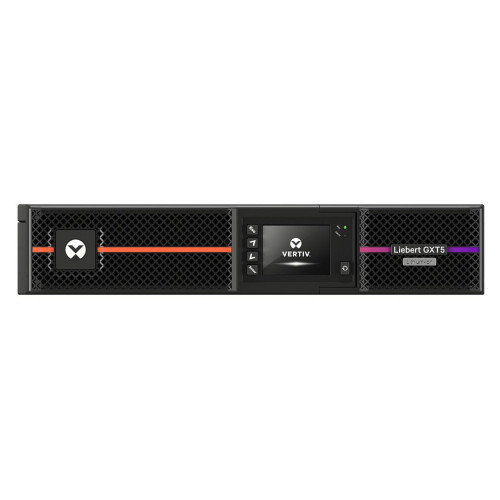
The GXT5-3000LVRT2UXL provides USB and RS-232 serial interfaces onboard, with an Intellislot expansion slot supporting optional SNMP, Modbus, and BACnet communications cards. Management software includes Vertiv Environet and compatibility with NUT (Network UPS Tools). The front panel carries an LCD for local status and configuration. The unit includes an EPO (Emergency Power Off) input, internal automatic bypass, and support for an external maintenance bypass. It is rack/tower convertible at 2U, with dimensions of 3.4 × 16.9 × 21.3 in and seven outlets: 1× NEMA L5-30R twist-lock and 6× NEMA 5-20R (programmable load-segmentation groups).
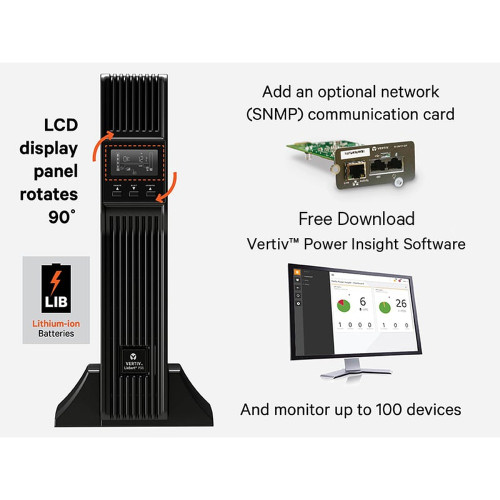
The PSI5-3000SRT120LI provides USB and an EPO connector onboard, with an optional Liebert IntelliSlot UNITY card enabling SNMP and web management. The LCD display is rotatable, which the spec sheet flags as aiding flexible rack or tower orientation. The PSI5 is a 3U unit at 5.14 × 17.24 × 16.92 in — notably shallower in depth (16.92 in vs 21.3 in), which is relevant for short-depth racks and shallow wall-mount enclosures. It provides 10 outlets: 9× NEMA 5-20R and 1× NEMA L5-30R. RS-232 is not listed in the PSI5 spec sheet. FCC Part 15 Class B (consumer/light-commercial EMI) is listed versus Class A for the GXT5.
Both units share the Intellislot SNMP expansion path and USB connectivity. The GXT5 adds RS-232 and explicitly documents Modbus/BACnet support, which matters in building automation or industrial environments. The PSI5 delivers three additional 5-20R outlets (10 vs 7), a shallower 16.92 in depth versus 21.3 in, and a rotatable LCD — advantages for tight-space installations. Load-segmentation (programmable outlet groups) is specified for the GXT5; the PSI5 spec sheet does not address this feature.
Which should you choose: the GXT5-3000LVRT2UXL or the PSI5-3000SRT120LI?
Our take: The GXT5-3000LVRT2UXL is the stronger choice when zero transfer time, confirmed runtime scalability, and building-automation protocol support are required. Its online double-conversion topology delivers zero ms transfer time versus an undisclosed figure for the PSI5's line-interactive design, and its VRLA battery system is explicitly scalable via external battery cabinets — a capability not confirmed in the PSI5 spec sheet. It also adds RS-232 and documented Modbus/BACnet support absent from the PSI5. Conversely, the PSI5-3000SRT120LI is the stronger fit when depth is constrained (16.92 in vs 21.3 in), weight matters (56 lbs vs 66 lbs), a higher steady-state efficiency figure is prioritized (98.1% vs 94% double-conversion mode), more standard outlets are needed (10 vs 7), or lithium-ion battery chemistry is a site requirement. Neither unit dominates on every axis; the right choice depends on whether the application demands double-conversion protection or favors the PSI5's physical and efficiency profile.
Side-by-Side Comparison
Spec-for-spec, from manufacturer data.
| Specification | Vertiv GXT5-3000LVRT2UXL | Vertiv PSI5-3000SRT120LI |
|---|---|---|
| Topology | Online Double-Conversion | Line-Interactive (AVR) |
| Capacity | 3000VA / 2700W | 3000VA / 2700W |
| Power Factor | 0.9 | 0.9 (derived: 2700W ÷ 3000VA) |
| Transfer Time | Zero (online) | Not specified |
| Battery Chemistry | VRLA (lead-acid) | Lithium-ion |
| Battery Serviceability | Hot-swappable, EBC scalable | Hot-swappable (front access); EBC not specified |
| Efficiency | Up to 94% (98%+ ECO mode) | 98.1% |
| Input Connection | NEMA L5-30P | NEMA L5-30P |
| Input Voltage Range | 60–150V AC | 75–146V AC |
| Output Outlets | 1× L5-30R, 6× 5-20R (7 total) | 1× L5-30R, 9× 5-20R (10 total) |
| Load Segmentation | Programmable outlet groups | Not specified |
| Form Factor / Rack Height | Rack/Tower, 2U | Rack/Tower, 3U |
| Dimensions (H×W×D in) | 3.4 × 16.9 × 21.3 | 5.14 × 17.24 × 16.92 |
| Weight | 66 lbs (30 kg) | 56 lbs |
| Connectivity | USB, RS-232, optional Intellislot (SNMP/Modbus/BACnet) | USB, EPO, optional Intellislot UNITY (SNMP/web) |
| Certifications / Listings | TAA, Energy Star 2.0, UL 1778, FCC Class A, CE | UL 1778, c-UL-us, UN38.3, NOM, FCC Class B |
| Warranty | 3-year advanced replacement | Not specified in provided data |
| MTBF | >200,000 hours | — |
Frequently Asked Questions
Which should you choose: the GXT5-3000LVRT2UXL or the PSI5-3000SRT120LI?
The GXT5-3000LVRT2UXL is the stronger choice when zero transfer time, confirmed runtime scalability, and building-automation protocol support are required. Its online double-conversion topology delivers zero ms transfer time versus an undisclosed figure for the PSI5's line-interactive design, and its VRLA battery system is explicitly scalable via external battery cabinets — a capability not confirmed in the PSI5 spec sheet. It also adds RS-232 and documented Modbus/BACnet support absent from the PSI5. Conversely, the PSI5-3000SRT120LI is the stronger fit when depth is constrained (16.92 in vs 21.3 in), weight matters (56 lbs vs 66 lbs), a higher steady-state efficiency figure is prioritized (98.1% vs 94% double-conversion mode), more standard outlets are needed (10 vs 7), or lithium-ion battery chemistry is a site requirement. Neither unit dominates on every axis; the right choice depends on whether the application demands double-conversion protection or favors the PSI5's physical and efficiency profile.
Is the GXT5-3000LVRT2UXL or PSI5-3000SRT120LI better for a short-depth rack cabinet?
The PSI5-3000SRT120LI is shallower: its specified depth is 16.92 in versus 21.3 in for the GXT5-3000LVRT2UXL — a difference of roughly 4.4 in. If your rack or enclosure has a depth restriction below approximately 22 in, the PSI5 is the only option of the two that fits based on stated dimensions.
Does either UPS support runtime extension with external battery cabinets?
The GXT5-3000LVRT2UXL explicitly states that runtime is scalable with external battery cabinets (EBCs). The PSI5-3000SRT120LI spec sheet provided does not mention EBC compatibility or external battery expansion. Buyers requiring confirmed extended runtime should verify PSI5 EBC availability directly with Vertiv before specifying.
Which UPS is better suited for a building automation or industrial control environment requiring Modbus or BACnet?
The GXT5-3000LVRT2UXL specifies optional Intellislot cards supporting SNMP, Modbus, and BACnet — protocols common in building management systems (BMS) and industrial control environments. The PSI5-3000SRT120LI lists optional Intellislot UNITY for SNMP and web management only; Modbus and BACnet support are not mentioned in its spec sheet. For BACnet or Modbus integration, the GXT5 is the specified choice based on available data.
More UPS Comparisons
- APC by Schneider Electric SMT3000RMI2U vs Vertiv GXT5-3000LVRT2UXL
- APC by Schneider Electric SMT3000RMI2U vs Panduit U03N11L
- APC by Schneider Electric SMT3000RMI2U vs Panduit U03N12L
- APC by Schneider Electric SMT3000RMI2U vs Panduit U03S12V
- APC by Schneider Electric SMT3000RMI2U vs APC by Schneider Electric SRT3000XLT
- APC by Schneider Electric SMT3000RMI2U vs APC by Schneider Electric SRT3000XLW-IEC
UPS Buying Guides
Get a Second Opinion on Your Camera Choice
Share your site layout, coverage goals, and budget. Our team will validate the camera selection, flag anything we would change, and recommend products that match the use case.