
APC by Schneider Electric SMT3000RMI2U vs APC by Schneider Electric SRT3000XLW-IEC: Specification Comparison
Both the APC Smart-UPS SMT3000RMI2U and the APC SRT3000XLW-IEC are 3000 VA / 2700 W single-phase UPS units from APC by Schneider Electric, aimed at protecting servers, network infrastructure, and critical loads in commercial and enterprise environments. The comparison covers the same power class but contrasts a 2U rack-mount Line Interactive design against a tower-format Double Conversion Online unit — a distinction that drives meaningful differences in protection depth, thermal output, installation footprint, and total cost of ownership for IT buyers and integrators.
In This Guide
- Which UPS topology and protection architecture is right for your load?
- How do output connections, runtime extensibility, and management interfaces compare?
- What are the physical, environmental, and certification differences that affect deployment?
- Which should you choose: the SMT3000RMI2U or the SRT3000XLW-IEC?
- Side-by-Side Specs
- FAQ
Which UPS topology and protection architecture is right for your load?
The SMT3000RMI2U uses a Line Interactive topology with a sine wave output. Transfer time is specified at 4 ms typical and 8 ms maximum — meaning the load briefly switches to battery during utility anomalies. This is adequate for most IT loads with standard ATX power supplies that tolerate brief interruptions.
The SRT3000XLW-IEC uses Double Conversion Online topology, also with a sine wave output. In online double conversion, the load runs continuously off the inverter; there is zero transfer time to battery because the inverter is always active. The output voltage distortion is specified at less than 2%, and the load crest factor is rated at 3:1. This architecture provides the highest level of isolation from utility disturbances — voltage sags, surges, frequency deviations, and waveform distortion — making it the preferred choice for sensitive or mission-critical equipment.
Surge energy rating is 320 J for the SMT3000RMI2U and 340 J for the SRT3000XLW-IEC. The SRT3000XLW-IEC additionally includes both automatic and manual internal bypass, a feature not listed in the SMT3000RMI2U specifications.
How do output connections, runtime extensibility, and management interfaces compare?
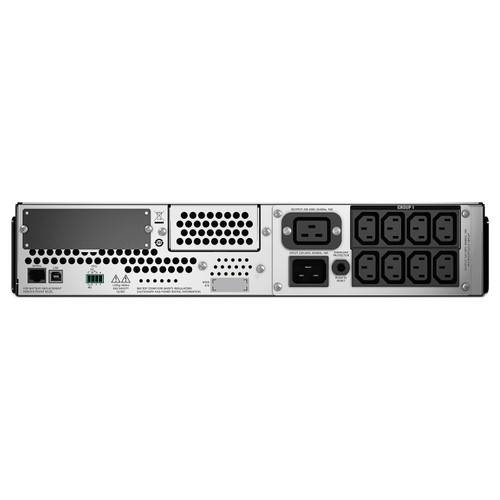
Both units share the same rated power: 3000 VA / 2700 W. Output connections differ meaningfully. The SMT3000RMI2U provides 8 IEC 320 C13 outlets, 3 IEC jumper positions, and 1 IEC 320 C19 outlet — totaling 12 protected output positions. The SRT3000XLW-IEC provides 6 IEC 320 C13 outlets (battery backup), 2 IEC jumper positions (battery backup), and 2 IEC 320 C19 outlets (battery backup) — totaling 10 protected output positions. The SMT3000RMI2U has two more C13 ports but one fewer C19 port.
Runtime extensibility is a key differentiator. The SRT3000XLW-IEC explicitly lists extended run capability (value: 1) and identifies a compatible extended battery module (APC-Smart-UPS-SRT-3000VA-208-230V-IEC). The SMT3000RMI2U specifications list replacement battery RBC43 but do not specify an extended-run battery module option.
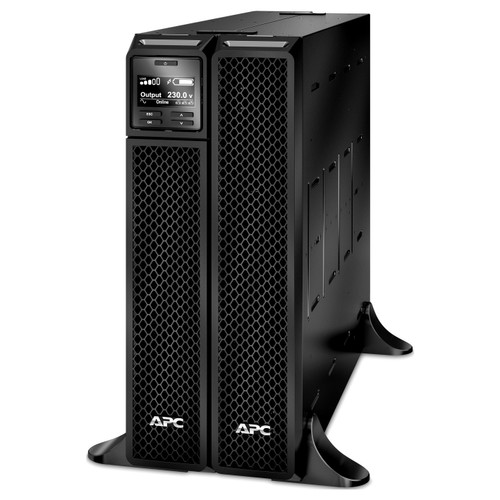
On management, the SMT3000RMI2U offers a serial port, USB port, and one available expansion slot. The SRT3000XLW-IEC offers RJ45 serial, USB, and a SmartSlot — directly comparable expansion capability. The SMT3000RMI2U control panel uses LED status indicators; the SRT3000XLW-IEC features a multi-function LCD status and control console. Typical recharge time is 3 hours for both; expected battery life is 3–5 years for both.
What are the physical, environmental, and certification differences that affect deployment?
The SMT3000RMI2U is a 2U rack-mount unit (mounting mode: rack-mounted with included kit), with a specified height of 86 mm and a package weight of 53 kg. It ships with rack mounting support rails. The SRT3000XLW-IEC is a tower-form-factor unit with dimensions of 43.2 x 8.5 x 63.5 cm (L x W x H) and a package weight of 75 lb (approximately 34 kg). Installers must account for rack space availability versus floor/shelf space when selecting between them.
Thermal output differs substantially: the SMT3000RMI2U dissipates 348 BTU/hr, while the SRT3000XLW-IEC dissipates 703 BTU/hr. The higher dissipation of the online unit is inherent to its continuous double-conversion operation and must be factored into room cooling calculations. Acoustic noise is rated at 55 dBA for both units.
Operating temperature range is not explicitly stated for the SMT3000RMI2U; storage temperature is listed as -15 to 45°C. The SRT3000XLW-IEC specifies 0 to 40°C operating and -15 to 45°C storage. Operating altitude is 0–10,000 ft (approx. 3,048 m) for the SMT3000RMI2U and 0–3,000 m (9,843 ft) for the SRT3000XLW-IEC — effectively equivalent. The SRT3000XLW-IEC carries additional certifications including UL 1778, CSA C22.2 No.107.3-05, FCC Part 15 Class A, ENERGY STAR V1.0 (USA and EU), and IP20; these are not listed for the SMT3000RMI2U. The SMT3000RMI2U lists GS Mark and EN/IEC 62040-1:2019/A11:2021, EN/IEC 62040-2 compliance; the SRT3000XLW-IEC lists EN/IEC 62040-1 and EN/IEC 62040-2 as well. RoHS compliance is listed for both.
Which should you choose: the SMT3000RMI2U or the SRT3000XLW-IEC?
Our take: The SRT3000XLW-IEC is the stronger choice when the load demands zero transfer time, stricter output voltage quality, and runtime extensibility. Its Double Conversion Online topology eliminates the 4–8 ms transfer window present in the SMT3000RMI2U, its output voltage distortion is specified at under 2% versus no equivalent figure published for the SMT line-interactive, and it supports extended battery modules for longer runtime — a capability absent from the SMT3000RMI2U spec sheet. Its surge energy rating is marginally higher at 340 J versus 320 J. However, the SRT3000XLW-IEC dissipates 703 BTU/hr versus 348 BTU/hr — double the cooling load — and is a tower unit rather than a 2U rack appliance. The SMT3000RMI2U is the appropriate choice for rack-dense deployments where IT loads tolerate brief transfers, rack space is constrained, and heat budget is tight. Platform qualifier: specify the SRT3000XLW-IEC for medical, broadcast, or high-sensitivity compute loads; specify the SMT3000RMI2U for standard rack IT infrastructure with managed power supplies.
Side-by-Side Comparison
Spec-for-spec, from manufacturer data.
| Specification | APC by Schneider Electric SMT3000RMI2U | APC by Schneider Electric SRT3000XLW-IEC |
|---|---|---|
| UPS Topology | Line Interactive | Double Conversion Online |
| Rated Power | 3000 VA / 2700 W | 3000 VA / 2700 W |
| Transfer Time | 4 ms typical; 8 ms maximum | 0 ms (online double conversion) |
| Waveform Type | Sine Wave | Sine Wave |
| Output Voltage Distortion | — | Less than 2% |
| Surge Energy Rating | 320 J | 340 J |
| Output Connections | 8x IEC C13, 3x IEC Jumpers, 1x IEC C19 | 6x IEC C13, 2x IEC Jumpers, 2x IEC C19 |
| Internal Bypass | — | Automatic and Manual |
| Extended Run Capable | — | Yes (external battery module supported) |
| Management Interfaces | Serial, USB, 1 expansion slot | RJ45 Serial, USB, SmartSlot |
| Control Panel | LED status display | Multi-function LCD console |
| Form Factor | 2U Rack-Mount | Tower |
| Heat Dissipation | 348 BTU/hr | 703 BTU/hr |
| Audible Noise | 55 dBA | 55 dBA |
| Typical Recharge Time | 3 hours | 3 hours |
| Expected Battery Life | 3–5 years | 3–5 years |
Frequently Asked Questions
Which should you choose: the SMT3000RMI2U or the SRT3000XLW-IEC?
The SRT3000XLW-IEC is the stronger choice when the load demands zero transfer time, stricter output voltage quality, and runtime extensibility. Its Double Conversion Online topology eliminates the 4–8 ms transfer window present in the SMT3000RMI2U, its output voltage distortion is specified at under 2% versus no equivalent figure published for the SMT line-interactive, and it supports extended battery modules for longer runtime — a capability absent from the SMT3000RMI2U spec sheet. Its surge energy rating is marginally higher at 340 J versus 320 J. However, the SRT3000XLW-IEC dissipates 703 BTU/hr versus 348 BTU/hr — double the cooling load — and is a tower unit rather than a 2U rack appliance. The SMT3000RMI2U is the appropriate choice for rack-dense deployments where IT loads tolerate brief transfers, rack space is constrained, and heat budget is tight. Platform qualifier: specify the SRT3000XLW-IEC for medical, broadcast, or high-sensitivity compute loads; specify the SMT3000RMI2U for standard rack IT infrastructure with managed power supplies.
Is the SRT3000XLW-IEC or SMT3000RMI2U better for servers that cannot tolerate any power interruption?
The SRT3000XLW-IEC is the appropriate choice for loads that cannot tolerate interruption. Its Double Conversion Online topology means the load runs off the inverter at all times — there is no transfer time to battery during a utility event. The SMT3000RMI2U is Line Interactive and specifies a transfer time of 4 ms typical and 8 ms maximum, which most standard server power supplies handle, but which can affect highly sensitive or legacy equipment.
Can I install the SMT3000RMI2U in a standard 19-inch equipment rack?
Yes. The SMT3000RMI2U is a 2U rack-mount unit and ships with rack mounting support rails included. The SRT3000XLW-IEC is a tower-form-factor unit with dimensions of 43.2 x 8.5 x 63.5 cm and is not specified for rack mounting in the provided spec data.
Which unit generates less heat, and does that matter for a small server room?
The SMT3000RMI2U dissipates 348 BTU/hr; the SRT3000XLW-IEC dissipates 703 BTU/hr — approximately double. In a small or thermally constrained server room, this difference is significant and must be accounted for in the room's cooling capacity. The higher heat output of the SRT3000XLW-IEC is a direct consequence of its continuous double-conversion operation.
More UPS Comparisons
- APC by Schneider Electric SMT3000RMI2U vs Vertiv GXT5-3000LVRT2UXL
- APC by Schneider Electric SMT3000RMI2U vs Panduit U03N11L
- APC by Schneider Electric SMT3000RMI2U vs Panduit U03N12L
- APC by Schneider Electric SMT3000RMI2U vs Panduit U03S12V
- APC by Schneider Electric SMT3000RMI2U vs APC by Schneider Electric SRT3000XLT
- Vertiv GXT5-3000LVRT2UXL vs APC by Schneider Electric SRT3000XLT
UPS Buying Guides
Get a Second Opinion on Your Camera Choice
Share your site layout, coverage goals, and budget. Our team will validate the camera selection, flag anything we would change, and recommend products that match the use case.