
APC by Schneider Electric SMT3000RMI2U vs APC by Schneider Electric SRT3000XLT: Specification Comparison
Both the SMT3000RMI2U and SRT3000XLT are rack-mounted 3000 VA / 2700 W single-phase UPS units from APC by Schneider Electric, targeting the same power-capacity tier for network infrastructure, servers, and point-of-sale equipment. The core differentiation lies in UPS topology — Line Interactive versus Double Conversion Online — which drives meaningful differences in protection depth, heat output, battery extensibility, and input voltage compatibility. This comparison evaluates those trade-offs on three axes most relevant to installers and IT buyers selecting between these two models.
In This Guide
- Which UPS topology and output protection level is right for your load?
- How do input voltage, output receptacles, and runtime extensibility compare?
- What are the physical footprint, connectivity, and management interface differences?
- Which should you choose: the SMT3000RMI2U or the SRT3000XLT?
- Side-by-Side Specs
- FAQ
Which UPS topology and output protection level is right for your load?
The SMT3000RMI2U uses a Line Interactive topology with a sine wave output and a transfer time of 4 ms typical / 8 ms maximum during a mains failure event. This topology passes utility power directly to the load under normal conditions, engaging the inverter only on transfer. The result is higher operating efficiency and lower heat dissipation (348 BTU/h specified), but connected equipment is exposed to utility power quality — including voltage sags and surges — between transfer events.
The SRT3000XLT uses a Double Conversion Online topology, also with a sine wave output. In this topology the load is always powered through the inverter; utility power is continuously rectified and then re-inverted, so there is effectively zero transfer time and the output is fully isolated from mains disturbances. The specified harmonic distortion is less than 2% and a crest factor of 3:1 is listed. This makes the SRT3000XLT the appropriate choice wherever power quality is poor or load sensitivity demands continuous galvanic isolation. The penalty is higher heat dissipation: 773 BTU/h specified — more than double the SMT3000RMI2U — which must be accounted for in rack thermal budgets.
Neither unit's efficiency curve is numerically specified in the provided data; both list runtime as a graph reference rather than a tabulated value. The SMT3000RMI2U lists a surge energy rating of 320 J; this figure is not present in the SRT3000XLT specification.
How do input voltage, output receptacles, and runtime extensibility compare?
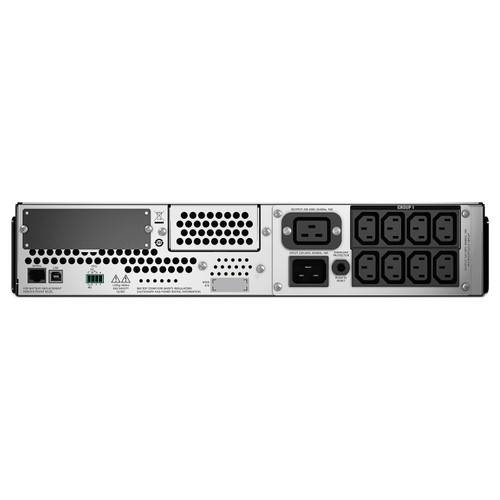
The SMT3000RMI2U is configured for 230 V AC (220/240 V adjustable) input and output, with an input voltage window of 151–302 V adjustable and 160–286 V listed. Input connections are BS1363A, IEC 320 C20, and Schuko CEE 7/EU1-16P; output provides 8 × IEC 320 C13, 3 IEC jumper outlets, and 1 × IEC 320 C19. This receptacle set suits European and international rack environments running IEC-standard PDUs and C13/C19 power leads.
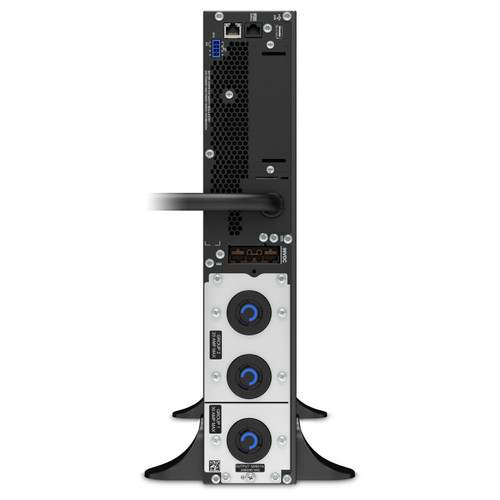
The SRT3000XLT is configured for 208 V AC input and output (configurable to 240 V), with input via NEMA L6-20P and output providing 2 × NEMA L6-20R and 1 × NEMA L6-30R. This is a North American voltage and connector ecosystem, making the two units non-interchangeable from a wiring and outlet compatibility standpoint. The SRT3000XLT also specifies an Internal Bypass (automatic and manual), which is not noted in the SMT3000RMI2U specifications.
Runtime extensibility differs meaningfully. The SMT3000RMI2U specifies 1 replacement battery (RBC43) with no external battery pack options noted in the provided specifications. The SRT3000XLT lists a battery option table supporting SRT96BP packs from 1 (1,491 VAh) through 10 (10,437 VAh), allowing runtime to be scaled substantially beyond the internal 497 VAh. The SRT3000XLT also lists battery voltage at 96 V and an Extendable Run Time flag, confirming external battery cabinet support. The SMT3000RMI2U does not provide equivalent extensibility data.
What are the physical footprint, connectivity, and management interface differences?
Both units occupy a 2U rack form factor per the SMT3000RMI2U specification; the SRT3000XLT dimension is listed as 17.01 in (43.2 cm) width but rack unit count is not explicitly stated in the provided spec — the rack-mounted-with-kit mounting mode is confirmed. Weight differs: the SMT3000RMI2U weighs 44.28 kg (97.6 lb); the SRT3000XLT weighs 31.3 kg (69 lb US), making the SRT3000XLT notably lighter despite containing a 96 V battery system. Both specify rack-mount from the front.
The SMT3000RMI2U provides a serial port, a USB port, and one available expansion slot for connectivity and management. The control panel uses an LED status display with on-line, on-battery, replace-battery, and overload indicators. An alarm is active on battery with configurable delays. The SRT3000XLT lists 1 free slot but does not enumerate specific serial or USB port presence in the provided specifications. It lists audible and visible alarms prioritized by severity.
The SMT3000RMI2U carries product certifications including CEE, AC, IRA, RCM, and VDE, and complies with EN/IEC 62040-1:2019/A11:2021 and EN/IEC 62040-2. An IP degree of protection is not stated. The SRT3000XLT specifies IP20. Both units share a 0–95% relative humidity operating and storage range, 0–10,000 ft operating altitude, 0–15,240 m storage altitude, and 55 dBA acoustic level. Battery charge power is 182 W rated for the SMT3000RMI2U and 165 W rated for the SRT3000XLT. Typical recharge time is 3 hours for both.
Which should you choose: the SMT3000RMI2U or the SRT3000XLT?
Our take: The SMT3000RMI2U is the stronger choice when deploying into a 230 V IEC-outlet European or international rack environment where operating efficiency and lower heat load matter and utility power quality is adequate. The SRT3000XLT is the stronger choice when the load demands continuous double-conversion isolation from mains disturbances, operates on a 208 V North American NEMA infrastructure, or requires scalable extended runtime via external battery cabinets. Three concrete spec deltas: (1) topology — Line Interactive (SMT3000RMI2U) vs Double Conversion Online (SRT3000XLT), directly affecting transfer time and output isolation; (2) heat dissipation — 348 BTU/h vs 773 BTU/h, a 2.2× difference with real rack cooling implications; (3) runtime extensibility — SRT3000XLT supports documented external battery packs to 10,437 VAh, while no equivalent option is specified for the SMT3000RMI2U. Platform qualifier: these two units are not outlet- or voltage-compatible and serve distinct regional wiring standards.
Side-by-Side Comparison
Spec-for-spec, from manufacturer data.
| Specification | APC by Schneider Electric SMT3000RMI2U | APC by Schneider Electric SRT3000XLT |
|---|---|---|
| UPS Topology | Line Interactive | Double Conversion Online |
| Rated Power (VA) | 3000 VA | 3000 VA |
| Rated Power (W) | 2700 W | 2700 W |
| Main Input Voltage | 230 V AC | 208 V AC |
| Other Input Voltage | 220 V / 240 V | 240 V |
| Main Output Voltage | 230 V AC | 208 V AC |
| Input Connection | BS1363A / IEC 320 C20 / Schuko CEE 7 | NEMA L6-20P |
| Output Connections | 8x IEC C13, 3x IEC Jumper, 1x IEC C19 | 2x NEMA L6-20R, 1x NEMA L6-30R |
| Transfer Time | 4 ms typical / 8 ms maximum | — |
| Waveform | Sine Wave | Sine Wave |
| Heat Dissipation | 348 BTU/h | 773 BTU/h |
| Acoustic Level | 55 dBA | 55 dBA |
| Weight | 44.28 kg (97.6 lb) | 31.3 kg (69 lb) |
| Replacement Battery | RBC43 | APCRBC152 / SRT96RMBPUS |
| External Battery Packs | — | SRT96BP (up to 10,437 VAh) |
| Surge Energy Rating | 320 J | — |
| Bypass Type | — | Internal (Automatic and Manual) |
| IP Rating | — | IP20 |
| Typical Recharge Time | 3 h | 3 h |
| Battery Life | 3–5 years | 3–5 years |
| Management Connectivity | Serial, USB, 1 Expansion Slot | 1 Free Slot (serial/USB not specified) |
| Rack Units | 2U | Not specified in provided data |
Frequently Asked Questions
Which should you choose: the SMT3000RMI2U or the SRT3000XLT?
The SMT3000RMI2U is the stronger choice when deploying into a 230 V IEC-outlet European or international rack environment where operating efficiency and lower heat load matter and utility power quality is adequate. The SRT3000XLT is the stronger choice when the load demands continuous double-conversion isolation from mains disturbances, operates on a 208 V North American NEMA infrastructure, or requires scalable extended runtime via external battery cabinets. Three concrete spec deltas: (1) topology — Line Interactive (SMT3000RMI2U) vs Double Conversion Online (SRT3000XLT), directly affecting transfer time and output isolation; (2) heat dissipation — 348 BTU/h vs 773 BTU/h, a 2.2× difference with real rack cooling implications; (3) runtime extensibility — SRT3000XLT supports documented external battery packs to 10,437 VAh, while no equivalent option is specified for the SMT3000RMI2U. Platform qualifier: these two units are not outlet- or voltage-compatible and serve distinct regional wiring standards.
Is the SMT3000RMI2U or SRT3000XLT better for sensitive server loads that cannot tolerate any power interruption?
The SRT3000XLT is better suited for loads that cannot tolerate any power interruption. Its Double Conversion Online topology continuously powers the load through the inverter, providing zero transfer time and full isolation from utility power disturbances. The SMT3000RMI2U uses a Line Interactive topology with a specified transfer time of 4 ms typical and 8 ms maximum, which means the load briefly rides through on battery during a switchover event.
Can I extend the runtime of either of these UPS units by adding external battery cabinets?
The SRT3000XLT explicitly supports external battery packs (SRT96BP series), with documented runtime values ranging from 1,491 VAh with one pack up to 10,437 VAh with ten packs. The SMT3000RMI2U specifications provided do not list any external battery cabinet or extension option; only the internal RBC43 replacement battery is noted.
Are the SMT3000RMI2U and SRT3000XLT interchangeable in the same rack installation?
No. The SMT3000RMI2U is configured for 230 V AC input and output with IEC 320 and Schuko outlet types, targeting European and international wiring standards. The SRT3000XLT is configured for 208 V AC input and output with NEMA L6-20P input and NEMA L6-20R/L6-30R output, targeting North American 208 V installations. The voltage levels, input plugs, and output receptacles are incompatible, so the two units are not interchangeable in the same rack without re-wiring the power infrastructure.
More UPS Comparisons
- APC by Schneider Electric SMT3000RMI2U vs Vertiv GXT5-3000LVRT2UXL
- APC by Schneider Electric SMT3000RMI2U vs Panduit U03N11L
- APC by Schneider Electric SMT3000RMI2U vs Panduit U03N12L
- APC by Schneider Electric SMT3000RMI2U vs Panduit U03S12V
- APC by Schneider Electric SMT3000RMI2U vs APC by Schneider Electric SRT3000XLW-IEC
- Vertiv GXT5-3000LVRT2UXL vs APC by Schneider Electric SRT3000XLT
UPS Buying Guides
Get a Second Opinion on Your Camera Choice
Share your site layout, coverage goals, and budget. Our team will validate the camera selection, flag anything we would change, and recommend products that match the use case.