
Vertiv GXT5-3000LVRT2UXL vs APC by Schneider Electric SRT3000XLW-IEC: Specification Comparison
Both the Vertiv Liebert GXT5-3000LVRT2UXL and the APC by Schneider Electric SRT3000XLW-IEC are 3000VA / 2700W online double-conversion UPS units aimed at business-critical infrastructure. The Vertiv is a 120V North American rack/tower platform with a NEMA L5-30P input, while the APC is a 208/230V international tower unit with IEC and multi-standard inputs. Buyers cross-shopping at this VA class should weigh regional voltage compatibility, output receptacle type, runtime scalability, noise levels, and management ecosystem before committing.
In This Guide
How do power capacity, output voltage, and runtime scalability compare?
Both units deliver 3000VA / 2700W at a 0.9 power factor in true online double-conversion topology with pure sine-wave output. The similarity ends at voltage: the GXT5-3000LVRT2UXL operates on a 120V AC input (range 60–150V, NEMA L5-30P) and delivers 110/115/120/125VAC user-configurable output across 7 receptacles (1× NEMA L5-30R twist-lock, 6× NEMA 5-20R). The SRT3000XLW-IEC is built for 208/230V environments (configurable to 220/240V) with IEC inputs (British BS1363A, IEC-320 C20, Schuko CEE 7/EU1-16P) and 10 IEC output connections (6× C13, 2× C19, 2× IEC jumpers). These are different voltage platforms; a buyer cannot substitute one for the other in the same circuit.
For runtime extensibility, the GXT5 explicitly supports External Battery Cabinets (EBCs) for scalable runtime, with a standard recharge time of approximately 3 hours to 90%. The SRT3000XLW-IEC also supports extended runtime via the APC Smart-UPS SRT 3000VA 208/230V IEC extended battery option, with the same 3-hour typical recharge time and a replacement battery module (APCRBC152) rated for a 3–5 year expected life. The GXT5 spec does not state an expected battery life figure; the SRT3000XLW-IEC does not state a specific runtime-to-capacity figure. Both ship with one internal battery module.
What are the physical, environmental, and acoustical differences?
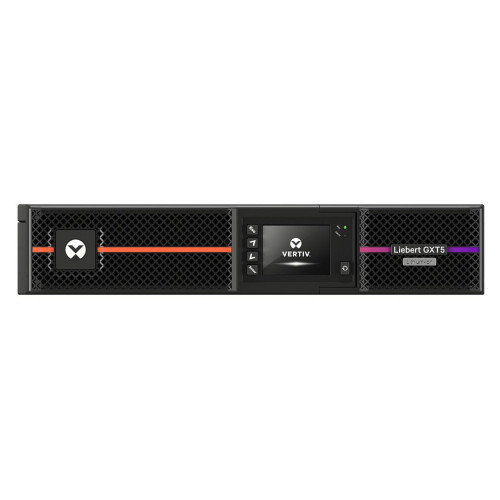
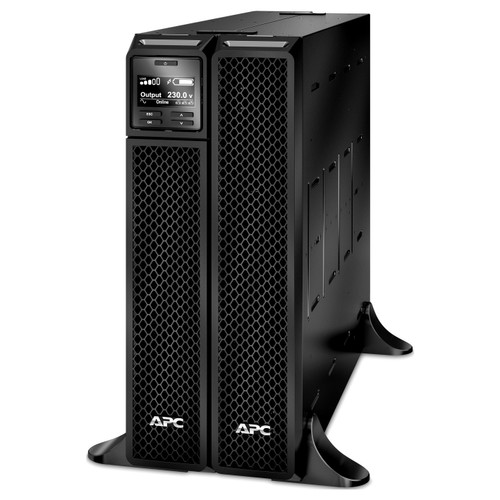
The GXT5-3000LVRT2UXL is a rack/tower convertible unit in a 2U rack footprint, measuring 3.4 × 16.9 × 21.3 inches (86.4 × 429.3 × 541 mm) and weighing 66 lbs (30 kg). The SRT3000XLW-IEC is a tower-only unit measuring 17.0 × 3.3 × 25.0 inches (43.2 × 8.5 × 63.5 cm) and listed at a package weight of 75 lb; no separate unit-only weight is provided in the specs. Buyers who need rack mounting have only one option here: the Vertiv.
Operating temperature range is identical for both: 0–40°C (32–104°F). The Vertiv supports operating altitude up to 10,000 ft (3,048 m) with derating; the APC spec lists a maximum operating elevation of 9,843 ft (3,000 m). Storage temperature differs: the Vertiv is rated –20 to 50°C (–4 to 122°F), while the APC is rated –15 to 45°C (5 to 113°F), giving the Vertiv a wider cold-storage window. Audible noise is a meaningful difference: the GXT5 specifies less than 45 dBA at 1 meter; the SRT3000XLW-IEC specifies 55 dBA at 1 meter — a 10 dB gap, which is roughly twice as loud perceptually. The Vertiv uses a variable-speed fan; the APC spec does not state variable versus fixed fan speed.
How do connectivity, management, and compliance certifications compare?
The GXT5-3000LVRT2UXL provides USB and RS-232 serial ports onboard, with optional Intellislot network management cards supporting SNMP, Modbus, and BACnet protocols. It is compatible with Vertiv Environet management software and NUT (Network UPS Tools). Load segmentation is supported via programmable outlet groups with independent control, and the unit includes an Emergency Power Off (EPO) input. It also supports internal automatic bypass and external maintenance bypass.
The SRT3000XLW-IEC provides RJ45 serial, a SmartSlot expansion bay, and USB onboard. The APC spec does not enumerate specific SmartSlot card protocols in the provided data, though SmartSlot is APC's standard network management card interface. The APC includes both automatic and manual internal bypass. Neither unit's spec details the protocols available via the serial port beyond the port type. The APC lists a surge energy rating of 340 joules explicitly; the Vertiv cites ANSI C62.41 Category B compliance but does not state a joule rating in the provided specs.
On compliance, the Vertiv carries TAA compliance, Energy Star 2.0, UL 1778, FCC Part 15 Class A, and CE. The APC holds CE, CSA C22.2 No.107.3-05, EAC, EN/IEC 62040-1, EN/IEC 62040-2, Energy Star V1.0 (USA and EU), FCC Part 15 Class A, RCM, UL 1778, and VDE — a broader international certification set. The Vertiv is TAA compliant; the APC spec does not state TAA compliance. The Vertiv specifies an MTBF of greater than 200,000 hours and peak efficiency of 94% double-conversion / 98%+ in ECO mode; the APC spec does not state MTBF or efficiency figures in the provided data. The Vertiv warranty is 3-year advanced replacement; the APC warranty is not stated in the provided specs.
Which should you choose: the GXT5-3000LVRT2UXL or the SRT3000XLW-IEC?
Our take: The GXT5-3000LVRT2UXL is the stronger choice when the deployment is in a North American 120V environment, requires rack mounting, and demands quieter operation or TAA-compliant procurement. Key spec deltas: the Vertiv runs on 120V AC input versus the APC's 208/230V input, making them non-interchangeable on different circuits; the Vertiv's audible noise ceiling is under 45 dBA versus the APC's 55 dBA — a 10 dB (roughly 2×) acoustic advantage; and the Vertiv is explicitly TAA compliant while the APC spec does not state TAA status. The SRT3000XLW-IEC is the appropriate unit for 208/230V international or mixed-voltage data center rows, offers a wider international certification portfolio (VDE, EAC, RCM, CSA), and states a 3–5 year expected battery life that the Vertiv spec omits. Select by input voltage first — these two products serve different electrical infrastructures.
Side-by-Side Comparison
Spec-for-spec, from manufacturer data.
| Specification | Vertiv GXT5-3000LVRT2UXL | APC by Schneider Electric SRT3000XLW-IEC |
|---|---|---|
| UPS Topology | Online Double Conversion | Online Double Conversion |
| Capacity (VA / W) | 3000VA / 2700W | 3000VA / 2700W |
| Power Factor | 0.9 | 0.9 |
| Nominal Input Voltage | 120V AC | 208V & 230V |
| Input Voltage Range | 60–150V | 208/220/230/240V (configurable) |
| Input Frequency | 50/60 Hz ±5 Hz | 40–70 Hz (auto sensing) |
| Input Connection | NEMA L5-30P | BS1363A, IEC-320 C20, Schuko CEE 7/EU1-16P |
| Output Voltage | 110/115/120/125VAC (configurable) ±3% | 208/220/230/240V (configurable); <2% distortion |
| Output Connections | 1× NEMA L5-30R, 6× NEMA 5-20R | 6× IEC C13, 2× IEC C19, 2× IEC Jumpers |
| Form Factor | Rack/Tower convertible, 2U | Tower only |
| Dimensions (H×W×D) | 3.4×16.9×21.3 in (86.4×429.3×541 mm) | 3.3×17.0×25.0 in (8.5×43.2×63.5 cm) |
| Weight | 66 lbs (30 kg) | 75 lbs (package weight; unit-only not stated) |
| Audible Noise | <45 dBA at 1 m | 55 dBA at 1 m |
| Operating Temperature | 0–40°C (32–104°F) | 0–40°C (32–104°F) |
| Storage Temperature | –20 to 50°C (–4 to 122°F) | –15 to 45°C (5 to 113°F) |
| Max Operating Altitude | 10,000 ft (3,048 m) with derating | 9,843 ft (3,000 m) |
| Battery Type | VRLA, hot-swappable | Sealed lead-acid, maintenance-free |
| Typical Recharge Time | ~3 hours to 90% | ~3 hours |
| Expected Battery Life | — | 3–5 years |
| Runtime Extensibility | Yes, via External Battery Cabinets (EBCs) | Yes, via APC extended battery option |
| Onboard Connectivity | USB, RS-232 Serial | USB, RJ45 Serial, SmartSlot |
| Network Management | Optional Intellislot (SNMP, Modbus, BACnet) | SmartSlot expansion (protocols not specified in provided specs) |
| Surge Protection | ANSI C62.41 Category B | 340 joules |
| Bypass | Internal automatic + external maintenance bypass | Internal automatic and manual bypass |
| EPO Input | Yes | — |
| Load Segmentation | Programmable outlet groups | — |
| Efficiency (Double-Conv.) | Up to 94%; 98%+ ECO mode | — |
| MTBF | >200,000 hours | — |
| TAA Compliant | Yes | — |
| Energy Star | Energy Star 2.0 | Energy Star V1.0 (USA & EU) |
| Certifications | UL 1778, FCC Part 15 Class A, CE, TAA | UL 1778, FCC Part 15 Class A, CE, CSA, VDE, EAC, RCM |
| Warranty | 3-year advanced replacement | — |
Frequently Asked Questions
Which should you choose: the GXT5-3000LVRT2UXL or the SRT3000XLW-IEC?
The GXT5-3000LVRT2UXL is the stronger choice when the deployment is in a North American 120V environment, requires rack mounting, and demands quieter operation or TAA-compliant procurement. Key spec deltas: the Vertiv runs on 120V AC input versus the APC's 208/230V input, making them non-interchangeable on different circuits; the Vertiv's audible noise ceiling is under 45 dBA versus the APC's 55 dBA — a 10 dB (roughly 2×) acoustic advantage; and the Vertiv is explicitly TAA compliant while the APC spec does not state TAA status. The SRT3000XLW-IEC is the appropriate unit for 208/230V international or mixed-voltage data center rows, offers a wider international certification portfolio (VDE, EAC, RCM, CSA), and states a 3–5 year expected battery life that the Vertiv spec omits. Select by input voltage first — these two products serve different electrical infrastructures.
Can I use the GXT5-3000LVRT2UXL and SRT3000XLW-IEC interchangeably on the same circuit?
No. The GXT5-3000LVRT2UXL is designed for 120V AC input (NEMA L5-30P) and delivers 110–125V output via NEMA receptacles. The SRT3000XLW-IEC is built for 208/230V input with IEC and multi-standard plugs, delivering 208/220/230/240V output over IEC connectors. These are different voltage platforms and cannot be substituted for one another without matching the site's electrical infrastructure to the unit's input voltage requirements.
Which UPS is better suited for a quiet office or wiring-closet installation?
Based on the provided specs, the GXT5-3000LVRT2UXL is significantly quieter: it is rated at less than 45 dBA at 1 meter using a variable-speed fan. The SRT3000XLW-IEC is rated at 55 dBA at 1 meter. A 10 dB difference is perceived as roughly twice as loud, so the Vertiv has a meaningful acoustic advantage in noise-sensitive environments.
Which unit is better for larger deployments that need extended runtime?
Both units support external battery extension. The GXT5-3000LVRT2UXL explicitly supports Vertiv External Battery Cabinets (EBCs) for scalable runtime. The SRT3000XLW-IEC supports an APC-branded extended battery option. Neither spec provides a comparative runtime-to-load table in the data supplied, so a direct runtime comparison at a given load percentage is not possible from the available specifications. Buyers should request runtime curves from both vendors at their target load before committing.
More UPS Comparisons
- APC by Schneider Electric SMT3000RMI2U vs Vertiv GXT5-3000LVRT2UXL
- APC by Schneider Electric SMT3000RMI2U vs Panduit U03N11L
- APC by Schneider Electric SMT3000RMI2U vs Panduit U03N12L
- APC by Schneider Electric SMT3000RMI2U vs Panduit U03S12V
- APC by Schneider Electric SMT3000RMI2U vs APC by Schneider Electric SRT3000XLT
- APC by Schneider Electric SMT3000RMI2U vs APC by Schneider Electric SRT3000XLW-IEC
UPS Buying Guides
Get a Second Opinion on Your Camera Choice
Share your site layout, coverage goals, and budget. Our team will validate the camera selection, flag anything we would change, and recommend products that match the use case.