
Ubiquiti USW-PRO-HD-24-POE vs Axis T8524: Specification Comparison
Both products are 24-port managed PoE rack-mount switches targeting IP security and surveillance deployments. The Ubiquiti USW-PRO-HD-24-POE is a multi-gigabit PoE++ platform with a 600W power budget, while the Axis T8524 is a PoE+ switch with a 370W budget optimized for Axis ecosystem integration. Buyers cross-shopping these units are typically specifying a closet switch for IP cameras, access control readers, and wireless APs — and must weigh per-port power, uplink speed, switching headroom, management platform, and warranty depth against deployment scale and vendor ecosystem.
In This Guide
- Which switch delivers more PoE power and network throughput per port?
- How do the physical build, power resilience, and operating environment compare?
- Which switch offers broader management, security features, and ecosystem integration?
- Which should you choose: the USW-PRO-HD-24-POE or the T8524?
- Side-by-Side Specs
- FAQ
Which switch delivers more PoE power and network throughput per port?
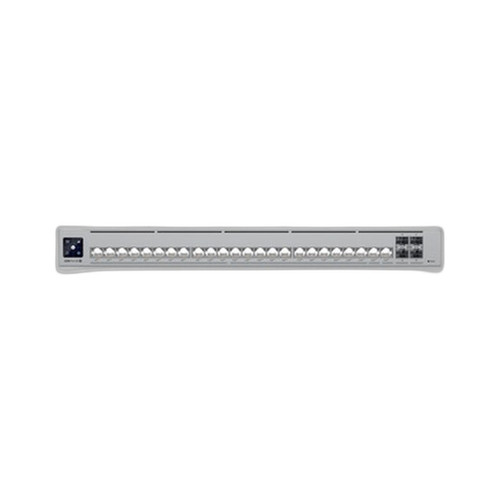
The USW-PRO-HD-24-POE provides 22× 2.5GbE ports plus 2× 10GbE copper uplinks, all 24 access ports operating at PoE++ (802.3bt), with a combined PoE budget of 600W — approximately 25W average across all 24 ports simultaneously, or up to 802.3bt maximums on individual ports. Its switching capacity is 230 Gbps aggregate with 115 Gbps non-blocking throughput and a forwarding rate of 171 Mpps. The four 10G SFP+ uplink slots provide high-bandwidth fiber or DAC connectivity to a core switch.
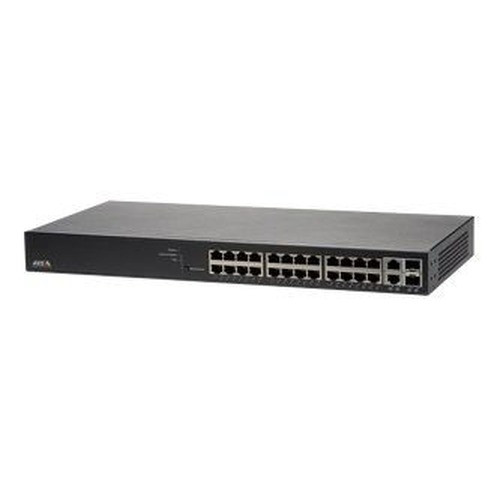
The T8524 provides 24× RJ45 PoE+ ports at 802.3at (up to 30W per port) with a 370W total power budget, plus 2× combo RJ45/SFP uplinks. Its switching capacity is 52 Gbps with a forwarding rate of 38.7 Mpps. Port speed is standard Gigabit Ethernet on all access ports; the uplinks are 1GbE RJ45 or SFP, not 10G.
In raw throughput terms, the USW-PRO-HD-24-POE's switching capacity (230 Gbps) is 4.4× higher than the T8524's (52 Gbps), and its forwarding rate (171 Mpps) is 4.4× higher than the T8524's (38.7 Mpps). Its multi-gig access ports (2.5GbE) are 2.5× the wire speed of the T8524's Gigabit ports. The PoE budget advantage is 600W vs. 370W — 62% more aggregate wattage — though the T8524's 30W-per-port ceiling matches 802.3at Class 4 maximum, which is sufficient for most fixed and PTZ cameras. The USW-PRO-HD-24-POE's PoE++ standard supports higher-draw devices (802.3bt, e.g., 60–90W per port), but the spec does not state a per-port maximum wattage.
How do the physical build, power resilience, and operating environment compare?
The USW-PRO-HD-24-POE is housed in an SGCC steel enclosure measuring 442 × 400 × 44 mm (1U) and weighing 6.2 kg without brackets. It operates from 100–240V AC with an internal 660W AC/DC power supply. The spec notes a DC power backup capability for PoE redundancy, though details on the DC input connector or voltage are not provided in the supplied spec. Operating temperature range is −5°C to 40°C.
The T8524 is housed in a metal chassis (color: black) measuring 442 × 211 × 44 mm (1U) and weighing 3.2 kg. It is notably shallower (211 mm depth vs. 400 mm), which can matter in shallow-depth wall-mount enclosures. It operates from 100–240V AC at 50/60 Hz. The T8524 includes 6kV surge protection on all network ports and AC lines — a spec not present for the USW-PRO-HD-24-POE. Operating temperature range is 0°C to 50°C.
The T8524 has a wider operating temperature ceiling (50°C vs. 40°C) and a lower cold-floor tolerance on the USW-PRO-HD-24-POE side (−5°C vs. 0°C), so neither unit is rated for outdoor or unconditioned spaces, but the T8524 tolerates warmer closets by 10°C. The T8524's 6kV surge protection is a certified, listed spec; the USW-PRO-HD-24-POE spec does not mention surge protection. The USW-PRO-HD-24-POE's enclosure certifications (CE, FCC, IC, Anatel) differ from the T8524's (EMC EN55032, EN55035, FCC Part 15B, VCCI, RCM, IEC 62368-1). NDAA compliance is stated for the USW-PRO-HD-24-POE; it is not stated for the T8524.
Which switch offers broader management, security features, and ecosystem integration?
The USW-PRO-HD-24-POE is managed through Ubiquiti's UniFi controller platform (referenced as Layer 2/3 management with STP/RSTP, 802.1X, and 1,000 VLAN support). The spec does not list specific network protocols (e.g., SNMP version, SSH, LLDP) or explicit cybersecurity features such as ACLs, DHCP snooping, or private VLANs in the provided data.
The T8524 lists an explicit protocol stack: IPv4, IPv6, HTTP, HTTPS, SNMP, SSH, DHCP, NTP, DNS, TCP/UDP. Security features are enumerated: password protection, IP address filtering, HTTPS encryption, IEEE 802.1X NAC, ACLs, Private VLANs, and DHCP snooping. Its MAC table supports 8K entries and jumbo frames up to 9,216 bytes. Management is via AXIS Device Manager, and the T8524 is listed as compatible with Milestone, Genetec, and standard HTTP/HTTPS VMS platforms. ONVIF support is also stated. The spec notes IGMP snooping and QoS support.
The T8524's security and protocol specs are more granularly documented in the provided data. AXIS Device Manager integration means the switch can appear natively in Axis camera management workflows — a meaningful operational advantage in all-Axis deployments. The USW-PRO-HD-24-POE's 1,000-VLAN capacity (vs. no stated VLAN limit for the T8524) and Layer 3 routing capability provide greater network segmentation headroom. The T8524's warranty is explicitly stated as 5 years; the USW-PRO-HD-24-POE's warranty is listed only as 'Manufacturer Warranty' with no duration specified in the provided spec.
Which should you choose: the USW-PRO-HD-24-POE or the T8524?
Our take: The USW-PRO-HD-24-POE is the stronger choice when the deployment demands multi-gigabit access speeds, a higher PoE power budget, or dense VLAN segmentation at scale. Its 230 Gbps switching capacity is 4.4× the T8524's 52 Gbps, its 600W PoE budget is 62% larger than the T8524's 370W, and its multi-gig 2.5GbE ports future-proof connections to high-bitrate cameras and Wi-Fi 6 APs. The T8524 is the stronger choice for Axis-centric deployments requiring native AXIS Device Manager integration, documented 6kV surge protection on every port, a warmer operating ceiling (50°C vs. 40°C), and a shallower 211 mm chassis for tight enclosures. The T8524's 5-year warranty is explicitly stated; the USW-PRO-HD-24-POE's warranty term is not specified in the provided spec. Buyers standardized on UniFi infrastructure will favor the Ubiquiti; those running an Axis-managed surveillance network with space-constrained or thermally marginal closets will favor the T8524.
Side-by-Side Comparison
Spec-for-spec, from manufacturer data.
| Specification | Ubiquiti USW-PRO-HD-24-POE | Axis T8524 |
|---|---|---|
| Access Port Count | 24 (22× 2.5GbE + 2× 10GbE) | 24× 1GbE RJ45 |
| Uplink Ports | 4× 10G SFP+ | 2× combo RJ45/SFP (1GbE) |
| PoE Standard | PoE++ (802.3bt) | PoE+ (802.3at) |
| PoE Budget | 600W | 370W |
| Per-Port PoE Max | Not stated in spec | 30W |
| Switching Capacity | 230 Gbps | 52 Gbps |
| Non-Blocking Throughput | 115 Gbps | — |
| Forwarding Rate | 171 Mpps | 38.7 Mpps |
| VLAN Support | 1,000 VLANs | VLAN (count not stated in spec) |
| MAC Table | — | 8K entries |
| Surge Protection | Not stated in spec | 6kV all ports and AC |
| Operating Temperature | -5°C to 40°C | 0°C to 50°C |
| Chassis Depth | 400 mm | 211 mm |
| Weight | 6.2 kg (13.7 lb) | 3.2 kg (7.05 lb) |
| Warranty | Manufacturer Warranty (duration not stated) | 5-year warranty |
| NDAA Compliant | Yes | Not stated in spec |
Frequently Asked Questions
Which should you choose: the USW-PRO-HD-24-POE or the T8524?
The USW-PRO-HD-24-POE is the stronger choice when the deployment demands multi-gigabit access speeds, a higher PoE power budget, or dense VLAN segmentation at scale. Its 230 Gbps switching capacity is 4.4× the T8524's 52 Gbps, its 600W PoE budget is 62% larger than the T8524's 370W, and its multi-gig 2.5GbE ports future-proof connections to high-bitrate cameras and Wi-Fi 6 APs. The T8524 is the stronger choice for Axis-centric deployments requiring native AXIS Device Manager integration, documented 6kV surge protection on every port, a warmer operating ceiling (50°C vs. 40°C), and a shallower 211 mm chassis for tight enclosures. The T8524's 5-year warranty is explicitly stated; the USW-PRO-HD-24-POE's warranty term is not specified in the provided spec. Buyers standardized on UniFi infrastructure will favor the Ubiquiti; those running an Axis-managed surveillance network with space-constrained or thermally marginal closets will favor the T8524.
Is the USW-PRO-HD-24-POE or the T8524 better for powering high-wattage cameras like PTZ or multi-sensor units?
The USW-PRO-HD-24-POE supports PoE++ (802.3bt), which can deliver more than 30W per port, and its total PoE budget of 600W is 230W greater than the T8524's 370W. The T8524 is rated at PoE+ (802.3at, up to 30W per port), which covers most PTZ and multi-sensor cameras but cannot power devices requiring 802.3bt wattage. If your camera or device list includes 802.3bt-class endpoints, the USW-PRO-HD-24-POE is the spec-supported choice. For standard 802.3at PTZ cameras, both switches are within specification.
Does either switch offer better protection against electrical surges in field installations?
The T8524 specifies 6kV surge protection on all network ports and AC lines — this is a listed, certified specification. The USW-PRO-HD-24-POE spec as provided does not state a surge protection rating. If surge protection on the switch itself is a requirement (e.g., in locations prone to lightning or power transients), the T8524's 6kV rating is a documented spec; the USW-PRO-HD-24-POE's capability in this area cannot be confirmed from the provided data.
Which switch integrates better with an all-Axis camera system managed by AXIS Device Manager?
The T8524 is explicitly listed as compatible with AXIS Device Manager, Milestone, and Genetec, and carries ONVIF certification. It is designed as part of the Axis network product portfolio. The USW-PRO-HD-24-POE is managed through Ubiquiti's UniFi platform; no AXIS Device Manager or third-party VMS compatibility is stated in the provided spec. For operators running an Axis-centric VMS workflow where switch visibility within the same management console matters, the T8524 is the spec-supported choice.
More Network Switch Comparisons
- Vivotek GEV-288A-370 vs Axis T8524
- Vivotek GEV-288A-370 vs Cradlepoint SW2400P-GN
- Vivotek GEV-288A-370 vs Allied Telesis AT-x530L-28GPX-901
- Vivotek GEV-288A-370 vs Ubiquiti USW-ENTERPRISE-24-POE
- Axis T8524 vs Cradlepoint SW2400P-GN
- Axis T8524 vs Allied Telesis AT-x530L-28GPX-901
Network Switch Buying Guides
Get a Second Opinion on Your Camera Choice
Share your site layout, coverage goals, and budget. Our team will validate the camera selection, flag anything we would change, and recommend products that match the use case.