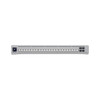
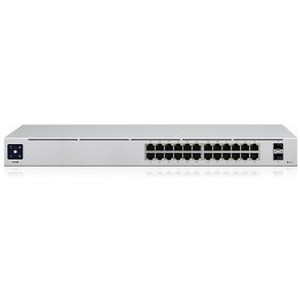
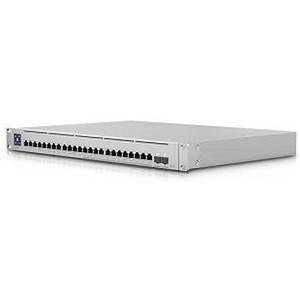
Ubiquiti USW-PRO-HD-24-POE 24-Port Multi-Gig PoE Network Switch
The Ubiquiti USW-PRO-HD-24-POE is a 1U rack-mount network switch engineered for high-density PoE deployments where you need to power dozens of IP cameras, wireless access points, or VoIP phones from a single device. Built into the Ubiquiti UniFi ecosystem, it delivers 230 Gbps aggregate switching capacity with 600W PoE budget — enough to power all 24 ports simultaneously if your endpoints draw that much current. The switch combines 22 ports of 2.5GbE with two 10GbE uplink ports and four 10G SFP+ fiber slots, ensuring your edge devices never starve for bandwidth while core infrastructure scales without bottlenecks.
Key Features
- 600W PoE budget with redundant DC backup: Power 24 cameras or access points simultaneously without external power supplies. The built-in redundancy DC option eliminates single points of failure — if AC input fails, the switch keeps PoE delivery running on battery backup until you restore power. This matters in unattended installations (warehouses, parking lots, remote sites) where powering down cameras is not an option.
- 22× 2.5GbE ports plus 2× 10GbE uplinks: Legacy gigabit devices plug into any 2.5GbE port and negotiate down automatically — zero compatibility headaches. New multi-gig endpoints (modern PoE+ cameras, WiFi 6 access points) get native 2.5 Gbps without oversubscription. The dual 10GbE ports let you trunk to core switches or pair two switches without a separate uplink module.
- Four 10G SFP+ slots for fiber expansion: If you need to run long distances without copper limitations, insert fiber transceivers into the SFP+ cages. Useful for buildings where camera closets or AP clusters sit 200+ meters from the main switch location.
- 230 Gbps switching fabric with 115 Gbps non-blocking throughput: These numbers mean the switch can handle simultaneous traffic on all 24 ports at line rate without packet loss — relevant when you're recording 24/7 video feeds while also serving APs and VoIP phones on the same device. Real-world: 24 cameras at 30 Mbps each = 720 Mbps aggregate; this switch laughs at that load.
- 171 Mpps (million packets per second) forwarding rate: In practical terms, this ensures wire-speed performance even with small packets, which matters for VoIP quality and dense wireless networks where AP-to-controller chatter creates lots of small frames.
- 1,000 VLAN support: Segment guest networks, management traffic, camera systems, and operational systems into completely isolated broadcast domains. Essential if you're integrating security camera networks alongside corporate WiFi or guest hotspots — each tenant or department stays in its own VLAN with no cross-talk.
- Layer 2 and Layer 3 routing with STP/RSTP: The switch handles intelligent spanning-tree redundancy if you wire it into a loop topology — rings of switches automatically detect and break loops, keeping your network stable. L3 routing lets you perform inter-VLAN routing directly on the switch without an external router, cutting latency for local traffic.
- Universal AC input (100–240V, 50/60 Hz) with 60W switch power draw (excluding PoE output): Plugs into any wall outlet worldwide. The low 60W consumption for the switch electronics means most of your power budget goes to PoE delivery, not wasted as heat in the device itself.
- Compact 1U steel enclosure (442 × 400 × 44 mm, 6.2 kg): Fits standard 19-inch racks alongside servers, UPS modules, and patch panels. Shipping and handling are manageable because it's not a massive chassis.
- -5°C to 40°C operating range: Suitable for climate-controlled server rooms and telecom closets but not unheated warehouses in winter or outdoor sun-exposed cabinets. If you need wider temperature, look at industrial-grade switches instead.
- NDAA Section 889 compliant hardware: Meets U.S. government procurement standards if you're bidding on federal, state, or municipal contracts. CE, FCC, and IC certifications ensure regulatory clearance across North America and Europe.
Integration and Management
The USW-PRO-HD-24-POE integrates natively with UniFi Protect and UniFi Video management platforms, but it's not locked to Ubiquiti controllers. Standard Ethernet-based management means you can assign it a static IP, log in via SSH, or integrate it with any third-party network management system that speaks Layer 2/3 protocols. ONVIF and standard switch MIBs work without special drivers or firmware hacks.
If you're running a mixed-vendor environment (Ubiquiti APs, Hikvision cameras, third-party VMS), the USW-PRO-HD-24-POE acts as a dumb but capable L2/L3 switch — no lock-in, no proprietary dependencies. This flexibility reduces risk in large deployments where vendor consolidation is impossible or uneconomical.
Deployment Scenarios
Education and Campus: A mid-size university with 100+ networked cameras across dormitories, classrooms, and parking areas can deploy one switch per building cluster, with fiber trunks to a central core. The 1,000 VLAN ceiling isolates residential, classroom, and security traffic. 600W PoE covers 24 cameras per switch with room to spare for APs.
Hospitality (Hotels, Resorts): Guest WiFi on one VLAN, staff management on another, PCI-isolated payments on a third, and security cameras isolated entirely. The redundant PoE power option keeps guest-facing cameras recording even if the main AC line falters briefly.
Warehouse and Logistics: Dense camera clusters at receiving docks, shipping areas, and storage racks require simultaneous power and network bandwidth. Twenty-four PoE cameras plugged into this switch transmit video to a local recorder or cloud gateway without competing for uplink bandwidth.
Service Provider and Integrator Standardization: System integrators often stock one or two switch SKUs to reduce parts inventory and accelerate deployments. The USW-PRO-HD-24-POE scales from small office (30–50 endpoints) through mid-market (100–200 endpoints) without oversizing or undersizing.
When to Choose a Different Model
If you need more than 24 ports, consider a 48-port variant in the same UniFi lineup. If your site has no AC power or operates in -40°C outdoor conditions, select an industrial-grade switch rated for those extremes. If you require full mesh redundancy (active-active clustering), evaluate switches with built-in ring topology support or look at enterprise-class core switches. If PoE budget is secondary and you primarily need fiber uplinks, smaller modular switches with fewer copper ports may be more cost-efficient.
Frequently Asked Questions
Q: Can the USW-PRO-HD-24-POE power 24 PoE+ cameras at full draw simultaneously?
A: Yes, if each camera draws up to 25W (typical PoE+ load). Total budget is 600W, divided by 24 ports = 25W average per port. Real-world deployments often mix 10–15W cameras with 5–8W APs, so you typically have headroom. Check your endpoint datasheets to confirm total wattage.
Q: Does this switch work with non-Ubiquiti cameras and controllers?
A: Yes. The USW-PRO-HD-24-POE is a standard Layer 2/3 switch. It works with Hikvision, Axis, Dahua, Bosch, and any other ONVIF-compliant or standards-based IP camera and VMS. No Ubiquiti controller is required, though UniFi integration is available if you choose to use it.
Q: Is the redundant DC backup included or an option?
A: The switch supports redundant DC input (pair of DC inputs for failover), but external battery or UPS pairing is your responsibility. The internal power supply accepts AC only; you would connect a separate 48V DC supply module if you want battery-backed PoE in the event of AC loss. Consult the datasheet for DC input specifications.
Q: What's the warranty on the USW-PRO-HD-24-POE?
A: Ubiquiti standard warranty is typically 1 year from date of purchase, covering defects in materials and workmanship. Extended warranty options may be available through specialty retailer or Ubiquiti's support program.
Q: Can I stack or cluster multiple USW-PRO-HD-24-POE switches for redundancy?
A: Yes. The switch supports Spanning Tree Protocol (STP) and Rapid STP (RSTP) for loop detection and automatic failover. You can wire two or more switches in a ring topology, and if one switch fails, the network automatically reroutes traffic through the other. This requires careful VLAN and STP configuration — consult your network engineer.
Q: Does the switch support 802.1X or other access control authentication?
A: The USW-PRO-HD-24-POE supports standard 802.1X port-based network access control (PNAC) for enterprise deployments where you need to authenticate devices before they join the network. This works with RADIUS servers and is useful in highly controlled security environments.
Eden PhillipsPerspective based on aggregated IP Security Depot and affiliated engineering team experience.
The USW-PRO-HD-24-POE solves a real problem I see on site surveys: the jump between small fanless 8-port switches and massive 48+ core units. You get 24 ports of usable bandwidth, 600W of PoE in a compact 1U chassis, and the flexibility to drop it into a Ubiquiti UniFi stack or treat it as a standards-based Layer 2/3 device in a mixed vendor environment. The 230 Gbps switching fabric isn't marketing fiction — it means all 24 ports can send/receive simultaneously at full wire speed without packet loss, which matters when you're running 24/7 camera surveillance alongside wireless and VoIP traffic.
Technical Highlights:
- 600W PoE budget with redundant DC backup option: Powers all 24 ports at up to 25W each; the redundancy feature means cameras stay live if AC input fails momentarily. In unattended deployments (parking lot cameras, warehouse perimeter), this is worth the extra engineering during commissioning.
- 22× 2.5GbE + 2× 10GbE + 4× SFP+ slots: Your edge endpoints negotiate to their native speed (legacy gigabit devices drop to 1GbE, new multi-gig endpoints get 2.5 Gbps), and fiber uplinks stay open for long-distance or redundant paths without module swaps.
- 171 Mpps forwarding and 115 Gbps non-blocking throughput: Real-world metric: 24 cameras at 30 Mbps each aggregate to 720 Mbps; this switch delivers that with zero queuing or packet loss. Layer 3 routing on-board means inter-VLAN camera traffic doesn't need an external router.
- 1,000 VLAN support with STP/RSTP: Segment security systems, guest networks, and operational traffic into isolated broadcast domains. Loop detection and rapid convergence keep redundant topologies stable without manual intervention.
Deployment Considerations:
- DC redundancy requires external planning: The switch supports dual DC inputs, but you're responsible for wiring a 48V DC supply or UPS. Don't assume AC + DC redundancy comes out of the box; spec it explicitly during procurement if it's a requirement.
- Operating range (-5°C to 40°C) excludes unheated outdoor cabinets: If your camera closets or network racks sit in an unheated warehouse in winter or direct outdoor sun, this switch will thermal-throttle or shut down. Plan for either heated cabinets or industrial-rated alternatives.
- NDAA Section 889 compliance is confirmed, but don't assume supply-chain continuity: The hardware is approved today, but verify with your procurement team that your specific purchase order SKU remains on the authorized list if you're rolling out to federal sites.
The USW-PRO-HD-24-POE is my go-to specification for multi-building campuses, hospitality chains, and mid-market logistics operations where you need one switch per distribution point (per building, per floor, or per warehouse section). It scales without oversizing, integrates with whatever VMS or controller you're already running, and the PoE power is genuinely sufficient for dense camera and AP clusters — no derating or power budgeting games required.