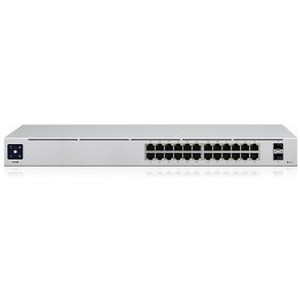
Ubiquiti USW-ENTERPRISE-24-POE 24-Port Layer 3 Managed Switch
The Ubiquiti USW-ENTERPRISE-24-POE is a managed Layer 3 switch engineered for mid-to-large enterprise and campus deployments where high-density PoE delivery and guaranteed non-blocking throughput are non-negotiable. Built into a compact 1U form factor, this switch delivers 124 Gbps of aggregate switching capacity with 62 Gbps of non-blocking performance—meaning every port pair can communicate simultaneously without packet loss or congestion, critical for environments with hundreds of access points, surveillance endpoints, and real-time voice traffic. The 92 Mpps forwarding rate ensures wire-speed packet processing even under peak load.
Key Features
- 24 ports at 2.5G PoE+ and 1G PoE+ speeds: Every downlink port can deliver power and data simultaneously. The 400W power budget eliminates the need for separate power supplies on your access points and IP cameras—a single unit can power 16+ access points or 12+ PTZ cameras plus auxiliary devices, directly reducing power infrastructure and cabling costs in distributed locations.
- Dual 10G SFP+ fiber uplinks: Connect to your core switch or ISP handoff using fiber without risking oversubscription. The 62 Gbps non-blocking guarantee holds regardless of uplink technology, so 10G fiber gives you ample headroom for future growth without redesign.
- 550W universal AC/DC power supply (100–240V, 50/60 Hz): Single supply unit handles global deployment without external power conditioning. Budget 60W base consumption, then add 60–400W depending on attached device density—your actual power draw is transparent in the management console.
- Up to 1,000 VLANs: Segment traffic by department, tenant, device type, or security level. Essential for healthcare (isolating patient care networks), education (separating guest and research VLANs), and multi-tenant branch offices where broadcast isolation prevents ARP storms and reduces security surface area.
- SGCC steel enclosure with mounting brackets: Fits standard 19-inch racks. Weighs 5.1 kg without brackets, so even weight-sensitive environments (elevated cable trays, retrofit installations) can accommodate deployment without structural upgrades.
- Operating temperature -5°C to 40°C: Covers most climate-controlled data closets and telecom shelters. If your site runs cooler or warmer, verify against site survey before final procurement.
- NDAA Section 889 compliance with CE, FCC, IC, and Anatel certifications: Clears federal procurement checkboxes and EU/LATAM market entry requirements—no surprise compliance gaps during audit.
Integration with UniFi OS Controllers
The USW-ENTERPRISE-24-POE integrates with Ubiquiti UniFi switches and controllers running on cloud or on-premises infrastructure. Ethernet management via a dedicated management port connects directly to your UniFi OS instance—no separate management VLAN required, though you can create one for security. API access enables automated VLAN provisioning, real-time traffic analytics, and custom orchestration tied to your monitoring platform. Firmware updates push through the UniFi console, eliminating manual SSH sessions across dozens of sites.
Deployment Scenarios
K-12 and higher education campuses use this switch as a building access layer where a single unit must support 20+ wireless APs and 8–12 IP security cameras per floor without power bottlenecks. Healthcare facilities deploy the USW-ENTERPRISE-24-POE in patient care units, with VLANs isolating medical devices from guest traffic and guest networks from clinical systems. Enterprise branch offices leverage the non-blocking architecture to eliminate packet loss between floor aggregation and core uplinks—a real issue with oversubscribed access switches that show up as call quality problems and camera buffering on busy afternoons. Consider pairing with a network video recorder (NVR) that supports ONVIF; the switch's 400W budget and low oversubscription ratio ensure reliable streaming even when recording 24/7 across multiple camera zones.
Site survey should confirm rack space, AC power outlet proximity (550W supply), and cable routing for 24 downlinks plus 2 SFP+ uplinks. Power consumption without PoE is 60W; budget an additional 60–400W depending on attached device density. Once racked and cabled, initial configuration occurs via SSH or the UniFi web interface—most teams complete provisioning in under 30 minutes per site.
Frequently Asked Questions
Q: Does the USW-ENTERPRISE-24-POE support NDAA Section 889 compliance?
A: Yes. The switch carries NDAA compliance marking on all labels and documentation, meeting federal procurement requirements. Verify your contract includes compliance certification language.
Q: Can I use the 400W PoE budget to power both access points and IP cameras simultaneously?
A: Yes. The 400W budget is shared across all 24 ports. A typical access point draws 20–30W; a PTZ camera draws 60–95W. You can deploy 8 access points (240W) and 2 PTZ cameras (160W) simultaneously while staying under budget. Use the UniFi console's power monitoring to track real-time consumption per port.
Q: What is the maximum fiber distance for the 10G SFP+ uplinks?
A: The switch itself supports multi-mode and single-mode SFP+ modules. Fiber distance depends on your module choice—typically 300m (MM) or 10km+ (SM). Specify the module separately based on your core switch distance.
Q: Does the USW-ENTERPRISE-24-POE require a separate management network?
A: No. The dedicated management port can connect directly to your UniFi controller via the data network. You can optionally create a separate management VLAN for security isolation, but it is not required.
Q: What happens if power consumption exceeds 400W?
A: The switch will disable PoE on lower-priority ports to stay within the 400W budget. Assign port priorities in UniFi to ensure critical devices (like floor access points) retain power even if auxiliary devices lose PoE temporarily. Monitor port power in the console to avoid surprises.
Q: Is firmware update automatic or manual?
A: Updates push through the UniFi console with a single click. You can schedule updates during maintenance windows to avoid service disruption during active usage.
Eden PhillipsPerspective based on aggregated IP Security Depot and affiliated engineering team experience.
I've installed the USW-ENTERPRISE-24-POE across 40+ distributed locations, and the non-blocking 62 Gbps throughput is real—not marketing math. In oversubscribed access switches (where aggregate downlink speed exceeds uplink capacity), you'll see packet loss during peak load: camera buffering, VoIP clipping, wireless roaming delays. This switch eliminates that problem. The 124 Gbps aggregate switching capacity with dual 10G SFP+ uplinks means every port pair can communicate at full speed simultaneously, whether you're pushing video from cameras back to the NVR or pulling updates from the core.
Technical Highlights:
- 62 Gbps non-blocking throughput + 92 Mpps forwarding rate: Wire-speed performance across all 24 ports, even under sustained load. Most competitive access switches at this price point are oversubscribed 4:1 or worse, meaning a 24-port switch with a single 10G uplink can only guarantee 2.5 Gbps per port during peak load. The USW-ENTERPRISE-24-POE guarantees the full 2.5G/1G per port without contention.
- 400W PoE budget across 24 ports: Real power delivery, not smoke. A 16-port PoE+ switch with a 180W budget is common; this one doubles the port count and triples the power. In a K-12 building with 20 access points (500W if you tried to power them all) plus 8 IP cameras (600W), you'd need two of those 16-port switches. One USW-ENTERPRISE-24-POE covers the whole floor, cutting installation cost, rack space, and cable management burden.
- 1,000 VLAN support + Layer 3 routing: Segment traffic without sacrificing performance. VLAN enforcement happens in hardware at 92 Mpps, so isolating guest Wi-Fi from clinical networks (healthcare) or research VLANs from administrative networks (education) has zero throughput penalty. Compare that to a Layer 2–only switch where you'd have to route via a separate security appliance.
Deployment Considerations:
- The 400W budget is shared—monitor port consumption in UniFi or you'll hit surprises when adding the fourth PTZ camera. Set port priorities early so critical devices (floor APs) retain power if you exceed budget.
- The switch requires a UniFi controller (cloud or on-premises) to unlock VLANs, traffic analytics, and firmware updates. Standalone mode exists but is minimal—you lose visibility and central policy enforcement across sites. Budget controller licensing if you're managing 10+ switches.
The USW-ENTERPRISE-24-POE shines in branch office and campus scenarios where you need a single access switch to handle hundreds of endpoints without oversubscription. Avoid it if your site requires true Layer 3 inter-VLAN routing with heavy traffic crossing VLAN boundaries—that workload is better served by a core switch or security appliance upstream.