
Axis T8524 vs Allied Telesis AT-x530L-28GPX-901: Specification Comparison
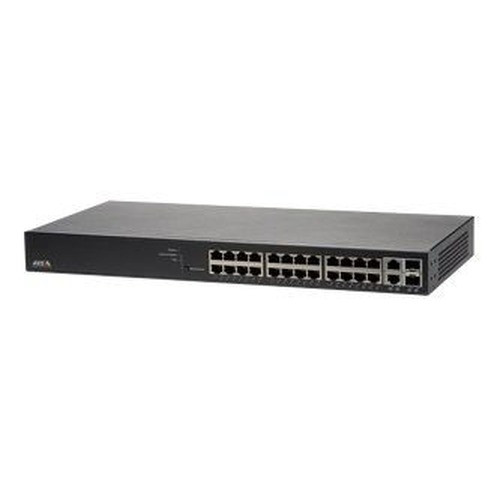
Both the Axis T8524 and Allied Telesis AT-x530L-28GPX-901 are 1U rack-mount managed switches with 24 PoE+ copper ports targeting physical-security and enterprise LAN deployments. This comparison evaluates the three dimensions that drive purchase decisions in this class: port throughput and switching performance, PoE power budget and port power delivery, and management, security, and integration capabilities. Buyers cross-shopping these units typically need to balance switch fabric headroom against total PoE wattage available for cameras, access control panels, and wireless access points.
In This Guide
- Which switch delivers more switching headroom and forwarding throughput?
- Which switch can power more or higher-wattage devices across all 24 ports?
- Which switch provides stronger security controls and ecosystem integration?
- Which should you choose: the T8524 or the AT-x530L-28GPX-901?
- Side-by-Side Specs
- FAQ
Which switch delivers more switching headroom and forwarding throughput?
The AT-x530L-28GPX-901 leads decisively on raw fabric performance. Its switching fabric is rated at 128 Gbps versus the T8524's 52 Gbps — a 2.46× advantage — and its forwarding rate is 95.2 Mpps compared to the T8524's 38.7 Mpps. Latency figures for the AT-x530L at 1 Gbps are 3.98 µs and 1.63 µs at 10 Gbps, while the T8524 spec sheet provides no latency figures.
The AT-x530L also offers four 1/10 Gigabit SFP+ uplink ports plus two stacking ports (marked with an asterisk in the spec data), giving installers more uplink bandwidth and the option to aggregate units into a stack. The T8524 provides only two RJ-45/SFP combo uplink ports. For high-density camera deployments or environments where the switch serves as an aggregation layer, the AT-x530L's fabric and uplink count are meaningfully superior.
The T8524 MAC table is specified at 8K entries; the AT-x530L spec sheet does not publish a MAC table size. Jumbo frame support is documented at 9,216 bytes for the T8524; the AT-x530L spec sheet does not state a jumbo frame limit. Both use a standard 1U form factor (44 mm height), but the AT-x530L is significantly deeper at 421 mm versus the T8524's 211 mm — a critical fit consideration in shallow or mid-depth cabinets.
Which switch can power more or higher-wattage devices across all 24 ports?
The AT-x530L-28GPX-901 carries a 740 W total PoE budget versus the T8524's 370 W — exactly double. Both switches support the same per-port PoE+ ceiling of 30 W across all 24 ports. The AT-x530L's higher budget means that in practice far more ports can draw at or near their 30 W maximum simultaneously before the switch begins load-shedding. The T8524 at 370 W can sustain roughly 12–13 ports at 30 W before reaching budget; the AT-x530L sustains all 24 at 30 W with margin.
The AT-x530L spec sheet explicitly lists compatibility with 7.5 W (802.3az), 15.4 W (802.3af), and 30 W (802.3at) standards. The T8524 is specified as IEEE 802.3at Type 2 Class 4 (PoE+, 30 W per port). Neither switch lists 60 W or 90 W (802.3bt) support; the AT-x530L spec sheet explicitly shows dashes for PoE++ columns.
Maximum power consumption for the AT-x530L is 890 W with a heat dissipation of 3,037 BTU/h and an audible noise rating of 42 dBA (asterisked). The T8524 spec sheet does not publish a maximum system power consumption figure, heat dissipation, or acoustics rating, which can complicate data-center power planning. Surge protection is specified for the T8524 at 6 kV on all network ports and AC lines; the AT-x530L spec sheet does not state a surge protection rating.
Which switch provides stronger security controls and ecosystem integration?
The T8524 publishes an explicit and detailed security feature list: IEEE 802.1X network access control, ACL, Private VLANs, DHCP Snooping, password protection, IP address filtering, and HTTPS encryption. Network protocol support includes IPv4, IPv6, HTTP, HTTPS, SNMP, SSH, DHCP, NTP, and DNS. The switch also ships with AXIS Device Manager and is documented as compatible with ONVIF, Milestone, and Genetec — a significant advantage for physical-security integrators working within those VMS ecosystems.
The AT-x530L-28GPX-901 spec sheet, as provided, does not enumerate supported security protocols, management software, VMS compatibility, network protocols, or SNMP versions. It documents stacking port availability and latency tiers but omits management feature depth. Buyers relying on the provided spec data cannot confirm 802.1X, ACL, or DHCP snooping support for the AT-x530L from the supplied documentation alone.
The T8524 carries a documented 5-year warranty and approvals under EN 55032, EN 55035, FCC Part 15B, VCCI, RCM, and IEC/EN/UL 62368-1. Operating temperature is 0–50 °C. The AT-x530L spec sheet does not publish a warranty term, operating temperature range, or regulatory approvals in the supplied data. For compliance-sensitive installations, the T8524's published certifications provide a clearer audit trail.
Which should you choose: the T8524 or the AT-x530L-28GPX-901?
Our take: The AT-x530L-28GPX-901 is the stronger choice when raw PoE budget and switching headroom are the primary constraints. Its 740 W PoE budget is double the T8524's 370 W, allowing all 24 ports to operate at full 30 W simultaneously, and its 128 Gbps fabric and 95.2 Mpps forwarding rate are 2.46× and 2.46× higher respectively than the T8524's 52 Gbps and 38.7 Mpps. The T8524, however, is the more defensible choice for physical-security integrators who require documented 802.1X, ACL, Private VLAN, and DHCP Snooping controls, verified ONVIF and VMS compatibility with Axis Device Manager, Milestone, and Genetec, published 6 kV surge protection, and a stated 5-year warranty — none of which appear in the AT-x530L spec data as supplied. Choose the AT-x530L for high-density power and uplink-rich aggregation roles; specify the T8524 where surveillance-platform integration and documented security controls are contractually or operationally required.
Side-by-Side Comparison
Spec-for-spec, from manufacturer data.
| Specification | Axis T8524 | Allied Telesis AT-x530L-28GPX-901 |
|---|---|---|
| PoE Ports | 24x RJ-45 PoE+ | 24x RJ-45 PoE+ |
| Uplink Ports | 2x RJ-45/SFP combo | 4x SFP+ (1/10G) |
| Stacking Ports | — | 2 (asterisked) |
| Switching Fabric | 52 Gbps | 128 Gbps |
| Forwarding Rate | 38.7 Mpps | 95.2 Mpps |
| Latency at 1 Gbps | — | 3.98 µs |
| Max PoE Budget | 370 W | 740 W |
| Max Per-Port PoE | 30 W (802.3at) | 30 W (802.3at) |
| PoE++ (60W/90W) | — | Not supported |
| MAC Table | 8K | — |
| Jumbo Frames | 9,216 bytes | — |
| Surge Protection | 6 kV all ports + AC | — |
| Operating Temperature | 0–50 °C | — |
| Max Power Consumption | — | 890 W |
| Noise Rating | — | 42 dBA |
| Warranty | 5 years | — |
Frequently Asked Questions
Which should you choose: the T8524 or the AT-x530L-28GPX-901?
The AT-x530L-28GPX-901 is the stronger choice when raw PoE budget and switching headroom are the primary constraints. Its 740 W PoE budget is double the T8524's 370 W, allowing all 24 ports to operate at full 30 W simultaneously, and its 128 Gbps fabric and 95.2 Mpps forwarding rate are 2.46× and 2.46× higher respectively than the T8524's 52 Gbps and 38.7 Mpps. The T8524, however, is the more defensible choice for physical-security integrators who require documented 802.1X, ACL, Private VLAN, and DHCP Snooping controls, verified ONVIF and VMS compatibility with Axis Device Manager, Milestone, and Genetec, published 6 kV surge protection, and a stated 5-year warranty — none of which appear in the AT-x530L spec data as supplied. Choose the AT-x530L for high-density power and uplink-rich aggregation roles; specify the T8524 where surveillance-platform integration and documented security controls are contractually or operationally required.
Is the T8524 or AT-x530L-28GPX-901 better for larger deployments with many high-wattage cameras?
The AT-x530L-28GPX-901 is better suited for larger deployments with many high-wattage devices. Its 740 W PoE budget — double the T8524's 370 W — means all 24 ports can run at the full 30 W PoE+ ceiling simultaneously without budget-induced throttling. The T8524's 370 W budget limits simultaneous full-load ports to roughly 12–13. The AT-x530L also offers four 10G SFP+ uplinks and stacking support for further expansion, while the T8524 provides only two combo uplink ports.
Which switch is better for a Milestone or Genetec VMS environment?
The T8524 is the documented choice for Milestone and Genetec environments. The provided T8524 spec data explicitly lists compatibility with both VMS platforms as well as ONVIF and AXIS Device Manager. The AT-x530L-28GPX-901 spec sheet as supplied does not reference VMS compatibility, ONVIF support, or management software integrations, so that compatibility cannot be confirmed from the provided specifications.
Will either switch fit in a shallow network cabinet?
The T8524 is significantly more cabinet-friendly in depth-constrained enclosures. Its chassis measures 442 × 211 × 44 mm (depth 211 mm / 8.31 in), making it suitable for shallow or mid-depth cabinets. The AT-x530L-28GPX-901 is 441 × 421 × 44 mm (depth 421 mm / 16.57 in) — nearly double the depth — requiring a full-depth cabinet of at least 450 mm. Both units are 1U tall and approximately the same width.
More Network Switch Comparisons
- Vivotek GEV-288A-370 vs Axis T8524
- Vivotek GEV-288A-370 vs Cradlepoint SW2400P-GN
- Vivotek GEV-288A-370 vs Allied Telesis AT-x530L-28GPX-901
- Vivotek GEV-288A-370 vs Ubiquiti USW-ENTERPRISE-24-POE
- Axis T8524 vs Cradlepoint SW2400P-GN
- Axis T8524 vs Ubiquiti USW-ENTERPRISE-24-POE
Network Switch Buying Guides
Get a Second Opinion on Your Camera Choice
Share your site layout, coverage goals, and budget. Our team will validate the camera selection, flag anything we would change, and recommend products that match the use case.