
Ubiquiti USW-PRO-24-POE vs Axis T8524: Specification Comparison
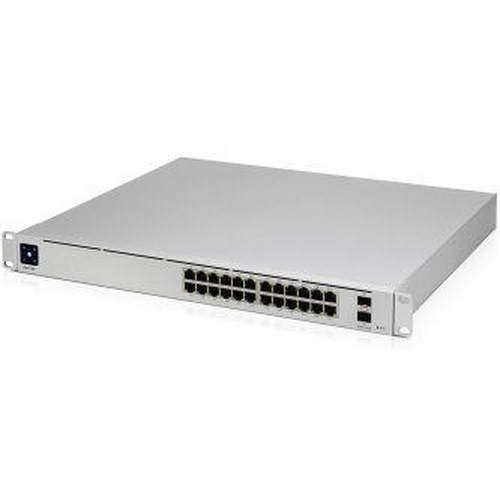
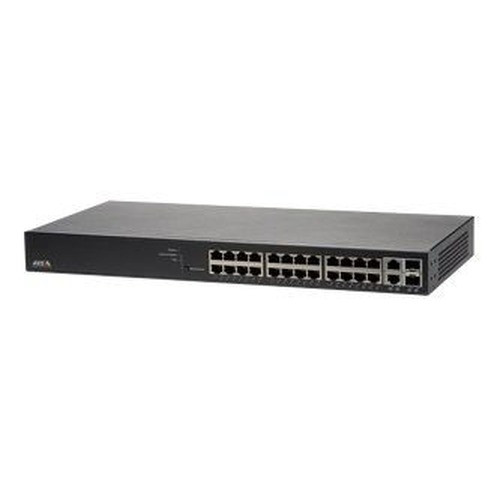
Both the Ubiquiti USW-PRO-24-POE and the Axis T8524 are 1U rack-mount, 24-port managed PoE switches targeting physical-security and enterprise-access deployments. Each provides 24 RJ-45 PoE ports, SFP uplinks, and Layer-2 management including VLAN support. The comparison turns on three axes that matter most to installers and IT buyers in this class: raw switching fabric and forwarding performance; PoE standard, per-port wattage, and total power budget; and security feature depth, management ecosystem, and environmental/compliance positioning.
In This Guide
- Which switch delivers more headroom in switching capacity and forwarding throughput?
- How do PoE standard, per-port wattage, and total power budget compare?
- Which unit offers deeper security controls, management tooling, and compliance coverage?
- Which should you choose: the USW-PRO-24-POE or the T8524?
- Side-by-Side Specs
- FAQ
Which switch delivers more headroom in switching capacity and forwarding throughput?
The USW-PRO-24-POE specifies an 88 Gbps switching fabric with 44 Gbps non-blocking throughput and a 65 Mpps forwarding rate. The Axis T8524 specifies a 52 Gbps switching capacity and 38.7 Mpps forwarding rate; non-blocking throughput is not separately stated in its specs.
The Ubiquiti unit's fabric is 69% larger (88 vs 52 Gbps) and its forwarding rate is 68% higher (65 vs 38.7 Mpps). Both switches ship with 24 Gigabit RJ-45 data ports. The USW-PRO-24-POE adds two 10G SFP+ uplinks; the T8524 provides two RJ-45/SFP combo uplinks, whose maximum line rate is not explicitly stated in the provided specs.
The T8524 specifies an 8K MAC address table and 9,216-byte jumbo-frame support; equivalent figures are not provided in the USW-PRO-24-POE specs. For a 24-camera surveillance VLAN with modest east-west traffic, either fabric is ample, but the Ubiquiti unit leaves substantially more headroom for multi-VLAN, high-density, or future uplink aggregation scenarios.
How do PoE standard, per-port wattage, and total power budget compare?
The USW-PRO-24-POE supports PoE++ (IEEE 802.3bt), the highest standardized PoE tier. Per the provided specs, it delivers a 400 W total PoE output budget from a 450 W internal supply (50 W consumed by the switch itself). The spec sheet also lists a '30W' per-port figure under Poe Power; the 802.3bt standard supports up to 90 W per port, but only the 400 W aggregate budget is confirmed in the provided specs.
The Axis T8524 supports PoE+ (IEEE 802.3at Type 2 Class 4), capped at 30 W per port, with a stated 370 W total output budget. The T8524 also specifies 6 kV surge protection on all network ports and AC lines—a spec absent from the USW-PRO-24-POE documentation provided.
The Ubiquiti unit's 400 W budget exceeds the T8524's 370 W by 30 W—enough for roughly one additional 25 W PTZ camera. More consequentially, PoE++ (802.3bt) on the USW-PRO-24-POE enables powering high-wattage devices (pan-tilt drives, multi-radio APs, edge compute nodes) that PoE+ cannot support. Deployments limited to 802.3at-class cameras will see no practical advantage from the higher PoE tier.
Which unit offers deeper security controls, management tooling, and compliance coverage?
The Axis T8524 lists an explicit security feature set: password protection, IP address filtering, HTTPS encryption, IEEE 802.1X network access control, ACLs, Private VLANs, DHCP snooping, and 6 kV surge protection on all ports. Management integrates with AXIS Device Manager and is compatible with Milestone, Genetec, and ONVIF-compliant VMS platforms. Network protocol support includes IPv4/IPv6, SNMP (v1/v2c/v3 per the enrichment specs), SSH, STP/RSTP/MSTP, and LLDP-MED.
The USW-PRO-24-POE is managed via UniFi Controller software (Ethernet management per specs) and supports up to 1,000 VLANs versus the T8524 (VLAN support count not specified in provided specs). Security feature granularity for the Ubiquiti unit—ACLs, 802.1X, DHCP snooping—is not enumerated in the provided specs. NDAA Section 889 compliance is confirmed for the Ubiquiti unit; the T8524's NDAA status is not stated in the provided specs.
The T8524 carries a stated 5-year warranty. The USW-PRO-24-POE warranty duration is described only as 'Manufacturer Warranty' without a term in the provided specs. Operating temperature range differs: USW-PRO-24-POE is rated -5 to 40 °C; T8524 is rated 0 to 50 °C—the Ubiquiti unit tolerates slightly colder environments, while the Axis unit tolerates hotter ones.
Which should you choose: the USW-PRO-24-POE or the T8524?
Our take: The USW-PRO-24-POE is the stronger choice when PoE++ device support, higher switching headroom, or NDAA Section 889 compliance are hard requirements. It delivers an 88 Gbps fabric (vs 52 Gbps), a 65 Mpps forwarding rate (vs 38.7 Mpps), and a 400 W PoE++ budget (vs 370 W PoE+), making it the better fit for mixed deployments that include 802.3bt-class endpoints or dense multi-VLAN environments. The Axis T8524 is the stronger choice for purpose-built Axis surveillance networks: its native AXIS Device Manager integration, confirmed Milestone/Genetec VMS compatibility, explicit 802.1X/ACL/Private VLAN/DHCP-snooping security stack, 6 kV surge protection on all ports, and a stated 5-year warranty reduce integration risk and total cost of ownership in all-Axis camera deployments. Buyers in regions requiring NDAA compliance should note that only the USW-PRO-24-POE carries a confirmed Section 889 declaration in the provided specs.
Side-by-Side Comparison
Spec-for-spec, from manufacturer data.
| Specification | Ubiquiti USW-PRO-24-POE | Axis T8524 |
|---|---|---|
| PoE Standard | PoE++ (IEEE 802.3bt) | PoE+ (IEEE 802.3at, Class 4) |
| Total PoE Budget | 400 W | 370 W |
| Max PoE per Port | Not specified in provided specs | 30 W |
| Switching Capacity | 88 Gbps | 52 Gbps |
| Non-Blocking Throughput | 44 Gbps | Not specified in provided specs |
| Forwarding Rate | 65 Mpps | 38.7 Mpps |
| PoE Data Ports | 24x Gigabit RJ-45 | 24x Gigabit RJ-45 |
| Uplink Ports | 2x 10G SFP+ | 2x RJ-45/SFP combo |
| VLAN Support | Up to 1,000 | Supported (count not specified in provided specs) |
| Surge Protection | Not specified in provided specs | 6 kV on all network ports and AC lines |
| 802.1X / ACL / DHCP Snooping | Not enumerated in provided specs | Yes (802.1X, ACL, Private VLAN, DHCP Snooping) |
| Management Software | UniFi Controller | AXIS Device Manager |
| MAC Table Size | Not specified in provided specs | 8K |
| Operating Temperature | -5 to 40 °C | 0 to 50 °C |
| NDAA Section 889 Compliant | Yes | Not specified in provided specs |
| Warranty | Manufacturer Warranty (term not specified) | 5 years |
Frequently Asked Questions
Which should you choose: the USW-PRO-24-POE or the T8524?
The USW-PRO-24-POE is the stronger choice when PoE++ device support, higher switching headroom, or NDAA Section 889 compliance are hard requirements. It delivers an 88 Gbps fabric (vs 52 Gbps), a 65 Mpps forwarding rate (vs 38.7 Mpps), and a 400 W PoE++ budget (vs 370 W PoE+), making it the better fit for mixed deployments that include 802.3bt-class endpoints or dense multi-VLAN environments. The Axis T8524 is the stronger choice for purpose-built Axis surveillance networks: its native AXIS Device Manager integration, confirmed Milestone/Genetec VMS compatibility, explicit 802.1X/ACL/Private VLAN/DHCP-snooping security stack, 6 kV surge protection on all ports, and a stated 5-year warranty reduce integration risk and total cost of ownership in all-Axis camera deployments. Buyers in regions requiring NDAA compliance should note that only the USW-PRO-24-POE carries a confirmed Section 889 declaration in the provided specs.
Is the USW-PRO-24-POE or the T8524 better for powering high-wattage PTZ cameras and multi-radio access points?
The USW-PRO-24-POE supports PoE++ (IEEE 802.3bt), which can deliver higher per-port wattage than the T8524's PoE+ (IEEE 802.3at, 30 W per port maximum). If your PTZ cameras or APs exceed 30 W per port, only the USW-PRO-24-POE's 802.3bt standard can support them. For devices at or below 30 W, both switches are sufficient, and the T8524's 370 W aggregate budget covers up to 12 ports at full 30 W simultaneously.
Which switch is easier to integrate into an existing Axis camera deployment managed by AXIS Device Manager?
The Axis T8524 is purpose-built for Axis ecosystems. The provided specs confirm native AXIS Device Manager support, ONVIF compliance, and VMS compatibility with Milestone and Genetec. The USW-PRO-24-POE is managed through the UniFi Controller platform; integration with AXIS Device Manager or third-party VMS platforms is not addressed in its provided specs.
Does either switch meet NDAA Section 889 compliance requirements for federal or government-adjacent deployments?
Yes—the USW-PRO-24-POE is confirmed NDAA Section 889 compliant per the provided specs. The Axis T8524's NDAA compliance status is not stated in the provided specs for this comparison. Buyers with federal procurement requirements should verify the T8524's compliance status directly with Axis or the distributor before specifying it.
More Network Switch Comparisons
- Vivotek GEV-288A-370 vs Axis T8524
- Vivotek GEV-288A-370 vs Cradlepoint SW2400P-GN
- Vivotek GEV-288A-370 vs Allied Telesis AT-x530L-28GPX-901
- Vivotek GEV-288A-370 vs Ubiquiti USW-ENTERPRISE-24-POE
- Axis T8524 vs Cradlepoint SW2400P-GN
- Axis T8524 vs Allied Telesis AT-x530L-28GPX-901
Network Switch Buying Guides
Get a Second Opinion on Your Camera Choice
Share your site layout, coverage goals, and budget. Our team will validate the camera selection, flag anything we would change, and recommend products that match the use case.