
Ubiquiti USW-FLEX-MINI-3 vs Altronix NETWAY5P: Specification Comparison
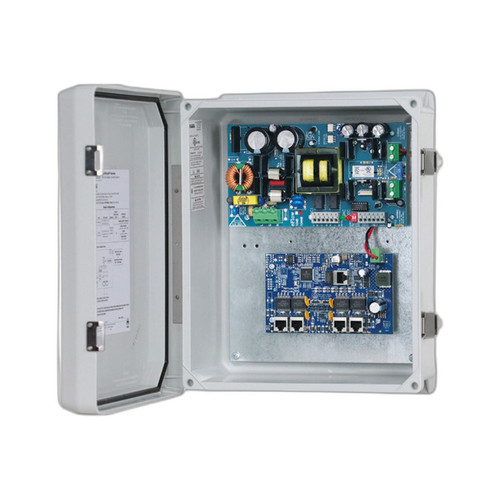
Both the Ubiquiti USW-FLEX-MINI-3 and the Altronix NETWAY5P are 5-port Gigabit PoE switches targeting installers who need to power and connect IP endpoints—cameras, access control readers, intercoms—at the edge. The Ubiquiti unit is a compact desktop/wall-mount managed switch aimed at IT-centric UniFi environments, while the Altronix unit is a DIN-rail/panel-mount managed Layer 2 switch built for physical-security enclosure integration. Both deliver PoE+ across all five ports at Gigabit speeds, making them direct cross-shop candidates for branch, retail, and distributed security deployments.

In This Guide
How do port count, PoE standard, and total power budget compare?
Both switches provide exactly 5 ports at 10/100/1000 Mbps Gigabit speed. On the PoE standard, however, the two diverge in the spec data: the USW-FLEX-MINI-3 lists its PoE Power field as '802.3af' (PoE, up to 15.4 W per port) despite its product name and marketing bullets claiming PoE+ (802.3at, up to 30 W per port). Buyers should verify with the datasheet at /content/product-datasheets/USW-FLEX-MINI-3.pdf before specifying high-draw endpoints. The NETWAY5P explicitly lists PoE+ (802.3at) in its PoE Power field and carries a stated total power budget of 120 W across all five ports, which works out to a maximum average of 24 W per port simultaneously—a concrete, usable number for load planning. No aggregate power budget figure is provided for the USW-FLEX-MINI-3 in the supplied specs.
For installers powering PTZ cameras, dual-head readers, or IP intercoms that draw 15–25 W each, the NETWAY5P's 120 W declared budget and confirmed 802.3at rating give a clearer specification baseline. The USW-FLEX-MINI-3's power specification conflict between the field-level '802.3af' and the marketing-level 'PoE+' must be resolved via its datasheet before committing to high-draw endpoints.
How do form factor, mounting, operating environment, and warranty differ?
The USW-FLEX-MINI-3 is a compact desktop/wall-mount unit weighing 0.330 lb, with approximate dimensions of 6.1 × 4.3 × 1.5 inches (note: the '_Dimensions' field in the spec data reads '107.16 × 70.15 × 21.17 inches,' which is physically implausible and is treated as a data entry error; the tilde-prefixed datasheet value of 6.1 × 4.3 × 1.5 inches is used instead). It carries CE, FCC, and IC certifications and an operating temperature range of -5 to 45 °C (23 to 113 °F). The NETWAY5P supports DIN-rail and panel mounting, making it purpose-built for security enclosures and control panels—a critical differentiator for integrators who need the switch inside an IDF cabinet or alarm panel enclosure. No operating temperature range, dimensions, weight, or environmental certifications are provided in the NETWAY5P specs.
On warranty, the NETWAY5P carries a Lifetime warranty, while the USW-FLEX-MINI-3 lists only 'Manufacturer Warranty' with no stated duration in the supplied specs. For long-cycle security infrastructure, the NETWAY5P's lifetime coverage is a meaningful total-cost-of-ownership advantage. The USW-FLEX-MINI-3's specified operating range (-5 to 45 °C) provides a documented thermal envelope; no equivalent figure exists for the NETWAY5P in the provided data.
What management capabilities and ecosystem integration does each switch offer?
The USW-FLEX-MINI-3 is a fully managed switch with a Web GUI and deep integration into the Ubiquiti UniFi Network ecosystem. Documented Layer 2 features include VLAN, QoS, Port Mirroring, and IGMP Snooping. UniFi integration means centralized provisioning, monitoring, and firmware management across all UniFi devices from a single controller—a strong fit for IT-managed networks or multi-site deployments already running UniFi. The switching capacity is specified at 10 Gbps with a forwarding rate of 7.44 Mpps. The power supply is an external 5 V, 1 A adapter, meaning the switch itself draws power from AC and distributes PoE downstream.
The NETWAY5P is described as a Managed Layer 2 switch with full-duplex Gigabit fabric, but no specific Layer 2 feature set (VLAN tagging, QoS, port mirroring, etc.) is enumerated in the supplied specs. No switching capacity in Gbps or forwarding rate in Mpps is provided. The NETWAY5P is powered by a single centralized PoE source—meaning it is itself a PoE-powered device (PD) that receives power upstream, then distributes it downstream. This is architecturally different from the USW-FLEX-MINI-3, which takes AC power. For integrators running a single PoE trunk from a main switch into an enclosure, this topology can simplify wiring; for others, it constrains where the unit can be placed. No proprietary management platform is specified for the NETWAY5P.
Which should you choose: the USW-FLEX-MINI-3 or the NETWAY5P?
Our take: The USW-FLEX-MINI-3 is the stronger choice when the deployment runs a Ubiquiti UniFi infrastructure and requires documented Layer 2 features—VLAN, QoS, Port Mirroring, IGMP Snooping—alongside a specified 10 Gbps switching capacity and 7.44 Mpps forwarding rate. The NETWAY5P, however, holds three concrete advantages: a declared 120 W total PoE budget versus no stated aggregate figure for the USW-FLEX-MINI-3; an explicit 802.3at PoE+ port rating versus a conflicting '802.3af' field entry on the Ubiquiti unit that must be datasheet-verified; and a Lifetime warranty versus an unspecified warranty duration. The NETWAY5P's DIN-rail and panel-mount form factor also makes it the natural fit inside a security enclosure. Specify the NETWAY5P for enclosure-integrated physical-security builds where PoE budget certainty and long-term warranty coverage are non-negotiable; specify the USW-FLEX-MINI-3 for IT-managed UniFi sites where centralized management and documented Layer 2 policy control are the primary drivers.
Side-by-Side Comparison
Spec-for-spec, from manufacturer data.
| Specification | Ubiquiti USW-FLEX-MINI-3 | Altronix NETWAY5P |
|---|---|---|
| Port Count | 5 | 5 |
| Port Speed | 10/100/1000 Mbps (Gigabit) | 10/100/1000 Mbps (Gigabit) |
| PoE Standard (spec field) | 802.3af (field); PoE+ claimed in name/bullets — verify datasheet | PoE+ (802.3at) |
| Total PoE Power Budget | Not stated in supplied specs | 120 W |
| Switching Capacity | 10 Gbps | Not stated in supplied specs |
| Forwarding Rate | 7.44 Mpps | Not stated in supplied specs |
| Management | Managed; Web GUI; UniFi Network integration | Managed Layer 2 switch (interface not specified) |
| Layer 2 Features | VLAN, QoS, Port Mirroring, IGMP Snooping | Not specified in supplied specs |
| Form Factor / Mount | Desktop / Wall-mount | DIN-rail and panel mount |
| Power Input | 5 V, 1 A AC adapter | Single centralized PoE source (PD device) |
| Operating Temperature | -5 to 45 °C (23 to 113 °F) | Not stated in supplied specs |
| Dimensions | 6.1 × 4.3 × 1.5 in (datasheet value) | Not stated in supplied specs |
| Weight | 0.330 lb | Not stated in supplied specs |
| Certifications | CE, FCC, IC | Not stated in supplied specs |
| Warranty | Manufacturer Warranty (duration not stated) | Lifetime |
| Country of Origin | CN | Not stated in supplied specs |
Frequently Asked Questions
Which should you choose: the USW-FLEX-MINI-3 or the NETWAY5P?
The USW-FLEX-MINI-3 is the stronger choice when the deployment runs a Ubiquiti UniFi infrastructure and requires documented Layer 2 features—VLAN, QoS, Port Mirroring, IGMP Snooping—alongside a specified 10 Gbps switching capacity and 7.44 Mpps forwarding rate. The NETWAY5P, however, holds three concrete advantages: a declared 120 W total PoE budget versus no stated aggregate figure for the USW-FLEX-MINI-3; an explicit 802.3at PoE+ port rating versus a conflicting '802.3af' field entry on the Ubiquiti unit that must be datasheet-verified; and a Lifetime warranty versus an unspecified warranty duration. The NETWAY5P's DIN-rail and panel-mount form factor also makes it the natural fit inside a security enclosure. Specify the NETWAY5P for enclosure-integrated physical-security builds where PoE budget certainty and long-term warranty coverage are non-negotiable; specify the USW-FLEX-MINI-3 for IT-managed UniFi sites where centralized management and documented Layer 2 policy control are the primary drivers.
Which switch is better if I need to power high-draw PTZ cameras or dual-head access control readers?
The NETWAY5P is the safer specification. It explicitly states PoE+ (802.3at, up to 30 W per port) and a total power budget of 120 W across all five ports. The USW-FLEX-MINI-3's spec data contains a conflict—its PoE Power field reads '802.3af' (15.4 W per port) while its product name and bullets claim PoE+. Verify against the USW-FLEX-MINI-3 datasheet before powering any device that draws more than 15.4 W. No total power budget is stated for the USW-FLEX-MINI-3 in the supplied specs.
Can I manage the NETWAY5P through the same dashboard as my other Ubiquiti gear?
No. The NETWAY5P is an Altronix product with no stated integration with the Ubiquiti UniFi platform. The USW-FLEX-MINI-3 is purpose-built for UniFi Network management, including centralized provisioning, monitoring, and firmware updates via a UniFi controller. If your site is standardized on UniFi, the USW-FLEX-MINI-3 is the only option of the two that supports that ecosystem. The NETWAY5P's management interface is not specified in the supplied data beyond 'Managed Layer 2 switch.'
Which switch is easier to install inside a security or access-control enclosure?
The NETWAY5P is designed for enclosure integration: it supports DIN-rail and panel mounting and is itself PoE-powered (PD), meaning it receives power over a single Ethernet cable from an upstream PoE switch—no separate AC wiring inside the enclosure. The USW-FLEX-MINI-3 is a desktop/wall-mount unit powered by an external 5 V, 1 A AC adapter, which requires an AC power outlet or power tap inside or near the enclosure. For a clean, AC-free enclosure build, the NETWAY5P's topology is architecturally simpler.
More Network Switch Comparisons
- TP-Link ES205GP vs Ubiquiti USW-FLEX
- TP-Link ES205GP vs Ubiquiti USW-FLEX-MINI
- TP-Link ES205GP vs Ubiquiti USW-FLEX-3
- TP-Link ES205GP vs Ubiquiti USW-FLEX-MINI-3
- TP-Link ES205GP vs TP-Link SG105PP-M2
- TP-Link SG105PP-M2 vs Ubiquiti USW-FLEX
Network Switch Buying Guides
Get a Second Opinion on Your Camera Choice
Share your site layout, coverage goals, and budget. Our team will validate the camera selection, flag anything we would change, and recommend products that match the use case.