
Ubiquiti USW-ENTERPRISE-24-POE vs Ubiquiti USW-PRO-24-POE: Specification Comparison
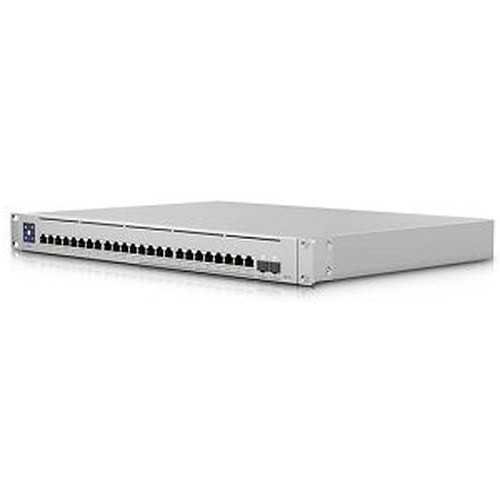
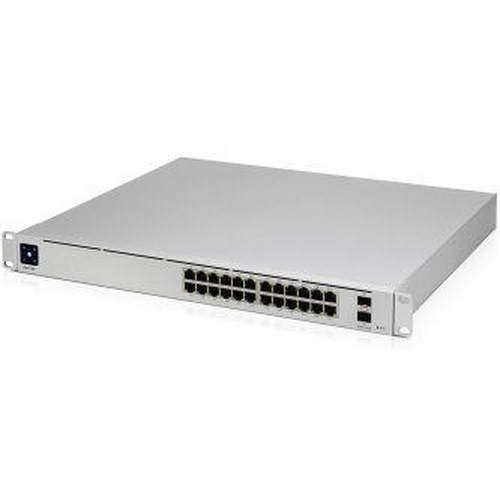
Both the USW-ENTERPRISE-24-POE and the USW-PRO-24-POE are Ubiquiti 24-port rack-mount managed PoE switches in a 1U form factor, each offering 400W PoE budget and dual 10G SFP+ uplinks with 1,000 VLAN support. They occupy the same product class and would be cross-shopped by installers sizing a PoE access layer for IP cameras, wireless APs, or VoIP endpoints. The comparison centers on port-speed tier, PoE standard generation, switching performance, and power envelope.
In This Guide
- Which switch delivers higher per-port speed and what PoE standard does each support?
- How do switching capacity, non-blocking throughput, and forwarding rate compare?
- What are the power draw, power supply rating, and physical size differences?
- Which should you choose: the USW-ENTERPRISE-24-POE or the USW-PRO-24-POE?
- Side-by-Side Specs
- FAQ
Which switch delivers higher per-port speed and what PoE standard does each support?
The USW-ENTERPRISE-24-POE provides 24 ports at 2.5G/1G with PoE+ (802.3af/at), while the USW-PRO-24-POE provides 24 ports at Gigabit (1G/100M/10M) with PoE++ (802.3bt). The ENTERPRISE unit's 2.5G access ports offer up to 2.5× the per-port bandwidth of the PRO's Gigabit ports, which benefits high-throughput endpoints such as Wi-Fi 6/6E APs that can saturate a 1G link under load.
On the PoE standard, the relationship inverts: the PRO unit supports PoE++ (802.3bt) at up to 90W per port, while the ENTERPRISE unit supports PoE+ (802.3at) at up to 30W per port. Both switches share the same 400W aggregate PoE budget, so the PRO can deliver higher single-port wattage for devices like Pan-Tilt-Zoom cameras with heaters or high-power APs, whereas the ENTERPRISE is capped at 30W per port regardless of budget headroom.
How do switching capacity, non-blocking throughput, and forwarding rate compare?
The USW-ENTERPRISE-24-POE specifies a switching capacity of 124 Gbps aggregate with 62 Gbps non-blocking throughput and a forwarding rate of 92 Mpps. The USW-PRO-24-POE specifies 88 Gbps switching capacity, 44 Gbps non-blocking throughput, and 65 Mpps forwarding rate.
The ENTERPRISE unit's non-blocking throughput is 41% higher (62 Gbps vs. 44 Gbps) and its forwarding rate is 42% higher (92 Mpps vs. 65 Mpps). This performance gap is a direct consequence of the ENTERPRISE's higher port-speed tier: 24 ports at 2.5G plus 2 ports at 10G requires a larger switching fabric than 24 ports at 1G plus 2 ports at 10G. For deployments pushing sustained high-bandwidth traffic across many ports simultaneously, the ENTERPRISE's larger fabric reduces the risk of congestion.
What are the power draw, power supply rating, and physical size differences?
Both switches are 1U rack-mount units with SGCC steel enclosures and share the same voltage range (100–240V AC) and operating temperature range (-5 to 40°C). The USW-ENTERPRISE-24-POE draws 60W (excluding PoE output) and ships with an internal 550W power supply, while the USW-PRO-24-POE draws 50W (excluding PoE output) and ships with an internal 450W power supply.
The ENTERPRISE unit is physically deeper (325 mm vs. 285 mm, a 40 mm difference) and heavier (5.1 kg vs. 4.3 kg). For tight rack spaces or weight-constrained enclosures, the PRO's smaller footprint is a practical advantage. The ENTERPRISE's 550W supply provides 150W more headroom over its 60W base draw and 400W PoE budget than the PRO's 450W supply does over its 50W base draw and 400W PoE budget, suggesting marginally more thermal and electrical headroom in the ENTERPRISE's power architecture.
Which should you choose: the USW-ENTERPRISE-24-POE or the USW-PRO-24-POE?
Our take: The USW-ENTERPRISE-24-POE is the stronger choice when endpoints require more than 1G of access-layer bandwidth or when switching fabric headroom matters under simultaneous full-load conditions. Its 2.5G access ports deliver up to 2.5× the per-port throughput of the PRO's Gigabit ports, its non-blocking throughput is 62 Gbps versus 44 Gbps, and its forwarding rate is 92 Mpps versus 65 Mpps. Conversely, the USW-PRO-24-POE is the better fit when connected devices require single-port power delivery above 30W—its PoE++ (802.3bt) standard supports up to 90W per port versus the ENTERPRISE's 30W PoE+ (802.3at) ceiling, within the same 400W aggregate budget. The PRO is also shallower (285 mm vs. 325 mm) and lighter (4.3 kg vs. 5.1 kg). Choose the ENTERPRISE for high-density Wi-Fi 6/6E or multi-gig camera deployments; choose the PRO where high-wattage single-port devices such as heated PTZ cameras or 802.3bt APs are the primary load.
Side-by-Side Comparison
Spec-for-spec, from manufacturer data.
| Specification | Ubiquiti USW-ENTERPRISE-24-POE | Ubiquiti USW-PRO-24-POE |
|---|---|---|
| SKU | USW-ENTERPRISE-24-POE | USW-PRO-24-POE |
| Access Port Speed | 2.5G / 1G | 1G / 100M / 10M |
| Access Port Count | 24 | 24 |
| Uplink Ports | 2 × 10G SFP+ | 2 × 10G SFP+ |
| PoE Standard | PoE+ (802.3af/at) | PoE++ (802.3bt) |
| Max Per-Port PoE Power | 30W (802.3at) | 90W (802.3bt) |
| Aggregate PoE Budget | 400W | 400W |
| Switching Capacity | 124 Gbps | 88 Gbps |
| Non-Blocking Throughput | 62 Gbps | 44 Gbps |
| Forwarding Rate | 92 Mpps | 65 Mpps |
| VLAN Support | 1,000 | 1,000 |
| Switch Power Draw (no PoE) | 60W | 50W |
| Internal Power Supply | 550W | 450W |
| Dimensions (W × D × H mm) | 442 × 325 × 44 | 442 × 285 × 44 |
| Weight (no brackets) | 5.1 kg (11.3 lb) | 4.3 kg (9.5 lb) |
| NDAA Compliant | Yes | Yes |
Frequently Asked Questions
Which should you choose: the USW-ENTERPRISE-24-POE or the USW-PRO-24-POE?
The USW-ENTERPRISE-24-POE is the stronger choice when endpoints require more than 1G of access-layer bandwidth or when switching fabric headroom matters under simultaneous full-load conditions. Its 2.5G access ports deliver up to 2.5× the per-port throughput of the PRO's Gigabit ports, its non-blocking throughput is 62 Gbps versus 44 Gbps, and its forwarding rate is 92 Mpps versus 65 Mpps. Conversely, the USW-PRO-24-POE is the better fit when connected devices require single-port power delivery above 30W—its PoE++ (802.3bt) standard supports up to 90W per port versus the ENTERPRISE's 30W PoE+ (802.3at) ceiling, within the same 400W aggregate budget. The PRO is also shallower (285 mm vs. 325 mm) and lighter (4.3 kg vs. 5.1 kg). Choose the ENTERPRISE for high-density Wi-Fi 6/6E or multi-gig camera deployments; choose the PRO where high-wattage single-port devices such as heated PTZ cameras or 802.3bt APs are the primary load.
Can the USW-PRO-24-POE power devices that need more than 30W per port?
Yes. The USW-PRO-24-POE supports PoE++ (802.3bt), which allows up to 90W per port. The USW-ENTERPRISE-24-POE is limited to PoE+ (802.3at) at a maximum of 30W per port. Both switches share the same 400W aggregate PoE budget, so high-wattage ports on the PRO consume that budget faster across fewer devices.
Is the USW-ENTERPRISE-24-POE or USW-PRO-24-POE better for deployments using Wi-Fi 6 or Wi-Fi 6E access points?
The USW-ENTERPRISE-24-POE is generally the better fit. Its 24 access ports run at 2.5G, which can sustain the multi-gigabit backhaul that Wi-Fi 6/6E APs are capable of delivering. The USW-PRO-24-POE's access ports are capped at 1G, which can become a bottleneck for high-throughput APs. However, if those same APs also require more than 30W of PoE power, only the PRO's PoE++ standard can supply it.
Are there meaningful differences in rack-space or weight between the two switches?
Both switches occupy 1U of rack space. The USW-PRO-24-POE is shallower (285 mm deep vs. 325 mm) and lighter (4.3 kg vs. 5.1 kg). The 40 mm depth difference may matter in shallow-depth wall-mount or compact network cabinets. All other physical characteristics—1U height, SGCC steel enclosure, and operating temperature range—are identical between the two models.
More Network Switch Comparisons
- Vivotek GEV-288A-370 vs Axis T8524
- Vivotek GEV-288A-370 vs Cradlepoint SW2400P-GN
- Vivotek GEV-288A-370 vs Allied Telesis AT-x530L-28GPX-901
- Vivotek GEV-288A-370 vs Ubiquiti USW-ENTERPRISE-24-POE
- Axis T8524 vs Cradlepoint SW2400P-GN
- Axis T8524 vs Allied Telesis AT-x530L-28GPX-901
Network Switch Buying Guides
Get a Second Opinion on Your Camera Choice
Share your site layout, coverage goals, and budget. Our team will validate the camera selection, flag anything we would change, and recommend products that match the use case.