
Ubiquiti UISP-S-PRO vs Axis T8524: Specification Comparison
Both the Ubiquiti UISP-S-PRO and the Axis T8524 are 24-port managed Gigabit PoE switches in 1U 19-inch rack-mount form factors, positioned for enterprise, carrier, and physical-security deployments. The comparison examines the three dimensions that most directly govern switch selection in surveillance and enterprise LAN environments: PoE standard and power budget, switching capacity and uplink architecture, and security feature depth plus management ecosystem and warranty coverage. Neither product's pricing is evaluated here; all claims derive strictly from the published specifications above.

In This Guide
- Which switch delivers more PoE headroom and a higher per-port power standard?
- How do the two switches compare on switching capacity, throughput, and uplink options?
- Which switch offers stronger security features, management tools, and warranty protection?
- Which should you choose: the UISP-S-PRO or the T8524?
- Side-by-Side Specs
- FAQ
Which switch delivers more PoE headroom and a higher per-port power standard?
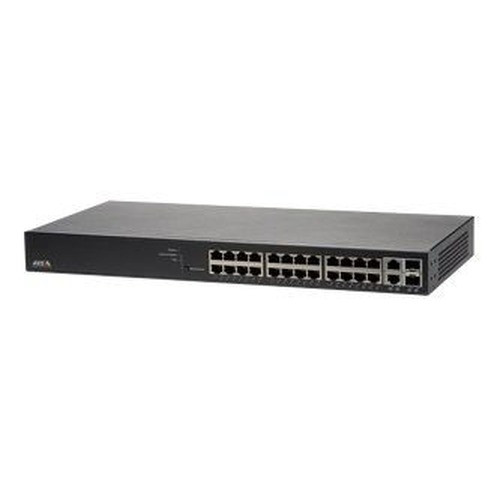
The Axis T8524 is rated to IEEE 802.3at (PoE+), delivering up to 30 W per port across all 24 ports with a total PoE budget of 370 W. That budget supports a full load of PoE+ devices — cameras with IR illuminators, PTZ motors, or dual-radio APs — without port rationing. The Ubiquiti UISP-S-PRO lists 802.3af PoE on all 24 ports. IEEE 802.3af is capped at 15.4 W per port (12.95 W usable at the device), roughly half the per-port ceiling of PoE+. The UISP-S-PRO datasheet does not publish a total PoE power budget figure; buyers cannot confirm aggregate wattage from the available specs. For deployments mixing high-draw devices such as PTZ cameras, multi-sensor units, or PoE-powered access controllers, the T8524's documented 370 W budget and 30 W per-port ceiling provide a concrete, plannable headroom advantage.
How do the two switches compare on switching capacity, throughput, and uplink options?
The Axis T8524 publishes explicit switching capacity of 52 Gbps with 38.7 Mpps throughput, a 8K MAC address table, and 9216-byte jumbo frame support. It also provides two combo RJ45/SFP uplink ports, enabling fiber uplinks for longer runs or aggregation to a core switch without consuming PoE downlink ports. The Ubiquiti UISP-S-PRO does not publish switching capacity, throughput (Mpps), MAC table size, or jumbo frame specifications in the available data. Uplink port count and SFP availability are not stated. Buyers who need to validate non-blocking performance, plan fiber uplinks, or size MAC tables for large VLAN deployments will find the T8524's published figures actionable; the UISP-S-PRO's equivalent figures are absent from the available spec set.
Which switch offers stronger security features, management tools, and warranty protection?
The Axis T8524 lists a detailed security stack: IEEE 802.1X port-based NAC, DHCP snooping, Private VLANs, ACLs, IP address filtering, HTTPS encryption, password protection, and 6 kV surge protection on all network ports and AC lines. Management integrates with AXIS Device Manager and supports SNMP, SSH, IPv4/IPv6, NTP, DNS, STP/RSTP/MSTP, LLDP-MED, and IGMP snooping. It carries EMC approvals including EN 55032, EN 55035, FCC Part 15B, VCCI, RCM, and IEC 62368-1, and is backed by a published 5-year warranty. The UISP-S-PRO lists VLAN, QoS, Port Mirroring, Link Aggregation, SNMP, Web GUI, and CLI management. It notes BLE (Bluetooth Low Energy) support, which is not listed for the T8524. Its security feature granularity (802.1X, ACL specifics, surge rating) is not detailed in the available specs, and its warranty is described only as 'Manufacturer Warranty' without a stated term.
Which should you choose: the UISP-S-PRO or the T8524?
Our take: The Axis T8524 is the stronger choice when PoE power headroom, published switching performance, and documented security depth are the primary selection criteria. On PoE standard alone, the T8524 delivers 30 W per port (802.3at) versus the UISP-S-PRO's 15.4 W per port ceiling (802.3af) — a 2× per-port advantage — and backs it with a published 370 W total budget versus no stated budget for the UISP-S-PRO. The T8524 documents 52 Gbps switching capacity and 38.7 Mpps throughput; the UISP-S-PRO publishes neither figure. The T8524's 5-year stated warranty contrasts with the UISP-S-PRO's unquantified 'Manufacturer Warranty.' The UISP-S-PRO may suit pure Ubiquiti UISP ecosystem deployments or sites where 802.3af-class devices dominate and budget constraints favor that platform, but buyers cannot validate its aggregate power or forwarding performance from the available specifications.
Side-by-Side Comparison
Spec-for-spec, from manufacturer data.
| Specification | Ubiquiti UISP-S-PRO | Axis T8524 |
|---|---|---|
| PoE Standard | 802.3af (15.4 W/port max) | 802.3at PoE+ (30 W/port max) |
| Total PoE Budget | Not published | 370 W |
| PoE Ports | 24 | 24 |
| Uplink Ports | Not published | 2x combo RJ45/SFP |
| Switching Capacity | Not published | 52 Gbps |
| Throughput | Not published | 38.7 Mpps |
| MAC Address Table | Not published | 8K |
| Jumbo Frames | Not published | 9216 bytes |
| Management Interfaces | Web GUI, CLI, SNMP | Web GUI, CLI, SNMP, SSH |
| VLAN Support | Yes | Yes (incl. Private VLANs) |
| IEEE 802.1X NAC | Not published | Yes |
| DHCP Snooping | Not published | Yes |
| Surge Protection | Not published | 6 kV (all ports + AC) |
| Operating Temperature | Not published | 0°C to 50°C |
| Form Factor | 1U 19-inch rack | 1U 19-inch rack (442x211x44 mm) |
| Warranty | Manufacturer Warranty (term not stated) | 5-year warranty |
Frequently Asked Questions
Which should you choose: the UISP-S-PRO or the T8524?
The Axis T8524 is the stronger choice when PoE power headroom, published switching performance, and documented security depth are the primary selection criteria. On PoE standard alone, the T8524 delivers 30 W per port (802.3at) versus the UISP-S-PRO's 15.4 W per port ceiling (802.3af) — a 2× per-port advantage — and backs it with a published 370 W total budget versus no stated budget for the UISP-S-PRO. The T8524 documents 52 Gbps switching capacity and 38.7 Mpps throughput; the UISP-S-PRO publishes neither figure. The T8524's 5-year stated warranty contrasts with the UISP-S-PRO's unquantified 'Manufacturer Warranty.' The UISP-S-PRO may suit pure Ubiquiti UISP ecosystem deployments or sites where 802.3af-class devices dominate and budget constraints favor that platform, but buyers cannot validate its aggregate power or forwarding performance from the available specifications.
Can the UISP-S-PRO power PTZ cameras or multi-sensor cameras that require more than 15 W?
Based on the available specifications, the UISP-S-PRO supports 802.3af PoE, which is capped at 15.4 W per port (12.95 W delivered). PTZ cameras and multi-sensor units commonly require 25–30 W, which falls in the 802.3at (PoE+) range. The T8524 supports up to 30 W per port under 802.3at. If your camera inventory includes high-draw devices, verify the power class requirement against the switch standard before deploying the UISP-S-PRO.
Does the Axis T8524 work with non-Axis cameras and VMS platforms?
Yes. The T8524 lists ONVIF compliance and compatibility with Milestone and Genetec VMS platforms in addition to AXIS Device Manager. It also supports standard HTTP/HTTPS management, making it usable as a general-purpose managed switch in mixed-vendor surveillance or enterprise environments.
What uplink options does each switch provide for connecting to a core or distribution layer?
The Axis T8524 provides two combo RJ45/SFP uplink ports, supporting either copper or fiber uplinks without consuming PoE downlink ports. The UISP-S-PRO's uplink port configuration is not specified in the available data; buyers should consult the full datasheet or Ubiquiti's product page to confirm uplink port type and count before designing the aggregation topology.
More Network Switch Comparisons
- Vivotek GEV-288A-370 vs Axis T8524
- Vivotek GEV-288A-370 vs Cradlepoint SW2400P-GN
- Vivotek GEV-288A-370 vs Allied Telesis AT-x530L-28GPX-901
- Vivotek GEV-288A-370 vs Ubiquiti USW-ENTERPRISE-24-POE
- Axis T8524 vs Cradlepoint SW2400P-GN
- Axis T8524 vs Allied Telesis AT-x530L-28GPX-901
Network Switch Buying Guides
Get a Second Opinion on Your Camera Choice
Share your site layout, coverage goals, and budget. Our team will validate the camera selection, flag anything we would change, and recommend products that match the use case.