
TP-Link SG6428X vs Comnet CNGE24FX12TX12MSPOE: Specification Comparison
Both the TP-Link SG6428X and Comnet CNGE24FX12TX12MSPOE are managed Ethernet switches aimed at professional network infrastructure, each offering a mix of copper and fiber ports with PoE+ support. The SG6428X targets enterprise LAN aggregation and campus core deployments with high throughput and Layer 3 routing depth. The CNGE24FX12TX12MSPOE is purpose-built for hardened, industrial, and outdoor-adjacent environments where temperature extremes, vibration, shock, and rail certifications are mission-critical. This comparison covers port architecture and throughput, environmental and physical ruggedness, and management depth.
In This Guide
- How do port architecture and switching throughput compare between these two switches?
- Which switch is better suited for harsh physical and environmental conditions?
- How do Layer 3 routing depth, management features, and platform ecosystem compare?
- Which should you choose: the SG6428X or the CNGE24FX12TX12MSPOE?
- Side-by-Side Specs
- FAQ
How do port architecture and switching throughput compare between these two switches?
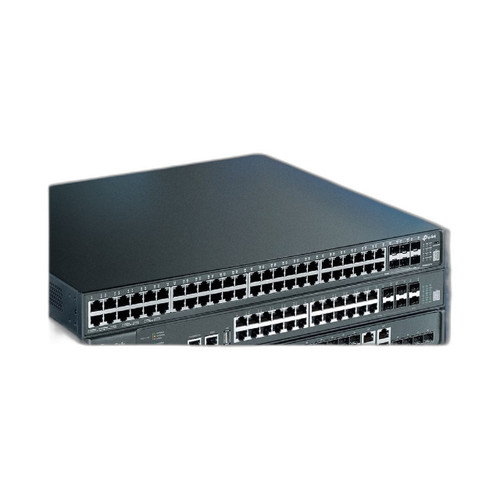
The TP-Link SG6428X provides 24 Gigabit RJ45 ports and 4×10GE SFP+ uplink slots, yielding a switching capacity of 128 Gbps with a dual-core ARM processor running at 1.5 GHz. Storage is 2×4 MB NOR flash plus 8 GB eMMC. The 10GE SFP+ uplinks support high-bandwidth aggregation to core switches or servers. PoE+ (802.3af/at) is supported across PoE-capable ports with a total PoE budget of 1,440 W, enabling dense powered-device deployments.
The Comnet CNGE24FX12TX12MSPOE splits its 24 ports evenly: 12 RJ45 (10/100/1000Base-TX) and 12 SFP fiber ports, with 12 of those ports carrying PoE+ at up to 30 W each. Switching bandwidth is rated at 54 Gbps with a switching latency of 7 µS. The MAC address table holds 8K entries, maximum VLANs is 256, and jumbo frames up to 9.6 KB are supported. Static routing capacity is limited to 32 routes. The SG6428X delivers 2.4× the switching bandwidth and adds 10GE uplink capability absent from the Comnet unit.
Which switch is better suited for harsh physical and environmental conditions?
The Comnet CNGE24FX12TX12MSPOE is explicitly hardened for industrial and transportation environments. Its operating temperature range is -40 °C to +75 °C, and storage temperature spans -40 °C to +85 °C. It carries certifications for shock resistance (IEC60068-2-27), free fall (IEC60068-2-32), vibration (IEC60068-2-6), safety (EN60950-1), and railway operation (EN50121-4). EMI compliance covers FCC Part 15 and CISPR Class A; EMS compliance includes EN61000-4-2 through EN61000-4-11. MTBF is specified at greater than 100,000 hours. The unit is available in mains-powered (11 lb) and DC-only-powered (7.9 lb) configurations.
The TP-Link SG6428X is a rack-mount commercial-grade switch rated for -5 °C to 45 °C operating temperature. No shock, vibration, railway, or industrial environmental certifications are listed in the provided specifications. It is physically larger at 17.3 × 16.5 × 1.7 in versus the Comnet's 17 × 10 × 1.5 in. For installations in temperature-controlled data rooms or wiring closets, the SG6428X's environmental envelope is adequate. For outdoor enclosures, transit, utility, or industrial control room deployments, the Comnet's 115 °C wider operating range and its suite of IEC/EN hardening certifications are decisive differentiators not matched by the SG6428X.
How do Layer 3 routing depth, management features, and platform ecosystem compare?
The TP-Link SG6428X operates as a full Layer 3 managed switch supporting RIP, OSPF, VRRP, ECMP, PIM-SM/DM, static routing, and policy-based routing (PBR). Management interfaces include CLI, SNMP v1/v2c/v3, RMON, and a dedicated RJ45 management port. The switch integrates into TP-Link's Omada SDN ecosystem, enabling controller-based centralized management alongside standalone operation. The 8 GB eMMC storage supports feature-rich firmware and logging.
The Comnet CNGE24FX12TX12MSPOE is described as a hardened managed switch. The provided specifications list static routing with a capacity of 32 routes, 256 VLANs, and an 8K MAC table. Detailed routing protocol support (dynamic routing protocols, SNMP version support, or a named SDN ecosystem) is not enumerated in the provided specifications. DRAM is 1 GB and flash is 128 MB. Buyers requiring dynamic routing protocols such as OSPF or multicast routing (PIM), or integration into a centralized SDN management platform, cannot confirm those capabilities from the available Comnet spec data and should verify directly with Comnet before specifying.
Which should you choose: the SG6428X or the CNGE24FX12TX12MSPOE?
Our take: The SG6428X is the stronger choice when the deployment is in a climate-controlled environment and demands high switching throughput, 10GE uplinks, deep Layer 3 routing protocols, or integration into an SDN-managed campus network. Its 128 Gbps switching capacity is 2.4× the Comnet's 54 Gbps, its 4×10GE SFP+ uplinks have no equivalent on the Comnet unit, and its documented routing suite (OSPF, PIM, VRRP, PBR) far exceeds the Comnet's specified 32-route static routing ceiling. Conversely, the CNGE24FX12TX12MSPOE is the required choice for any deployment outside a controlled equipment room: its -40 °C to +75 °C operating range, IEC60068 shock/vibration certifications, EN50121-4 railway rating, and greater-than-100,000-hour MTBF address conditions the SG6428X is not rated for. Its equal fiber-to-copper port split also suits fiber-dominant industrial runs. Specify the SG6428X for enterprise LAN aggregation; specify the CNGE24FX12TX12MSPOE for hardened edge, transit, or industrial control network segments.
Side-by-Side Comparison
Spec-for-spec, from manufacturer data.
| Specification | TP-Link SG6428X | Comnet CNGE24FX12TX12MSPOE |
|---|---|---|
| Product Type | Omada Stackable L3 Managed Switch | Hardened Managed Ethernet Switch |
| Total Ports | 28 (24×GbE RJ45 + 4×10GE SFP+) | 24 (12×RJ45 + 12×SFP) |
| RJ45 Ports | 24 × Gigabit | 12 × 10/100/1000Base-TX |
| Fiber / SFP Ports | 4 × 10GE SFP+ | 12 × SFP |
| PoE+ Ports | 24 (802.3af/at) | 12 (IEEE 802.3at) |
| PoE Budget | 1,440 W | Not separately specified (max consumption 390 W) |
| Switching Capacity | 128 Gbps | 54 Gbps |
| Switching Latency | — | 7 µS |
| Layer 3 Routing | OSPF, RIP, VRRP, ECMP, PIM-SM/DM, PBR, Static | Static (32 routes max) |
| Operating Temperature | -5 °C to +45 °C | -40 °C to +75 °C |
| Industrial Certifications | — | IEC60068-2-27/32/6, EN50121-4, EN60950-1 |
| MTBF | — | > 100,000 hours |
| Memory (RAM) | — | 1 GB DRAM |
| Storage (Flash) | 2×4 MB NOR + 8 GB eMMC | 128 MB Flash |
| Management | CLI, SNMP v1/v2c/v3, RMON, Omada SDN, dedicated Mgmt port | Managed (protocol detail not specified in provided specs) |
| Dimensions (W×D×H) | 17.3 × 16.5 × 1.7 in | 17 × 10 × 1.5 in |
Frequently Asked Questions
Which should you choose: the SG6428X or the CNGE24FX12TX12MSPOE?
The SG6428X is the stronger choice when the deployment is in a climate-controlled environment and demands high switching throughput, 10GE uplinks, deep Layer 3 routing protocols, or integration into an SDN-managed campus network. Its 128 Gbps switching capacity is 2.4× the Comnet's 54 Gbps, its 4×10GE SFP+ uplinks have no equivalent on the Comnet unit, and its documented routing suite (OSPF, PIM, VRRP, PBR) far exceeds the Comnet's specified 32-route static routing ceiling. Conversely, the CNGE24FX12TX12MSPOE is the required choice for any deployment outside a controlled equipment room: its -40 °C to +75 °C operating range, IEC60068 shock/vibration certifications, EN50121-4 railway rating, and greater-than-100,000-hour MTBF address conditions the SG6428X is not rated for. Its equal fiber-to-copper port split also suits fiber-dominant industrial runs. Specify the SG6428X for enterprise LAN aggregation; specify the CNGE24FX12TX12MSPOE for hardened edge, transit, or industrial control network segments.
Is the SG6428X or CNGE24FX12TX12MSPOE better for a factory floor or outdoor enclosure installation?
The CNGE24FX12TX12MSPOE is the appropriate choice. Its operating temperature range of -40 °C to +75 °C, combined with IEC60068-2-27 shock, IEC60068-2-6 vibration, and EN50121-4 railway certifications, covers the conditions found on factory floors, transit systems, and outdoor-adjacent enclosures. The SG6428X is rated only to -5 °C to 45 °C with no listed industrial hardening certifications, making it unsuitable for those environments per the provided specifications.
Which switch supports more advanced Layer 3 routing for a campus or enterprise core deployment?
The SG6428X documents support for OSPF, RIP, VRRP, ECMP, PIM-SM/DM, static routing, and policy-based routing. The Comnet CNGE24FX12TX12MSPOE specifies only static routing with a capacity of 32 routes; dynamic routing protocol support is not listed in the provided specifications. For enterprise core or campus aggregation requiring dynamic routing or multicast, the SG6428X is the specifiable choice based on available data.
Do both switches support PoE+, and how does total PoE budget compare?
Both switches support IEEE 802.3at (PoE+) at up to 30 W per port. The SG6428X lists a total PoE budget of 1,440 W across its PoE-capable ports. The Comnet CNGE24FX12TX12MSPOE specifies 12 PoE+ ports at 30 W each and a maximum power consumption of 390 W; a separate dedicated PoE budget figure is not broken out in the provided specifications. Buyers powering many high-draw devices simultaneously should request the Comnet's PoE power budget table from Comnet directly before finalizing the design.
More Network Switch Comparisons
- TP-Link S5500-24GP4XF vs NETGEAR GS728TP-300NAS
- TP-Link S5500-24GP4XF vs Comnet CNGE24FX12TX12MSPOE
- TP-Link S5500-24GP4XF vs Ubiquiti USW-24
- TP-Link S5500-24GP4XF vs Ubiquiti USW-ENTERPRISEXG-24
- TP-Link S5500-24GP4XF vs TP-Link SL2428P
- TP-Link S5500-24GP4XF vs TP-Link SG3428XPP-M2
Network Switch Buying Guides
Get a Second Opinion on Your Camera Choice
Share your site layout, coverage goals, and budget. Our team will validate the camera selection, flag anything we would change, and recommend products that match the use case.