
Panduit U10N12V vs APC by Schneider Electric SRT10KRMXLT-5KTF2: Specification Comparison
Both the Panduit U10N12V and the APC Smart-UPS SRT10KRMXLT-5KTF2 are 10 kVA true online double-conversion rack-mount UPS systems targeting data center, enterprise, and edge deployments. The comparison centers on input tolerance and voltage range, output flexibility and transformer integration, and management and serviceability features—the three axes most relevant when selecting a 10 kVA online UPS for a mixed-voltage rack environment.
In This Guide
- Which unit offers broader input voltage tolerance and frequency flexibility?
- How do the two units differ in output voltage range and load capability?
- Which unit provides more capable management interfaces and easier field serviceability?
- Which should you choose: the U10N12V or the SRT10KRMXLT-5KTF2?
- Side-by-Side Specs
- FAQ
Which unit offers broader input voltage tolerance and frequency flexibility?
The Panduit U10N12V accepts an input voltage range of 160–280V AC, covering a wide tolerance window suited for environments with unstable utility power or international grid variations. No input frequency range is specified in the provided data sheet.
The APC SRT10KRMXLT-5KTF2 accepts input voltages from 100V to 275V, giving it a lower minimum input threshold (100V vs. 160V), which can be advantageous in regions or facilities where under-voltage sags are a concern. APC also specifies an input frequency window of 40–70 Hz, indicating compatibility with non-standard or generator-supplied power. The APC unit's upper input ceiling of 275V is marginally lower than Panduit's 280V.
For sites subject to severe under-voltage conditions or generator operation with frequency deviation, the APC's 100V minimum input and 40–70 Hz window provide documented flexibility that the Panduit spec sheet does not address. Conversely, Panduit's 160V lower bound is sufficient for most North American and European utility feeds.
How do the two units differ in output voltage range and load capability?
The Panduit U10N12V outputs 120V AC ±2%, fixed. It is a single-output-voltage unit rated at 10 kVA capacity. No wattage output figure is listed in the provided specifications. Output is a pure sine wave, consistent with its true online double-conversion topology.
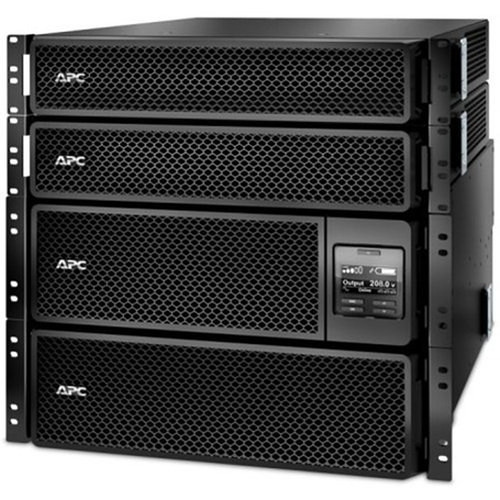
The APC SRT10KRMXLT-5KTF2 bundles two 208V-to-120V, 5 kVA step-down transformers into the SKU. Its output voltage range spans 120V to 208V, enabling it to power both 120V and 208V loads from a single system. Output power is explicitly rated at 10,000W (10 kW) alongside the 10 kVA capacity, yielding a unity power factor. Output THD is specified at 2% and crest factor at 3:1. A surge energy rating of 480 J and surge protection are documented. Audible alarms and Emergency Power Off (EPO) are also confirmed.
The APC unit's dual-voltage output and bundled transformer pair make it directly applicable to mixed-voltage rack environments without additional infrastructure. The Panduit U10N12V does not list equivalent dual-voltage capability, EPO, surge joule rating, or output wattage in the provided specifications.
Which unit provides more capable management interfaces and easier field serviceability?
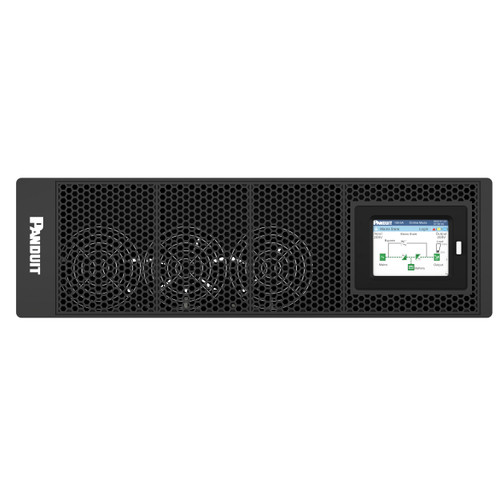
The Panduit U10N12V documents SNMP v1/v2c/v3 and HTTP management interfaces, plus a front-panel LCD status monitor. Battery modules are hot-swappable and front-accessible, allowing replacement without removing the unit from the rack or powering down connected loads. The 2U form factor (17.3 in W × 10.3 in H / 440 mm × 262 mm) is confirmed in the spec data.
The APC SRT10KRMXLT-5KTF2 confirms web-based management and audible alarms. SNMP version support, specific CLI or NMC card details, and front-panel display type are not enumerated in the provided specifications. Battery hot-swap capability and front-access serviceability are not documented in the data provided. Noise level is specified at 55 dB.
Panduit's explicit SNMP v1/v2c/v3 versioning, HTTP interface, front-panel LCD, and confirmed hot-swap front-access batteries are directly documented advantages for enterprise IT environments requiring remote polling and zero-downtime battery maintenance. APC's management depth cannot be fully compared on the data provided.
Which should you choose: the U10N12V or the SRT10KRMXLT-5KTF2?
Our take: The SRT10KRMXLT-5KTF2 is the stronger choice when a site requires dual-voltage output (120V and 208V) from a single 10 kVA UPS, generator compatibility with a documented 40–70 Hz input frequency window, or a lower minimum input voltage threshold (100V vs. 160V). It also ships with the two 208V-to-120V step-down transformers included and declares a 10,000W output at unity power factor—output wattage the Panduit spec sheet does not state. The U10N12V is the stronger choice when network management granularity matters: it documents SNMP v1/v2c/v3 plus HTTP, a front-panel LCD, and confirmed hot-swappable front-accessible batteries—none of which are confirmed in the APC spec data provided. Buyers deploying in a 120V-only rack with strong utility power and a preference for documented zero-downtime battery service should evaluate the U10N12V; those managing mixed-voltage or generator-backed environments should favor the APC bundle.
Side-by-Side Comparison
Spec-for-spec, from manufacturer data.
| Specification | Panduit U10N12V | APC by Schneider Electric SRT10KRMXLT-5KTF2 |
|---|---|---|
| UPS Topology | True Online Double-Conversion | Double-Conversion (Online) |
| Capacity (VA) | 10,000 VA | 10,000 VA |
| Output Power (W) | — | 10,000 W |
| Form Factor | 2U Rack-Mount | Rack-Mount (U height not specified in provided data) |
| Input Voltage Min | 160V AC | 100V AC |
| Input Voltage Max | 280V AC | 275V AC |
| Input Frequency Range | — | 40–70 Hz |
| Output Voltage | 120V AC ±2% (fixed) | 120V–208V (dual-voltage with included transformers) |
| Output Frequency | — | 50/60 Hz |
| Output Voltage THD | — | 2% |
| Crest Factor | — | 3:1 |
| Surge Energy Rating | — | 480 J |
| Emergency Power Off (EPO) | — | Yes |
| Management Interface | SNMP v1/v2c/v3, HTTP, LCD | Web-based (SNMP version not specified in provided data) |
| Hot-Swap Batteries | Yes (front-accessible) | — |
| Audible Alarm | — | Yes |
| Noise Level | — | 55 dB |
| Width | 17.3 in (440 mm) | — |
| Height | 10.3 in (262 mm) — 2U | — |
| Bundled Accessories | None listed | Two 208V-to-120V 5 kVA step-down transformers included |
Frequently Asked Questions
Which should you choose: the U10N12V or the SRT10KRMXLT-5KTF2?
The SRT10KRMXLT-5KTF2 is the stronger choice when a site requires dual-voltage output (120V and 208V) from a single 10 kVA UPS, generator compatibility with a documented 40–70 Hz input frequency window, or a lower minimum input voltage threshold (100V vs. 160V). It also ships with the two 208V-to-120V step-down transformers included and declares a 10,000W output at unity power factor—output wattage the Panduit spec sheet does not state. The U10N12V is the stronger choice when network management granularity matters: it documents SNMP v1/v2c/v3 plus HTTP, a front-panel LCD, and confirmed hot-swappable front-accessible batteries—none of which are confirmed in the APC spec data provided. Buyers deploying in a 120V-only rack with strong utility power and a preference for documented zero-downtime battery service should evaluate the U10N12V; those managing mixed-voltage or generator-backed environments should favor the APC bundle.
Is the U10N12V or SRT10KRMXLT-5KTF2 better for a mixed 120V/208V rack environment?
Based on the provided specifications, the APC SRT10KRMXLT-5KTF2 is the documented choice for mixed-voltage racks. Its SKU includes two 208V-to-120V, 5 kVA step-down transformers and supports output voltages from 120V to 208V. The Panduit U10N12V specifies a fixed 120V AC output only; no dual-voltage or transformer capability is listed in its provided specifications.
Which unit is easier to maintain in a live rack without downtime?
The Panduit U10N12V explicitly specifies hot-swappable, front-accessible battery modules and front-accessible components, enabling battery replacement without powering down connected loads or removing the unit from the rack. The APC SRT10KRMXLT-5KTF2's provided specifications do not document hot-swap battery capability or front-access serviceability, so a direct comparison on this dimension cannot be made from the data provided.
Which UPS handles generator or weak-grid power better?
The APC SRT10KRMXLT-5KTF2 documents a lower minimum input voltage of 100V (vs. 160V for the Panduit U10N12V) and an input frequency range of 40–70 Hz, making it explicitly suited to generator-backed or variable-frequency utility feeds. The Panduit U10N12V does not list an input frequency tolerance in the provided specifications, so its behavior on generator power cannot be confirmed from the available data.
More UPS Comparisons
- APC by Schneider Electric SRTL10KRM4UT-5KTF2 vs Panduit U10N32V
- APC by Schneider Electric SRTL10KRM4UT-5KTF2 vs Panduit U10N11V
- APC by Schneider Electric SRTL10KRM4UT-5KTF2 vs Panduit U10N12V
- APC by Schneider Electric SRTL10KRM4UT-5KTF2 vs Vertiv GXT5-10KHVRT5UXLN
- APC by Schneider Electric SRTL10KRM4UT-5KTF2 vs APC by Schneider Electric E3SUPS10KFBS
- APC by Schneider Electric SRTL10KRM4UT-5KTF2 vs APC by Schneider Electric SRT10KRMXLT-10KTF
UPS Buying Guides
Get a Second Opinion on Your Camera Choice
Share your site layout, coverage goals, and budget. Our team will validate the camera selection, flag anything we would change, and recommend products that match the use case.