
Panduit U03S11V vs APC by Schneider Electric SRT3000XLW-IEC: Specification Comparison
Both the Panduit U03S11V and APC SRT3000XLW-IEC are 3000VA / 2700W uninterruptible power supplies aimed at protecting critical IT and data center loads. The U03S11V is a 2U rackmount unit built on Panduit's SteadySine platform, while the SRT3000XLW-IEC is a tower-form double-conversion online UPS from APC's Smart-UPS SRT line with IEC outlet configurations targeting international and mixed-voltage environments. Both deliver true sine-wave output and carry ENERGY STAR certification, making them legitimate cross-shop candidates for installers specifying infrastructure power protection at the 3kVA tier.
In This Guide
Which UPS offers stronger output quality and topology protection?
The APC SRT3000XLW-IEC uses Double Conversion Online topology, meaning the load runs continuously from the inverter with zero transfer time during a mains failure — the inverter is always active and the battery is always in the power path. The Panduit U03S11V is specified as Line-Interactive / Double-Conversion; the spec sheet lists both topologies, though line-interactive and double-conversion are architecturally distinct. Buyers should verify with Panduit which mode the U03S11V actually operates in, as this materially affects isolation quality.
On output waveform distortion, the Panduit spec states less than 3% THD, while APC specifies less than 2% output voltage distortion. Both deliver sine-wave output. The APC unit also publishes a load crest factor of 3:1, a figure absent from the Panduit spec sheet. Panduit lists voltage regulation of ±2%; APC does not publish an equivalent regulation figure separately. For the most sensitive loads — medical imaging, high-frequency switching PSUs, precision lab equipment — the APC's confirmed double-conversion topology and slightly tighter distortion spec give it a verifiable edge on paper.
How do form factor, installation footprint, and outlet configuration differ?
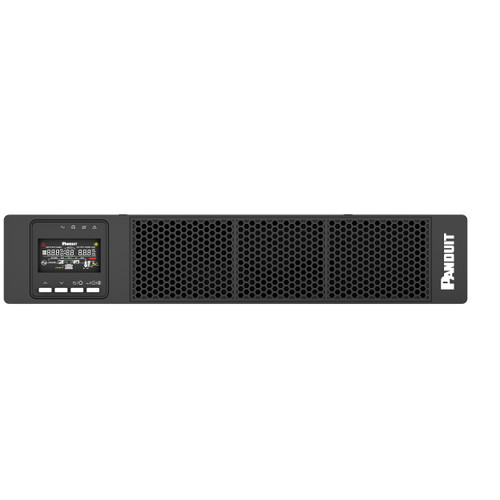
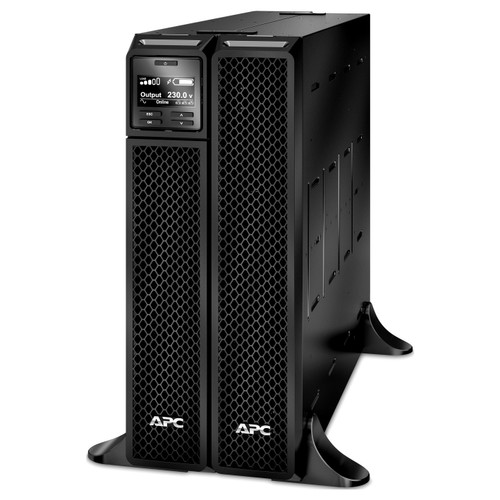
The Panduit U03S11V is a 2U rackmount unit measuring 3.4" H × 17.3" W (depth listed as approximately 18" / 440mm width confirmed). It is designed for standard 19" rack bays, directly relevant to server room and surveillance rack deployments. The APC SRT3000XLW-IEC is a tower unit measuring 17.0" × 3.3" × 25.0" (L×W×H), intended for floor or shelf placement. APC does not specify a rack-mount option for this SKU; the extended run sibling model is noted as a separate option.
Outlet configurations differ significantly. APC provides 6 × IEC 320 C13, 2 × IEC 320 C19, and 2 × IEC Jumper outputs — all battery-backed, all IEC format, suited for international power environments and IEC-cord equipment. The Panduit U03S11V spec does not enumerate individual outlet types or quantities in the provided data. Buyers requiring specific outlet counts or NEMA vs. IEC formats must request the full Panduit datasheet. APC's input accepts British BS1363A, IEC-320 C20, and Schuko CEE 7/EU1-16P — broad international compatibility. Panduit's input range of 90–295VAC is notably wide but connector types are not specified in the provided data.
Which unit provides better management integration and runtime flexibility?
The APC SRT3000XLW-IEC includes RJ45 Serial, USB, and a SmartSlot expansion bay for network management cards, plus a multi-function LCD control panel and prioritized audible/visible alarms. It ships with one internal battery module (replacement APCRBC152) with a stated typical recharge time of 3 hours and expected battery life of 3–5 years. Critically, APC explicitly supports extended runtime via external battery packs (APC-Smart-UPS-SRT-3000VA-208-230V-IEC), making it scalable for longer outage coverage.
The Panduit U03S11V offers USB, RS-232, Dry Contact, and an optional SNMP/Modbus card. Front hot-swap battery access is a notable operational advantage — batteries can be replaced without taking the unit offline or pulling it from the rack. The APC spec does not describe front-access or hot-swap capability for this tower model. Panduit also lists NEC Article 645 / 480.4 compliance, relevant for data center and information technology equipment room installations under the National Electrical Code. APC does not cite NEC compliance in the provided spec. Neither unit's runtime curve (minutes at load) is provided in the supplied specifications for either product.
Which should you choose: the U03S11V or the SRT3000XLW-IEC?
Our take: The SRT3000XLW-IEC is the stronger choice when confirmed double-conversion online topology, IEC international outlet flexibility, and scalable extended runtime are the primary requirements. APC's topology is unambiguously double-conversion, its output distortion is specified at less than 2% versus Panduit's less than 3%, and its 10-outlet IEC configuration with explicit external battery expansion support is fully documented. The Panduit U03S11V is the stronger choice for rackmount deployments requiring NEC 645/480.4 code compliance, front hot-swap battery service without rack extraction, and Modbus/dry-contact integration into building management or surveillance infrastructure — none of which the APC SRT3000XLW-IEC addresses in its provided spec. The APC is a tower unit; the Panduit is 2U rackmount. If the installation is a rack environment, the form-factor difference alone may be decisive.
Side-by-Side Comparison
Spec-for-spec, from manufacturer data.
| Specification | Panduit U03S11V | APC by Schneider Electric SRT3000XLW-IEC |
|---|---|---|
| Product Type | UPS — 2U Rackmount | UPS — Tower |
| Capacity | 3000VA / 2700W | 3000VA / 2700W |
| UPS Topology | Line-Interactive / Double-Conversion (dual-listed) | Double Conversion Online |
| Output Waveform | True Sine Wave | Sine Wave |
| Output Voltage Distortion (THD) | <3% | <2% |
| Voltage Regulation | ±2% | Not specified in provided data |
| Nominal Output Voltage | Not specified in provided data | 208 V & 230 V (configurable 220/240 V) |
| Input Voltage Range | 90–295VAC | 208 V & 230 V (other: 220/240 V) |
| Input Frequency | Not specified in provided data | 40–70 Hz (auto sensing) |
| Transfer Time | <5ms | 0ms (double-conversion online) |
| Output Connections | Not enumerated in provided data | 6× IEC C13, 2× IEC C19, 2× IEC Jumper (all battery backup) |
| Battery Access | Front Hot-Swappable | Not specified in provided data |
| Extended Runtime | Not specified in provided data | Yes — via external battery pack (sold separately) |
| Management Interfaces | USB, RS-232, Dry Contact, Optional SNMP/Modbus Card | USB, RJ45 Serial, SmartSlot |
| Audible Noise | Not specified in provided data | 55 dBA at 1.0 m |
| Certifications / Compliance | cULus, ENERGY STAR, NEC Article 645 / 480.4 | UL 1778, CE, CSA, FCC Part 15 Class A, ENERGY STAR V1.0, RCM, VDE, EAC |
Frequently Asked Questions
Which should you choose: the U03S11V or the SRT3000XLW-IEC?
The SRT3000XLW-IEC is the stronger choice when confirmed double-conversion online topology, IEC international outlet flexibility, and scalable extended runtime are the primary requirements. APC's topology is unambiguously double-conversion, its output distortion is specified at less than 2% versus Panduit's less than 3%, and its 10-outlet IEC configuration with explicit external battery expansion support is fully documented. The Panduit U03S11V is the stronger choice for rackmount deployments requiring NEC 645/480.4 code compliance, front hot-swap battery service without rack extraction, and Modbus/dry-contact integration into building management or surveillance infrastructure — none of which the APC SRT3000XLW-IEC addresses in its provided spec. The APC is a tower unit; the Panduit is 2U rackmount. If the installation is a rack environment, the form-factor difference alone may be decisive.
Can either UPS be rack-mounted?
Yes for the Panduit U03S11V — it is purpose-built as a 2U rackmount unit at 3.4" × 17.3". The APC SRT3000XLW-IEC is specified as a tower form factor; this SKU does not include rack-mount hardware per the provided spec. Buyers needing a rack-mounted APC SRT unit should evaluate a different APC SRT SKU that includes rack-mount rails.
Which UPS is better suited for international or mixed-voltage deployments?
The APC SRT3000XLW-IEC is the clearer fit. It supports 208 V and 230 V nominal output (configurable for 220 or 240 V), accepts British BS1363A, IEC-320 C20, and Schuko CEE 7/EU1-16P input connectors, and all 10 output receptacles are IEC format. The Panduit U03S11V lists a wide 90–295VAC input range but does not specify output voltage options or connector types in the provided data, making international compatibility harder to confirm without the full datasheet.
Which UPS is easier to service in a live rack environment?
The Panduit U03S11V specifies front hot-swappable battery access, meaning batteries can be replaced from the front of the rack without powering down the unit or removing it from the rack. The APC SRT3000XLW-IEC spec does not describe hot-swap or front-access battery replacement for this tower model. For environments where minimizing downtime during battery maintenance is a priority, the Panduit's hot-swap design is a documented advantage.
More UPS Comparisons
- APC by Schneider Electric SMT3000RMI2U vs Vertiv GXT5-3000LVRT2UXL
- APC by Schneider Electric SMT3000RMI2U vs Panduit U03N11L
- APC by Schneider Electric SMT3000RMI2U vs Panduit U03N12L
- APC by Schneider Electric SMT3000RMI2U vs Panduit U03S12V
- APC by Schneider Electric SMT3000RMI2U vs APC by Schneider Electric SRT3000XLT
- APC by Schneider Electric SMT3000RMI2U vs APC by Schneider Electric SRT3000XLW-IEC
UPS Buying Guides
Get a Second Opinion on Your Camera Choice
Share your site layout, coverage goals, and budget. Our team will validate the camera selection, flag anything we would change, and recommend products that match the use case.