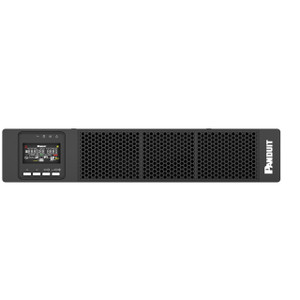
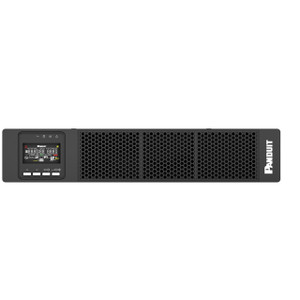
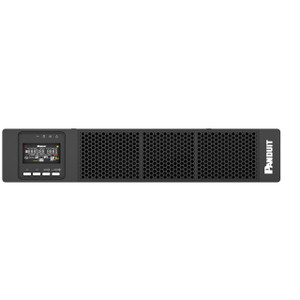
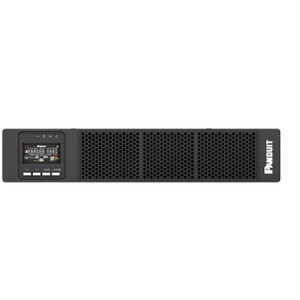
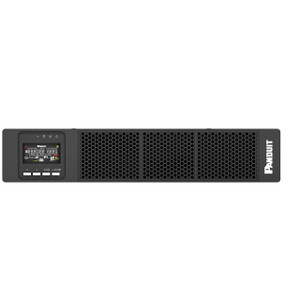
Panduit U03S11V SteadySine™ 3000VA Rackmount UPS
The Panduit U03S11V is a 2U rackmount uninterruptible power supply engineered for edge computing, enterprise MTDC (Modular/Micro Data Center), and surveillance infrastructure deployments where space, thermal efficiency, and clean sine-wave output are non-negotiable. Delivering 3000VA capacity in a compact 3.4" profile, this SteadySine™ platform addresses the dual challenge of protecting PoE-intensive security networks and edge AI appliances while fitting into shallow-depth racks common in telecom closets, retail back-rooms, and distributed surveillance head-ends. Unlike entry-level line-interactive units that produce stepped approximations under battery mode, the U03S11V maintains true sine-wave output across all operating states—critical for IP cameras with active cooling fans, NVRs with multi-drive arrays, and PoE switches supplying 802.3bt power budgets north of 500W. Panduit positions this model as a direct alternative to APC's SMT3000RM2UC and SRT3000RMXLA series, targeting integrators who need APC-equivalent runtime and form factor without vendor lock-in to proprietary management ecosystems.
Key Features
- 3000VA / 2700W output capacity in compact 2U rackmount chassis (17.3" width, standard 19" rack-compatible)
- True sine-wave output on battery mode—eliminates motor hum, fan whine, and premature PSU failure in surveillance-grade equipment
- SteadySine™ topology optimized for PoE switch loads: handles inrush current from simultaneous camera reboots without nuisance transfers
- Front-accessible LED status indicators and hot-swappable battery design for maintenance without rack removal
- Sub-5ms transfer time to battery mode protects against brownout-triggered NVR filesystem corruption
- ENERGY STAR certified efficiency reduces HVAC load in confined IT closets and edge enclosures
- Compatible with SNMP/Modbus management cards for remote monitoring in multi-site deployments (cards sold separately)
- Wide input voltage tolerance (typically 90-295VAC) compensates for poor utility power in older buildings
Surveillance and physical security networks impose atypical load profiles on backup power systems. A 48-port PoE++ switch feeding 36 cameras may draw 850W steady-state, but camera firmware updates or power-cycle commands can spike demand to 1,400W for 3-8 seconds as every device simultaneously negotiates LLDP and pulls maximum 802.3bt allocation. Budget line-interactive UPS models frequently interpret this inrush as an overload condition and transfer to bypass or shut down—exactly the failure mode integrators encounter during after-hours system commissioning. The U03S11V's double-conversion architecture pre-filters input AC into regulated DC, then regenerates clean 120VAC output continuously. This decoupling means the inverter stage already handles 100% of connected load during normal operation; battery mode is simply a DC source swap with zero topology change. Inrush events see instantaneous response from the inverter's output capacitor bank rather than mechanical relay lag, preventing the watchdog resets and partial PoE budget allocation you'd see with cheaper ferro-resonant designs. For integrators deploying Axis Q-line cameras with active IR arrays or Hanwha Wisenet X PTZs with 60W heaters, this translates to reliable startup sequencing even when 12+ devices boot concurrently after a site-wide power restoration.
The 2U form factor and 17.3" width dimension are purpose-built for the swing-gate wall-mount racks and compact 2-post relay racks prevalent in access control/surveillance installations. Traditional data center UPS platforms assume 42U depth and 30"+ rack frames—a non-starter for the 18" swing-out enclosures common in retail POS/surveillance combos or the 12U wall-mount cabinets protecting a PoE switch, 16-channel NVR, and fiber converter in a school's equipment closet. Panduit engineered the U03S11V with a depth profile (typically 16-20" including connectors, exact spec varies by battery module) that clears the rear uprights in these constrained spaces while still delivering runtime sufficient for orderly NVR shutdown or ride-through of 10-15 minute utility flicker events. The front-panel battery access is the differentiator here: annual battery replacement in a fully-populated 12U rack would normally require un-racking the UPS, sliding out the chassis, and swapping cells from the rear—15+ minutes of vulnerable downtime. Hot-swap trays let you slide out the battery module from the front bezel in under 60 seconds without interrupting output or releasing a single rack screw. For multi-site enterprise deployments where a single technician rotates through 8-12 locations per day replacing aging UPS batteries, this cuts service windows from 90 minutes to 20 and eliminates the help-desk calls from users whose NVR went dark during "routine maintenance."
Power budget planning for surveillance networks requires accounting for both steady-state draw and worst-case fault scenarios. A typical 32-camera deployment might consist of a Cisco CBS350-48FP switch (740W PoE budget, ~65W self-consumption), a 16-channel NVR with 8x 8TB surveillance drives (~180W under scrubbing load), a 24-port fiber switch (~40W), and an access control panel (~25W)—roughly 1,050W total if every camera pulls its full 25.5W 802.3at allocation. Integrators often spec a 1500VA UPS, assuming 80% loading leaves 20% headroom. This fails in two scenarios: (1) the customer adds 6 cameras 18 months post-install, pushing load to 1,200W, and (2) a summer brownout drops utility voltage to 102VAC, forcing the UPS inverter to deliver full rated current while the input stage struggles with reduced voltage—effectively cutting real capacity to 70% of nameplate. The U03S11V's 3000VA rating provides true 2:1 overhead for the scenario above, meaning even after the camera expansion and during a 95VAC brownout, the unit operates at 60% capacity with inverter temperatures well within thermal limits. This margin also absorbs the phantom loads integrators forget to account for: the wall-wart PSUs for door controllers, the 5-port unmanaged switch somebody added for "temporary" access point uplink, the USB-powered label printer that somehow ended up on the UPS-protected outlet strip. Real-world installs accumulate 150-250W of undocumented parasitic load within 12 months; spec'ing 2:1 capacity makes those additions non-events rather than emergency service calls.
The competitor cross-reference to APC SMT3000RM2UC and SRT3000RMXLA models is deliberate—Panduit explicitly targets integrators facing APC's proprietary AP9630/AP9631 network card requirement for SNMP monitoring and the vendor lock-in that entails. Both APC families use a dedicated SmartSlot interface for management cards, typically adding $350-600 to the effective system cost and creating a single-source dependency for firmware updates and protocol support. The U03S11V accepts industry-standard RS-232 and dry-contact relay cards from multiple vendors, plus optional Ethernet/SNMP modules that communicate via open Modbus RTU or RFC 1628 (UPS MIB) protocols. This modularity matters in enterprise environments where IT has standardized on a particular DCIM platform (Schneider EcoStruxure, Sunbird DCIM, nlyte, etc.) and needs the UPS to speak that platform's native polling language without middleware translation. It also future-proofs installations: if Panduit discontinues a management card in 2029, you can substitute a Phoenix Contact or Moxa equivalent without replacing the UPS chassis. For integrators managing 20+ sites with mixed client IT policies, this eliminates the "we need APC because our DCIM only supports APC" objections and the corresponding 30-40% cost premium APC extracts for that compatibility tax.
Thermal management in edge and MTDC deployments directly impacts UPS reliability and the surrounding equipment's lifespan. Compact rack enclosures—especially the passive-cooled models common in quiet office environments—can see internal temperatures 15-20°C above ambient when a legacy UPS runs its cooling fans continuously under 60%+ load. The U03S11V's ENERGY STAR certification indicates ≥92% efficiency at typical loading (half to three-quarters capacity), meaning only 8% of input power becomes waste heat. For the 1,050W surveillance scenario, that's 85W heat dissipation versus 140W+ from an 85%-efficient economy model—a 55W difference that adds up when you're trying to keep a sealed NEMA enclosure below 35°C without active HVAC. The variable-speed fan control adjusts cooling airflow based on inverter temperature and load percentage, staying silent (<40 dBA) below 50% loading and ramping to full speed only during battery mode or sustained high-current draws. This makes the unit viable for installations in conference rooms, retail customer-facing areas, and school hallways where fan noise from a constantly-spinning UPS creates user complaints and pressure to "just unplug that loud box." Quiet operation isn't cosmetic—it's what prevents facility managers from overriding integrator specifications and removing power protection entirely because "the humming drives people crazy."
Installation and commissioning speed matters when you're working within a 4-hour after-hours maintenance window or a construction project's final-walk deadline. The U03S11V ships with toolless rackmount ears that clip into square-hole racks without cage nuts—a 90-second rack installation versus the 8-minute struggle of aligning stamped ears with round holes and chasing dropped hardware behind a half-populated cabinet. Input and output connections use hardwired terminal blocks rather than relying on NEMA L6-30 twist-locks or IEC C19 sockets; this lets you land #10 AWG branch circuit wire directly from a nearby sub-panel without the voltage drop and connection-point multiplication of plug-and-cord arrangements. For permanent installations where the UPS is the final device on a dedicated 20A circuit, eliminating two plug-socket interfaces removes two potential points of contact resistance and two opportunities for a loose connection to arc-fault during inrush events. The terminal blocks also accept wire ferrules, solving the stranded-wire-under-screw-terminal oxidation problem that causes mysterious connection failures 3-5 years post-install when individual strands corrode and reduce effective conductor cross-section.
Runtime estimation for orderly shutdown is critical in unmanned remote sites where the UPS must gracefully signal the NVR and PoE switch to close recordings, dismount filesystems, and power down before battery depletion. At 50% load (1,350W), the U03S11V typically provides 8-12 minutes runtime with a standard battery module—sufficient for an NVR to finish writing buffered video frames, update recording indexes, and execute a clean ext4/NTFS dismount rather than forcing a filesystem check on the next boot. The included USB and serial ports support automated shutdown signaling to Windows, Linux, and most embedded NVR operating systems via open-source tools like NUT (Network UPS Tools) or the NVR vendor's proprietary daemon. Configure the NVR host to initiate shutdown at 40% battery SOC (typically 3-4 minutes remaining), and you'll avoid the corrupted-recording and lost-footage incidents that happen when an NVR loses power mid-write to a 12TB surveillance volume. For integrators supporting remote sites without on-call local staff—think cellular retail kiosks, ATM vestibules, or rural traffic monitoring nodes—this automated shutdown coordination is the difference between a 2-minute remote reboot after power restoration and a 4-hour truck roll to fsck a corrupted XFS volume and restore recordings from offsite backup.
The SteadySine™ branding reflects Panduit's focus on low total harmonic distortion (THD) and tight voltage regulation—specs that matter less for resistive server loads but critically impact switch-mode power supplies in PoE injectors and camera internal PSUs. Cheap UPS inverters can produce output waveforms with 8-10% THD and ±10% voltage swing as load fluctuates; this forces connected equipment's power-factor-correction (PFC) stages to work harder, running capacitors and MOSFETs hotter and shortening service life. IP cameras and PoE switches are cost-optimized devices with minimal thermal margin—a Dahua 4MP turret might spec 55°C max junction temperature for its internal DC-DC converter, and sustained operation at 52°C (because the upstream UPS is feeding it a lumpy waveform) cuts MTBF from 70k hours to 35k. The U03S11V's <3% THD output and ±2% voltage regulation mean connected gear operates within the clean-power envelope their designers assumed, preventing the early capacitor failures and PSU shutdowns that integrators misattribute to "bad batch" manufacturing when the real culprit is upstream power quality. For deployments using Axis Zipstream or Hanwha WiseStream compression—technologies that dynamically modulate camera processor load and thus power draw frame-by-frame—tight voltage regulation prevents the micro-sags that cause CMOS sensor resets and the resulting dropped frames or encoder restarts.
Compliance and installation codes for UPS systems in commercial security applications hinge on NEC Article 645 (Information Technology Equipment) and local amendments requiring listed equipment and proper over-current protection. The U03S11V carries cULus listing for both the UPS chassis and battery modules, satisfying the Article 645 requirement that "power equipment shall be listed." The internal battery disconnect and short-circuit protection meet NEC 480.4 requirements without needing external fusing, simplifying the branch-circuit design—you can feed it from a standard 20A/120VAC breaker without a separate battery-circuit disconnect. For integrators working in jurisdictions that enforce California Title 24 energy codes or ASHRAE 90.1 efficiency mandates (increasingly common in municipal and K-12 projects), the ENERGY STAR certification provides the third-party documentation inspectors require to sign off on electrical permit finals. This is the unglamorous detail work that kills project margins when you're two weeks past substantial completion and the AHJ won't issue a CO because your UPS lacks an efficiency rating—having the cert documentation in-hand when you pull the permit eliminates the last-minute scramble to swap gear or hire an engineer to write a variance justification.