
NETGEAR GS116EP-100NAS vs Vivotek GEL-205A-260: Specification Comparison
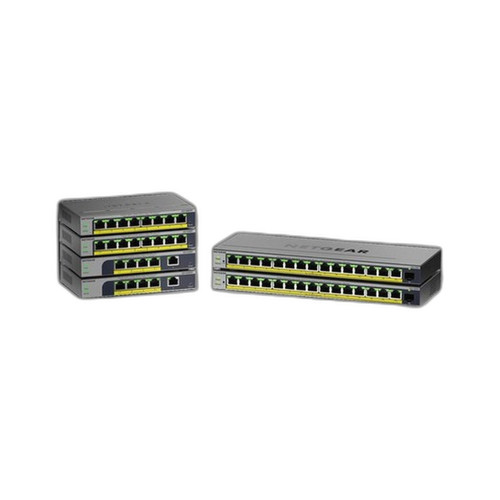
Both the NETGEAR GS116EP-100NAS and the Vivotek AW-GEL-205A-260 are 16-port Gigabit PoE switches targeting physical-security and network infrastructure installers. Each delivers PoE power across all 16 data ports and operates over standard RJ45 copper at 10/100/1000 Mbps. The comparison turns on meaningful differences in management capability, PoE power budget and port-level power allocation, uplink options, and environmental ratings — all critical factors when sizing a switch for a surveillance or access-control deployment.

In This Guide
How do the PoE power budgets and per-port power allocations compare?
The NETGEAR GS116EP-100NAS delivers PoE+ (802.3at) on all 16 ports at up to 30 W each. A total PoE power budget is not stated in the provided specifications, so installers must consult the datasheet to confirm aggregate wattage before deploying high-draw devices across all ports simultaneously.
The Vivotek AW-GEL-205A-260 specifies a 260 W total PoE budget and differentiates power by port group: ports 1–4 support IEEE 802.3bt at up to 90 W each (suitable for pan-tilt-zoom cameras, multi-sensor heads, or 802.3bt-class access readers), while ports 5–16 provide 802.3at at 30 W each. Pin assignment also differs — ports 1–4 use 4-pair delivery; ports 5–16 use 2-pair. Additionally, the Vivotek unit includes 4 kV surge protection per PoE port and an Extend PoE Mode rated to 250 m cable runs, neither of which is specified for the NETGEAR.
Which switch offers greater network management and switching performance?
The NETGEAR GS116EP-100NAS is explicitly unmanaged. It forwards traffic immediately with zero configuration but provides no VLAN segmentation, QoS prioritization, spanning-tree loop protection, port mirroring, storm control, or bandwidth control. Switching bandwidth figures listed in the specs vary across entries (values of 10 Gbps, 16 Gbps, and 32 Gbps appear), and no single authoritative throughput figure is confirmed in the provided evidence.
The Vivotek AW-GEL-205A-260 is a managed switch with a specified 40 Gbps switching bandwidth and 4.1 MB packet buffer. Management features confirmed in the specs include: 802.1Q tag-based VLAN (up to 4,096 IDs), port-based VLAN, IEEE 802.1d STP and 802.1w RSTP, Link Aggregation Control Protocol (LACP), CoS via port-based, 802.1p, and DSCP, loop protection, flow control, storm control, port-based mirroring, port isolation, bandwidth control, static MAC, PoE On/Off control, PoE auto-checking, and Non-Stop PoE. It also adds 2 SFP uplink ports alongside 2 additional GE RJ45 uplinks, bringing total port count to 20.
For deployments requiring traffic isolation between camera VLANs and corporate LANs, or QoS to prioritize video streams, only the Vivotek provides those controls from the specified feature set.
How do operating environment ratings and physical form factors differ?
The NETGEAR GS116EP-100NAS is rated for operation between 32 °F and 104 °F (0 °C to 40 °C). Mount type is listed as wall. Physical dimensions are noted as a field in the specs but no numeric values are provided in the supplied evidence.
The Vivotek AW-GEL-205A-260 carries a wider operating temperature range of 0 °C to 50 °C (32 °F to 122 °F), with storage rated to 70 °C. Operating humidity is specified at 10–90 % RH (non-condensing). Dimensions are given as 440 mm (W) × 210 mm (D) × 44 mm (H) — a standard 1U rack profile consistent with the included rack-mount kit. Weight is 2.67 kg. AC input accepts 100–240 V at 50–60 Hz, and maximum power draw is 280 W. The NETGEAR's AC input range, humidity rating, and weight are not stated in the provided specifications.
The Vivotek's 50 °C upper operating limit and rack-mount form factor are relevant for IDF closets or outdoor enclosures that exceed the NETGEAR's 40 °C ceiling.
Which should you choose: the GS116EP-100NAS or the GEL-205A-260?
Our take: The AW-GEL-205A-260 is the stronger choice when the deployment demands managed network segmentation, higher-wattage PoE devices, or a wider operating temperature envelope. Concretely: the Vivotek specifies a 260 W total PoE budget with 4 ports delivering 90 W (802.3bt) versus the NETGEAR's unspecified aggregate budget at 30 W maximum per port (802.3at only); the Vivotek's switching bandwidth is confirmed at 40 Gbps versus an unconfirmed figure for the NETGEAR; and the Vivotek's upper operating temperature is 50 °C versus 40 °C for the NETGEAR. The GS116EP-100NAS is the appropriate choice for a simple, plug-and-play edge deployment where all endpoints draw 30 W or less, no VLAN isolation is required, the ambient temperature stays below 40 °C, and installation simplicity outweighs feature depth. Verify the NETGEAR's total PoE budget from its datasheet before committing to a fully-loaded 16-camera installation.
Side-by-Side Comparison
Spec-for-spec, from manufacturer data.
| Specification | NETGEAR GS116EP-100NAS | Vivotek GEL-205A-260 |
|---|---|---|
| Product Type | Switch (Unmanaged) | Switch (Managed) |
| Total Ports | 16 | 20 (16 PoE + 2 GE RJ45 + 2 SFP) |
| PoE Data Ports | 16 | 16 |
| PoE Standard | IEEE 802.3at (PoE+) | IEEE 802.3af/at/bt |
| Max Per-Port PoE Power | 30 W (all 16 ports) | 90 W (ports 1–4); 30 W (ports 5–16) |
| Total PoE Budget | — | 260 W |
| Switching Bandwidth | Not confirmed in evidence | 40 Gbps |
| Packet Buffer | — | 4.1 MB |
| MAC Address Table | — | 8K |
| Jumbo Frames | — | 9,216 bytes |
| VLAN Support | None (unmanaged) | 802.1Q up to 4,096 IDs; port-based |
| STP / RSTP | — | IEEE 802.1d / 802.1w |
| PoE Surge Protection | — | 4 kV per port |
| Extended PoE Reach | — | 250 m (Extend PoE Mode) |
| Operating Temperature | 0 °C to 40 °C (32 °F to 104 °F) | 0 °C to 50 °C (32 °F to 122 °F) |
| Form Factor / Mount | Wall mount | 1U rack (rack-mount kit included) |
Frequently Asked Questions
Which should you choose: the GS116EP-100NAS or the GEL-205A-260?
The AW-GEL-205A-260 is the stronger choice when the deployment demands managed network segmentation, higher-wattage PoE devices, or a wider operating temperature envelope. Concretely: the Vivotek specifies a 260 W total PoE budget with 4 ports delivering 90 W (802.3bt) versus the NETGEAR's unspecified aggregate budget at 30 W maximum per port (802.3at only); the Vivotek's switching bandwidth is confirmed at 40 Gbps versus an unconfirmed figure for the NETGEAR; and the Vivotek's upper operating temperature is 50 °C versus 40 °C for the NETGEAR. The GS116EP-100NAS is the appropriate choice for a simple, plug-and-play edge deployment where all endpoints draw 30 W or less, no VLAN isolation is required, the ambient temperature stays below 40 °C, and installation simplicity outweighs feature depth. Verify the NETGEAR's total PoE budget from its datasheet before committing to a fully-loaded 16-camera installation.
Can either switch power a PTZ camera or multi-sensor head that requires more than 30 W?
Only the Vivotek AW-GEL-205A-260 supports this. Its ports 1–4 are rated at 90 W each under IEEE 802.3bt. The NETGEAR GS116EP-100NAS is specified at a maximum of 30 W per port (802.3at), so devices requiring more than 30 W would need a separate injector or a different switch.
Is the NETGEAR GS116EP-100NAS or the Vivotek AW-GEL-205A-260 better for a deployment that requires camera traffic to be isolated from the corporate network?
The Vivotek AW-GEL-205A-260 is the only option here. Its specifications confirm 802.1Q tag-based VLAN support with up to 4,096 VLAN IDs and port-based VLAN. The NETGEAR GS116EP-100NAS is unmanaged and provides no VLAN capability per its specifications.
Which switch is easier to install for a technician who does not want to configure a management interface?
The NETGEAR GS116EP-100NAS is explicitly described as an unmanaged, zero-configuration switch that begins forwarding traffic immediately upon power-up. The Vivotek AW-GEL-205A-260 is a managed switch; its full feature set — VLANs, QoS, STP, LACP — requires deliberate configuration. If the site does not need those features and all endpoints are within the 30 W PoE budget, the NETGEAR requires less setup time.
More Network Switch Comparisons
- Vivotek GEL-205A-260 vs TP-Link SL1218MP
- Vivotek GEL-205A-260 vs Allied Telesis AT-x530L-18GHXm-10
- Vivotek GEL-205A-260 vs Ubiquiti USW-LITE-16-POE
- Vivotek GEL-205A-260 vs Ubiquiti USW-16-POE
- TP-Link SL1218MP vs Allied Telesis AT-x530L-18GHXm-10
- TP-Link SL1218MP vs Ubiquiti USW-LITE-16-POE
Network Switch Buying Guides
Get a Second Opinion on Your Camera Choice
Share your site layout, coverage goals, and budget. Our team will validate the camera selection, flag anything we would change, and recommend products that match the use case.